您的浏览器禁用了JavaScript(一种计算机语言,用以实现您与网页的交互),请解除该禁用,或者联系我们。 [德意志银行]:亚洲宏观洞察:增长放缓但仍高于趋势,通胀受控 - 发现报告

亚洲宏观洞察:增长放缓但仍高于趋势,通胀受控

2026-06-09 德意志银行 金栩生
报告封面

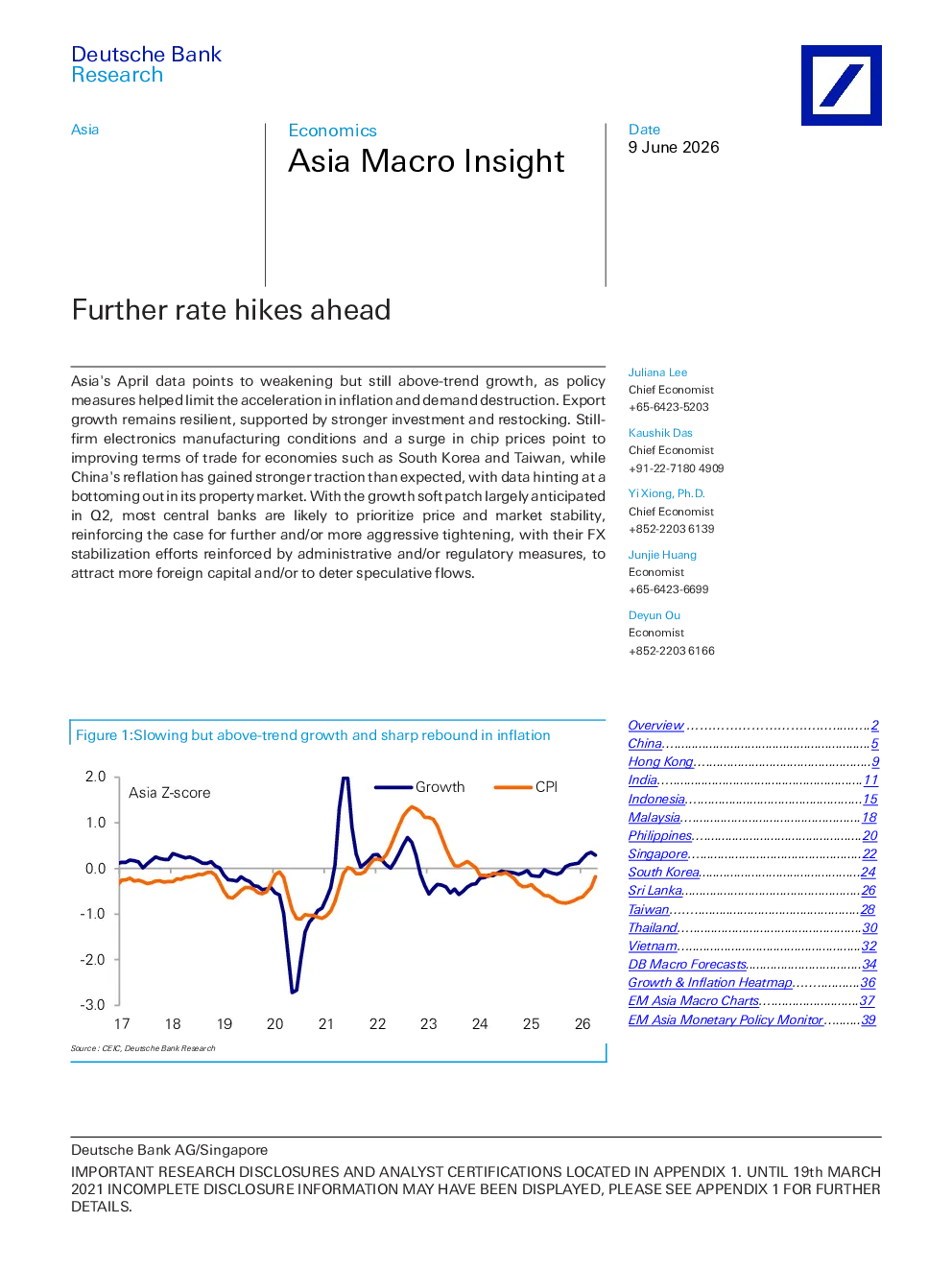
Asia Asia Macro Insight Further rate hikes ahead Juliana Lee Asia's April data points to weakening but still above-trend growth, as policymeasures helped limit the acceleration in inflation and demand destruction. Exportgrowth remains resilient, supported by stronger investment and restocking. Still-firm electronics manufacturing conditions and a surge in chip prices point toimproving terms of trade for economies such as South Korea and Taiwan, whileChina's reflation has gained stronger traction than expected, with data hinting at abottoming out in its property market. With the growth soft patch largely anticipatedin Q2, most central banks are likely to prioritize price and market stability,reinforcing the case for further and/or more aggressive tightening, with their FX Chief Economist Kaushik DasChief Economist Yi Xiong, Ph.D.Chief Economist Junjie HuangEconomist Deyun OuEconomist Overview As expected, growth slowed in April while inflation momentum accelerated,although neither move was as pronounced as feared, as policy measures helpedJuliana Lee Source : CEIC, Deutsche Bank Research Data do not yet suggest that Q2 growth will undershoot our baseline slowdown,althoughworsening delivery times remain a concern for the region’smanufacturing supply chain. In fact, Asia’s PMI held up relatively well, even as the Source : CEIC, Deutsche Bank Research Source : CEIC, Deutsche Bank Research The main downside risk to this export view remains a genuine supply-chaindisruption, not merely longer delivery delays. Even so, global manufacturing PMIdata—especially in electronic equipment—support our constructive baseline forAsian exports. We expect Asia’s export growth to remain robust, moving sidewaysat 8.6% in 2026, versus 8.9% in 2025, although the Iran war and US trade policyactions, including USTR Section 301 investigations, pose downside risks. Betterstill, this should be accompanied by sustained investment growth of close to 4.9% Source : CEIC, Deutsche Bank Research Source : CEIC, Deutsche Bank Research Manufacturing input costs continue to outpace output prices, even though botheased slightly, pointing to some deterioration in corporate margins—though thisdoes not apply to the semiconductor sector. In fact, stronger semiconductor pricingis likely to more than offset higher import prices, improving the terms of trade foreconomies such as South Korea and Taiwan and contributing positively to nominalgrowth. South Korea is set to record its strongest nominal growth since 1996,although this will likely be surpassed by Taiwan, where nominal growth may reachits highest level since 1987. South Korea is also seeing broader labour-union Source :CEIC, Deutsche Bank Research Source :CEIC, Deutsche Bank Research The impact of the Iran war has steepened China’s reflation path. Moreover, data hintat a durable bottoming-out in its housing market, driven less by broad macrostimulus than by improving underlying market dynamics, a more positive turn With a US-Iran deal still elusive, both inflation and FX dynamics point to higher ratesacross Asia. CPI inflation is likely to be three times higher than last year, at 2.7% in2026. Our baseline view is that both BI and BSP will hike by another 75bps, bringingtotal tightening to 125bps for BI and 100bps for BSP. We also expect both the BoKand RBI to deliver 100bps of rate hikes, with the BoK moving first. MAS is likely totighten again, while BNM's 25bp rate hike may be brought forward to this year,instead of next year as per our prevailing forecast. The SBV remains on our watchlist, although its continued reliance on liquidity management to balance risks to China Yi Xiong We forecast China’s GDP growth at 4.7% in 2026. This represents a small (0.2ppt)downward revision from our most recent forecast, owing to softer domesticactivities since the beginning of Q2 and policy tone fine-tuning at the April Politburomeeting. It remains higher than our 4.5% forecast in our last World Outlook, as we China's strong trade activities will likely more than offset weaker domesticdemand.Both exports and imports are growing much faster than expected. Werevised up our export growth forecast to 12% from 6% previously. The strong exportdemand can be attributed to multiple factors, including global AI investment, green Domestic demand remains the softer link. Consumption-wise, Higher fuel costsstarted to negatively affect consumer spending in a few categories, especiallytravel. Goods consumption has also slowed owing to the fading impact of previoussubsidies. As a result, retail sales slowed in April to just 0.2% YoY, and are expectedto stay soft if energy prices remain elevated. The government’s efforts to boost On the investment side, fixed-asset investment slipped unexpectedly in April, withboth infrastructure and manufacturing investment falling by 8% and 4% YoY,respectively. This deceleration reflects seasonality following fiscal dynamics, afterthe Politburo meeting viewed Q