访问是不够的:智能手机所有权如何影响中低收入国家的数字服务使用
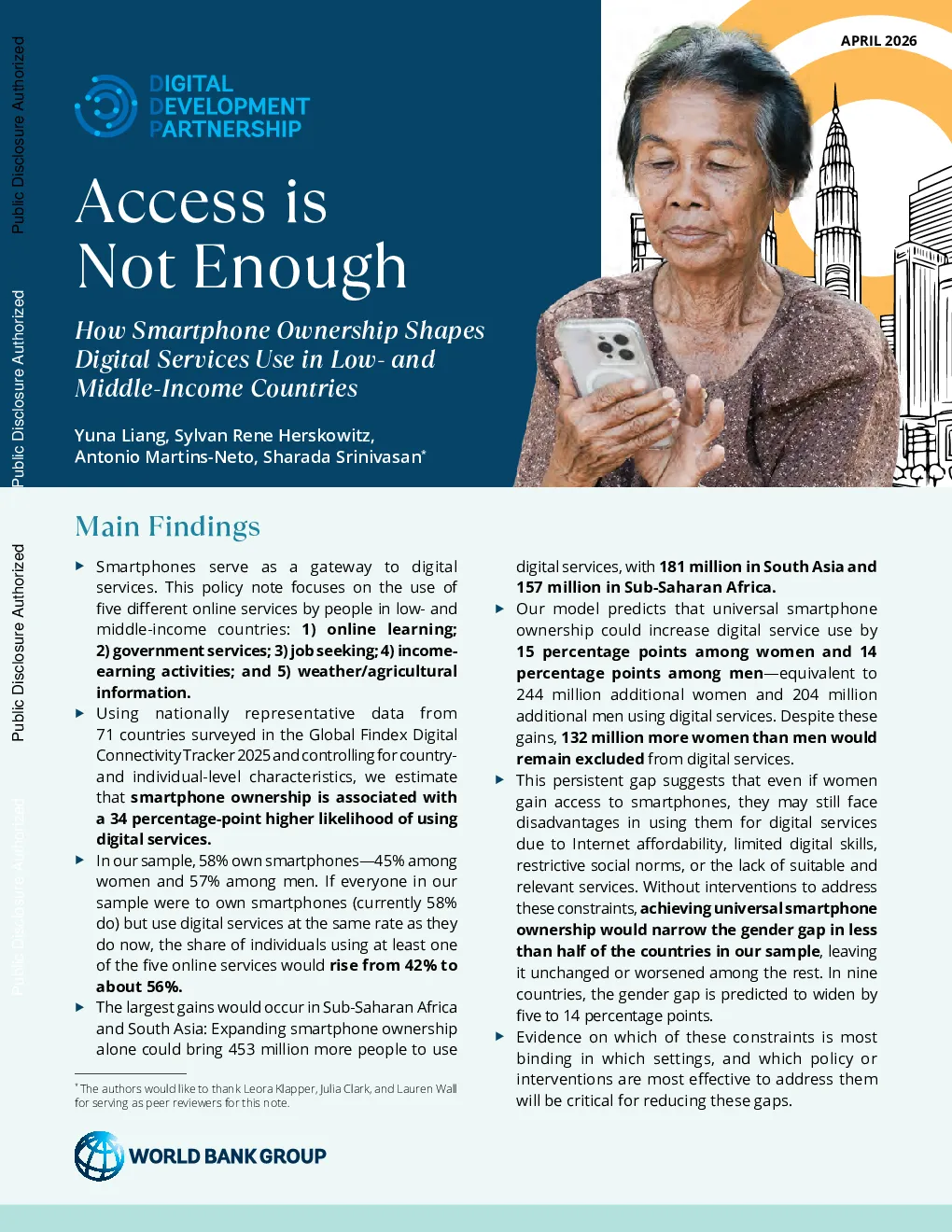
How Smartphone Ownership ShapesDigital Services Use in Low- and Yuna Liang, Sylvan Rene Herskowitz,Antonio Martins-Neto, Sharada Srinivasan Main Findings ▸Smartphonesserve as a gateway to digitalservices. This policy note focuses on the use offive different online services by people in low- and digital services, with181 million in South Asia and157 million in Sub-Saharan Africa. ▸Our model predicts that universal smartphoneownership could increase digital service use by 15 percentage points among women and 14percentage points among men—equivalent to244 million additional women and 204 million middle-incomecountries:1)online learning;2) government services; 3) job seeking; 4) income- ▸Usingnationally representative data from71 countries surveyed in the Global Findex DigitalConnectivity Tracker 2025 and controlling for country-Public Disclosure Authorized remain excludedfrom digital services.▸This persistent gap suggests that even if womengain access to smartphones, they may still facedisadvantages in using them for digital servicesdue to Internet affordability, limited digital skills,restrictive social norms, or the lack of suitable andrelevant services. Without interventions to address thatsmartphone ownership is associated with In our sample, 58% own smartphones—45% amongwomen and 57% among men. If everyone in oursample were to own smartphones (currently 58%do) but use digital services at the same rate as theydo now, the share of individuals using at least one these constraints,achieving universal smartphoneownership would narrow the gender gap in less about 56%.▸The largest gains would occur in Sub-Saharan Africaand South Asia: Expanding smartphone ownershipPublic Disclosure Authorized Evidence on which of these constraints is mostbinding in which settings, and which policy or As economic activity becomes more digitalized,people increasingly rely on online platforms toapply for public benefits, engage in online learning,and pursue job opportunities.While digitization holdsthe promise of revolutionizing access to these servicesand reaching the last mile of beneficiaries, this potentialcan only be realized when barriers to connectivity are 2025 to examine the extent to which universal smartphone ownership could increase digital servicesuse across LMICs, focusing on five different onlineservices:1)online learning;2)government services; Smartphones as a Gateway to Weuse individual-level data covering 72,755individualsfrom 71 LMICs5 to examine therelationship between smartphone ownership6anddigital service use, adjusting for country, householdincome, age, education, gender, urbanicity, and However,smartphone ownership is far fromuniversal across geographies.While 60% of adultsin LMICs own a smartphone, only 33% of adults in Sub-Saharan Africa and 40% in South Asia do.3Even wheresmartphone ownership is high, gender disparitiesfrequently persist. Across LMICs, the gender gap insmartphone ownership is around nine percentage Fifty eight percent of our sample own a smartphone.On average, individuals who own a smartphoneare 34 percentage points more likely to use at leastone of the five digital services, relative to non- Bridging these gaps is critical to ensure equitableandmeaningful participation in the digitaleconomy.This policy note uses newly available data The average number of digital services used in oursample is 0.8. Smartphone owners also engagewith a broader range of digital services, usingabout 0.6 additional services relative to non-owners.While other factors outside of the model owners would exhibit use patterns identical to currentowners within their respective demographic cohortsand countries—which may not always be the case—it We find that with universal smartphone ownership,the share of individuals in our sample using atleast one productive digital service would risefrom 42% to about 56%. However, the magnitude ofthis estimate varies widely across regions and evenacross countries within the same region (Figure 2). Theincrease is particularly pronounced in Sub-Saharan Modelling the Effects ofUniversal Smartphone Given the link between smartphone ownershipand digital services uptake, we next assess howbroader smartphone ownership could influencedigital participation.To this end, we model a scenarioof universal ownership and predict digital service Looking across use cases, digital service uptakewouldincrease 34–37 percent from baselinelevels.The largest simulated increases occur in onlinelearning, where predicted usage would climb by 11percentage points, followed by government services Gender Gaps in SmartphoneUse and Digital Engagement Asdigital participation becomes a gatewaytoeducation,income generation,and socialwelfare, digital inclusion policies must addressgender disparities to ensure women and girlsare not left further behind.In our sample, womenare 12 percentage-points less likely than men to Achieving universal smartphone ownership wouldclose the gender gap in