国际投资头寸(IIP): 2026年第一季度(初步)
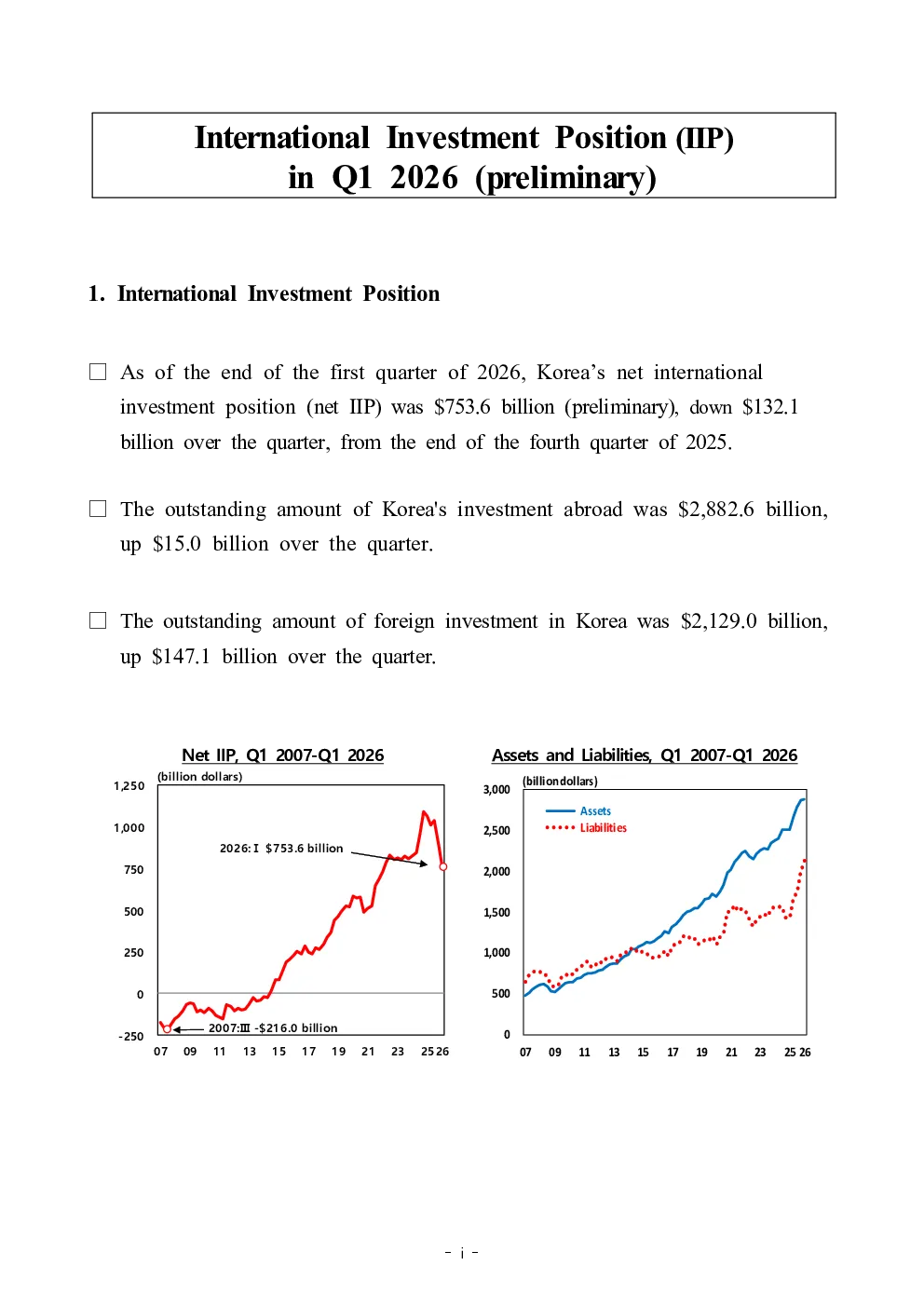
1. International Investment Position □As of the end of the first quarter of 2026, Korea’s net internationalinvestment position (net IIP) was $753.6 billion (preliminary), down$132.1billion over the quarter, from the end of the fourth quarter of 2025. □The outstanding amount of Korea's investment abroad was $2,882.6 billion,up $15.0 billion over the quarter. □The outstanding amount of foreign investment in Korea was $2,129.0 billion,up $147.1 billion over the quarter. 2. External Assets in Debt Instruments and External Debt □As of the end of the first quarter of 2026, net external assets in debtinstruments (external assets minus external debt) was $365.5 billion, down$7.6 billion over the quarter, from the end of the fourth quarter of 2025. * External assets and external debt exclude equity and investment fund shares of directinvestments, equity securities of portfolio investments, financial derivatives and otherequity from IIP assets or liabilities. □The outstanding amount of Korea's external assets in debt instruments was$1,139.9 billion, down $3.3 billion over the quarter. ―Short-term external assets decreased by $4.0 billion and long-termexternal assets increased by $0.7 billion. □Korea's external debt was $774.4 billion, up $4.2 billion over the quarter. ―Short-term external debt decreased by $4.2 billion and long-term externaldebt remained at end-of-quarter. o The short-term external debt ratio, vis-à-vis reserve assets, was 43.3%. International Investment Position (billion dollars) International Investment Position 1. Definition - The International Investment Position (IIP) is a statistical statement ofthe stock at a certain point in time of the value and composition ofthe financial assets, e.g., Korea's investment abroad, and liabilities, e.g.,foreign investment in Korea, of an economy’s residents vis-à-vis itsnonresidents. Its coverage is identical to that of the Financial Accountin the Balance of Payments, which is a set of flow statistics. - External Assets in Debt Instruments and External Debt are the actualfinancial assets and liabilities of an economy’s residents vis-à-visnonresidents. These figures include debt securities, loans, and tradecredits, but exclude investments in equity capital, equity securities,financial derivatives, and other equity from the IIP. 2. Periodicity: Quarterly. 3. Method of Compilation - The International Investment Position and External Assets and Debt arecompiled by valuing the stocks of external financial assets andliabilities at the market prices prevailing at the end of the reportingperiod. - Assets and liabilities denominated in currencies other than the U.S.dollar are translated into U.S. dollars using the cross rates for majorcurrencies against the U.S. dollar as of the end of the reporting period. 4. Composition 4.1 International Investment Position - Direct investmentsis a category of cross-border investment (equity,intercompany debts, such as loans, etc.) made by a resident in oneeconomy with the aim of controlling or exercising a significant degreeof influence on the management of an enterprise that is resident inanother economy. As a general rule, an investment whose investoracquires equity with an entitlement to at least 10% of the voting rightsin the invested enterprise falls into this category. -Portfolio investments include money market instruments in addition toequity securities and debt securities in the form of government bonds, aswell as corporate bonds, but exclude financial transactions captured as“direct investments“ or as “reserve assets.“ -Financial derivatives represent the appraised balance arising fromresidents’ external derivative transactions, the gains on which areclassified as financial derivative assets and the losses as financialderivative liabilities. -Other investments is a residual category that includes all financialtransactions not contained within direct investments, portfolioinvestments, financial derivatives, or reserve assets. It is subdivided intoloans, trade credits and advances, currency and deposits, other accountsreceivable/payable, other equity, and special drawing rights (SDRs). -Reserve assets are foreign reserves. 4.2 External Assets in Debt Instruments and External Debt - Sector Classification: classified into four categories, in accordance withthe transactors. o General Government: the central government, local governments, andsocial security institutions.o Central Bank: Bank of Korea.o Deposit-Taking Corporations, Except the Central Bank: commercialbanks, savings institutions, etc.o Other Sectors: other financial corporations (securities companies,insurance companies, etc.), other enterprises. Financial products based on an original maturity of one year or less areclassified as short-term and those with maturities exceeding one year aslong-term. Financial instruments are classified in accordance with theircharacteristics into: debt securities (government bonds, corporate bonds,etc