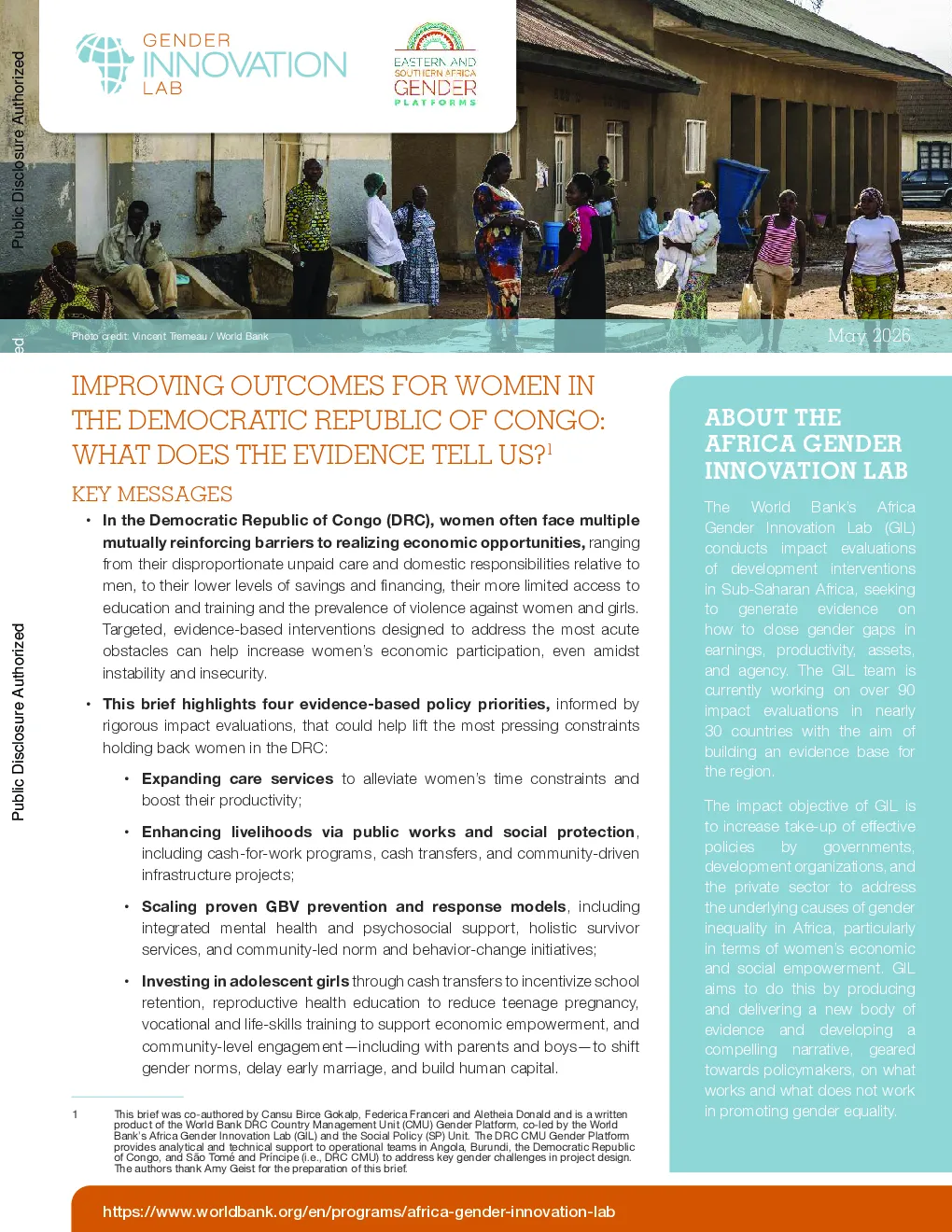
The Africa Gender Innovation Lab (GIL) of the World Bank conducts impact evaluations of development interventions in Sub-Saharan Africa to address gender gaps in earnings, productivity, assets, and agency. In the Democratic Republic of Congo (DRC), GIL identifies four key policy priorities based on rigorous impact evaluations:
-
Investing in Care: Expanding childcare services to alleviate women's time constraints and boost productivity. A study found that providing access to childcare centers increased women's engagement in commercial agriculture, household productivity, and monthly income, while also benefiting children's early development. The DRC's gender gap analysis shows women spend significantly more time on domestic tasks than men, with childcare being a potential solution.
-
Enhancing Livelihoods: Implementing public works programs, social protection measures (e.g., cash-for-work, cash transfers), and economic inclusion programs. A study on the Social Response to the Ebola Crisis Program found that public works programs improved livelihoods, particularly for women. Productive asset transfers and comprehensive economic inclusion programs can also diversify income sources and empower the most vulnerable women.
-
Scaling Prevention and Response to Eliminate Violence Against Women and Girls (GBV): Addressing GBV through legal and regulatory frameworks, awareness-raising initiatives, and evidence-based response models. The DRC has high rates of GBV, with 37% of women experiencing physical violence. Interventions like Narrative Exposure Therapy (NET) have shown strong effects on mental health outcomes, while programs like Engaging Men through Accountable Practice (EMAP) aim to shift gender attitudes and reduce violence.
-
Investing in Adolescent Girls' Empowerment: Focusing on reducing child marriage, improving education, and enhancing economic opportunities. The DRC has high rates of teenage pregnancy and low school completion rates for girls. Cash transfers supporting education, vocational training, and mentorship can delay child marriage and improve long-term economic prospects. School-based interventions on reproductive health have also reduced teenage pregnancy.
The GIL's research concludes that implementing evidence-based interventions can significantly narrow gender gaps in the DRC, supporting the country's development agenda by unlocking women's full economic potential. Prioritizing adolescent girls and strategically integrating evidence into policies and programs will yield substantial benefits for the DRC's future economic development.