地平线机器人:因OEM自研芯片部署面临短期压力,但长期逻辑完好
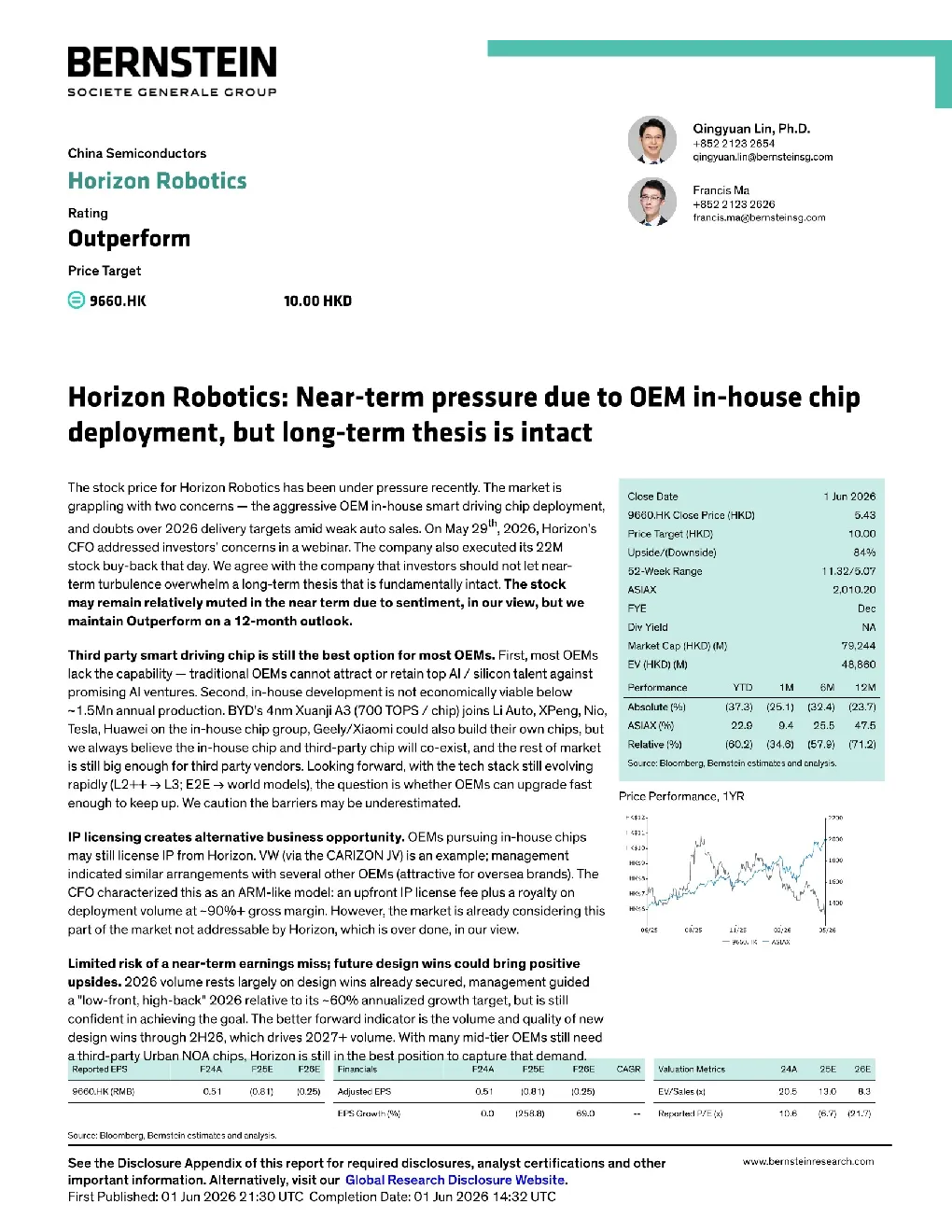
deployment, but long-term thesis is intact grappling with two concerns - the aggressive OEM in-house smart driving chip deployment,and doubts over 2026 delivery targets amid weak auto sales. On May 29th, 2026, Horizon'sCFO addressed investors'concerns ina webinar.The companyalso executed its22Mstock buy-back that day. We agree with the company that investors should not let near-term turbulence overwhelm a long-term thesis that is fundamentally intact. The stockmay remain relatively muted in the nearterm due to sentiment, in our view, but wemaintainOutperformona12-monthoutlook. lack the capability-traditional OEMs cannotattract orretain topAl/silicontalentagainstpromising Alventures.Second,in-house developmentis noteconomicallyviable belowTesla, Huawei on the in-house chip group, Geely/Xiaomi could also build their own chips, butwe always believe the in-house chip and third-party chip will co-exist, and the rest of marketis still big enough for third party vendors. Looking forward, with the tech stack still evolvingrapidly (L2++→L3; E2E→world models), the question is whether OEMs can upgrade fastenough tokeepup.We caution the barriers may be underestimated. IPlicensing createsalternativebusinessopportunity.OEMs pursuing in-house chipsmay still licenseIPfromHorizon.VW (via theCARIZON JV)is an example;managementindicated similar arrangementswith several other OEMs (attractivefor overseabrands).TheCFO characterized this as an ARM-like model:an upfront IP licensefee plus a royalty ondeploymentvolume at~90%+gross margin.However,themarketis already consideringthispart of the market not addressable by Horizon, which is over done, in our view. Limited risk of a near-term earnings miss; future design wins couldbring positiveupsides.2026volumerestslargelyondesign winsalreadysecured,managementguided a"low-front, high-back" 2026 relativeto its ~60% annualized growth target, butis stillconfident in achieving the goal. The better forward indicator is the volume and quality of newdesign wins through 2H26, which drives 2027+ volume. With many mid-tier OEMs still needa third-party UrbanNOA chips, Horizon is stillin thebest position to capture that demand.ReportedEPSF24AF25EF26EFinancialsF24AF25EF26E Managementexpressedfirmconfidencein Horizon'slong-termthesis.Coremessage:OEMin-housechipdevelopmentdoes not representa meaningful threatto Horizon's addressablemarket-rather, it is a shift in business model and a reallocation of profit.Horizon has flexible business model like ARM (IP licensing + royalty). 2026 will be "low in the first half, high in the second', but this Horizon's standardized customer enablement runs along two tracks: (i) standardized chip + software (e.g.,the Journey 6P chip paired with HSD smart-driving software), and (i) underlying IP licensing. The BPU core can be licensed standalone illustrative example. The economics align with ARM: CPU IP to Apple. Sometimes one-time, sometimes recurring. With VW,IP terms are renegotiated every three years; newlyadded IPfalls outsidethepriorframework and is chargedseparately,similartoa membershipor entryfee. Management emphasized the IP route is not dilutive to profitability: IP licensing has long been a meaningful revenue stream atattractive unit economics, and the royalty stream is near pure-margin, so the blended margin profile resembles ARM closely. Hardware is structurally multi-source: the auto industry historically does not run sole-source for major components. OEMswill treat in-house chips as a strategic priority while maintaining third-party supply for benchmarking, pricing leverage, andcontingency -analogous to handset OEMs running both in-house silicon and Qualcomm in parallel. Horizon supplies the BPU (Alcore).The BPU defines Al performance; on top of it,customers can build eithera dedicated smartdriving chip (spec close to Journey 6P) or an integrated cockpit-driving chip (spec close to Horizon's Starry cockpit-driving chip). The industry now has three supply chains: (i) NVIDIA + its software partners, (i) Horizon + its software, and (ii) OEM in-housechip + in-house software. The decisivelogic: because the BPU defines Al, the smart-driving algorithm layer grows out of Horizon'sare highly likely to run HSD; even if an OEM licenses the underlying IP and builds its own software, it remains within Horizon'secosystem."Whether you slice this horizontally or vertically,you cannot cut Horizon out."The profit pool is reallocated bypartnership model, but the Horizon's presence is preserved. Journey 6M:no signs of volume impact; remains a main-volume product for 2026. Journey 6M can run an entry-level urbanNoA (more interventions / lower MPIthan Journey 6P's full-spec HSD, but passes regulatory bars with respectable consumerexperience).Journey 6P remains the full-spec HSD platform. COCKPITOSPROGRESS(KAKACLAW) Adaptation and joint development with several top-tier domestic customers are progressing well. Horizon is not a software-resources. The model is