您的浏览器禁用了JavaScript(一种计算机语言,用以实现您与网页的交互),请解除该禁用,或者联系我们。 [美国银行]:Global Semiconductor: AI Power Semiconductor and Transition to 800V Data Centers - 发现报告

Global Semiconductor: AI Power Semiconductor and Transition to 800V Data Centers

信息技术 2026-05-25 Vivek Arya, Michael Jari, Didier Semama 美国银行 张兵
报告封面

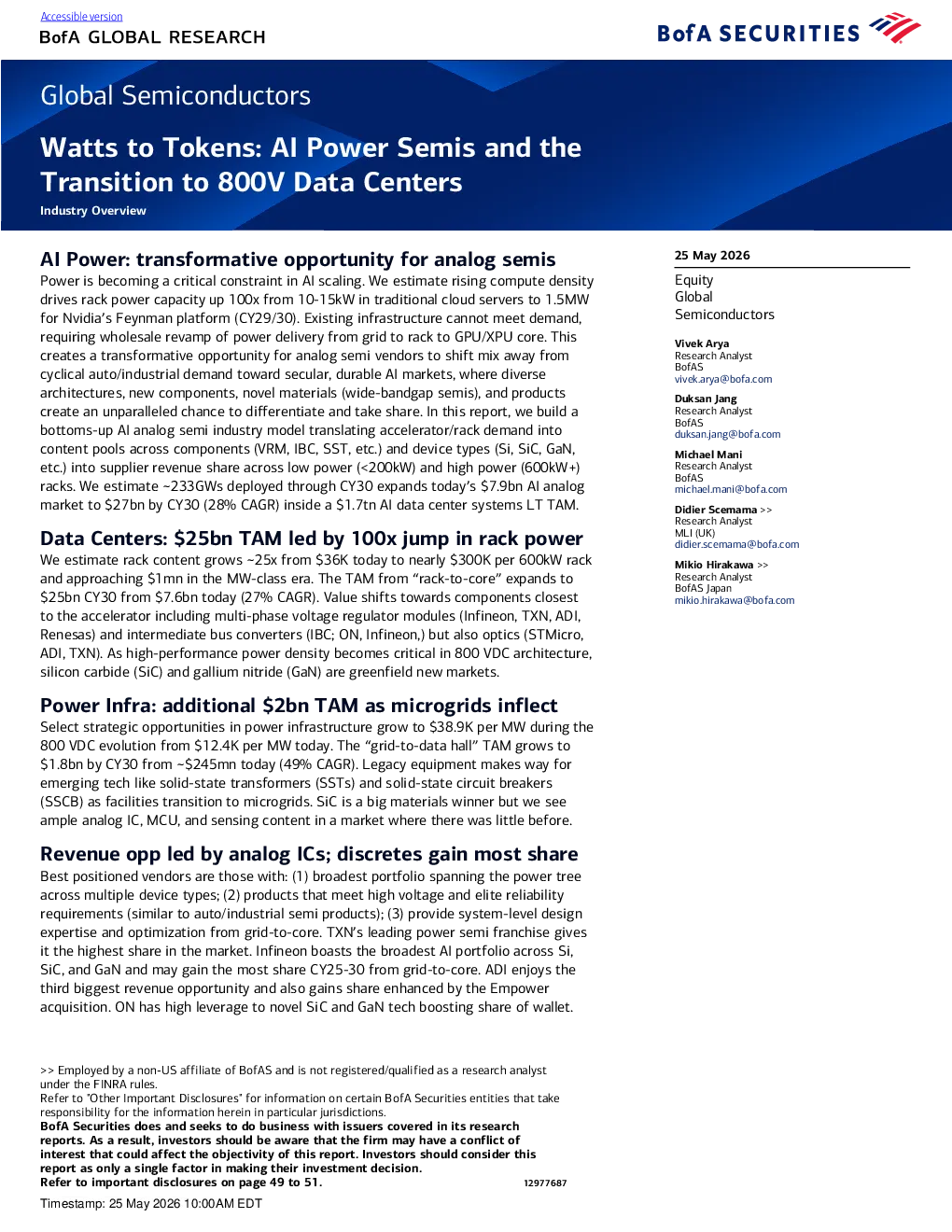
Watts to Tokens: AI Power Semis and theTransition to 800V Data Centers Industry Overview AI Power: transformative opportunity for analog semis 25 May 2026 Poweris becoming a critical constraint in AI scaling. We estimate rising compute densitydrives rack power capacity up 100x from 10-15kW in traditional cloud servers to 1.5MWfor Nvidia’s Feynman platform (CY29/30). Existing infrastructure cannot meet demand,requiring wholesale revamp of power delivery from grid to rack to GPU/XPU core. Thiscreates a transformative opportunity for analog semi vendors to shift mix away fromcyclical auto/industrial demand toward secular, durable AI markets, where diversearchitectures, new components, novel materials (wide-bandgap semis), and productscreate an unparalleled chance to differentiate and take share. In this report, we build abottoms-up AI analog semi industry model translating accelerator/rack demand into EquityGlobalSemiconductors Vivek AryaResearch AnalystBofASvivek.arya@bofa.com Duksan JangResearch AnalystBofASduksan.jang@bofa.com Michael ManiResearch AnalystBofASmichael.mani@bofa.com Didier Scemama>>Research AnalystMLI (UK)didier.scemama@bofa.com Data Centers: $25bn TAMled by 100x jump in rack power We estimaterack content grows ~25x from $36K today to nearly $300K per 600kW rackand approaching $1mn in the MW-class era. The TAM from“rack-to-core”expands to$25bn CY30 from $7.6bn today (27% CAGR). Value shifts towards components closestto the accelerator including multi-phase voltage regulator modules (Infineon, TXN, ADI,Renesas) and intermediate bus converters (IBC; ON, Infineon,) but also optics (STMicro,ADI, TXN). As high-performance power density becomes critical in 800 VDC architecture, Mikio Hirakawa>>Research AnalystBofAS Japanmikio.hirakawa@bofa.com Power Infra: additional $2bn TAM as microgrids inflect Select strategic opportunities in power infrastructure growto $38.9K per MW during the800 VDC evolutionfrom $12.4K per MW today. The“grid-to-data hall”TAM grows to$1.8bn by CY30 from ~$245mn today (49% CAGR). Legacy equipment makes way foremerging tech like solid-state transformers (SSTs) and solid-state circuit breakers(SSCB) as facilities transition to microgrids. SiC is a big materials winner but we seeample analog IC, MCU, and sensing content in a market where there was little before. Revenue opp led by analog ICs; discretes gain most share Best positioned vendors are those with: (1) broadest portfolio spanning the power treeacross multiple device types; (2) products that meet high voltage and elite reliabilityrequirements (similar to auto/industrial semi products); (3) provide system-level designexpertise and optimization from grid-to-core. TXN’s leading power semi franchise givesit the highest share in the market. Infineon boasts the broadest AI portfolio across Si,SiC, and GaN and may gain the most share CY25-30 from grid-to-core. ADI enjoys the >> Employed by a non-US affiliate of BofAS and is not registered/qualified as a research analystunder the FINRA rules. Refer to "Other Important Disclosures" for information on certain BofA Securities entities that takeresponsibility for the information herein in particular jurisdictions.BofA Securities does and seeks to do business with issuers covered in its research Contents Analog semis: key beneficiaries in high power14 Data center: $25bn TAM from rack to core18 Power Supply Units (PSU)19Intermediate Bus Conversion (IBC)20Server Board (GPU/XPU power, CPU, VRM, multi-phase)23Other components (protection, sensors, optics, etc.)26 Power Infra: $2bn TAM from grid to hall29 Energy Storage System (ESS)/Uninterruptible Power Supply (UPS)30Solid-State Transformer (SST)31Solid-State Circuit Breakers (SSCB)32 AI Power Analog Semi Model34 Glossary44 Power is the ultimate AI scaling constraint Multiple bottlenecks are emerging in the multi-year AI infrastructure buildout–memory,optics, leading-edge logic wafers, advanced substrates, etc.–but among the greatest Higher compute density is translating to higher power demands Traditional cloud data center operators mainly worried about compute space as powerand cooling infrastructure occupied a significantly smaller physical footprint. When theAI investment cycle began, server CPUs transitioned to power hungry GPUs, ordinaryinternet traffic evolved into intense training and inference workloads, and heavycomputational needs turned into heavy power needs. As demand surges and clustersbecome larger, the need for higher compute density per server rack (e.g. Hopper had only8 GPUs in a node while Blackwell’s scale-up domain is 72) to optimize performance Exhibit1:By the end of the decade,we think Nvidia’s roadmap could lead to >1.5megawattracksforthe Feynman era, nearly 100x higher than a standard server CPU rack at 10-15 kilowatts Power capacity per rack (kilowatts) across various generations of Nvidia platforms vs. a traditional server rack Performance-per-watt is a critical metric for oper