您的浏览器禁用了JavaScript(一种计算机语言,用以实现您与网页的交互),请解除该禁用,或者联系我们。 [PitchBook]:SPACs在VC的门口:新SPAC IPO激增,部分独角兽在私人市场停滞 - 发现报告

SPACs在VC的门口:新SPAC IPO激增,部分独角兽在私人市场停滞

金融 2026-05-11 Kyle Stanford, Caleb Wilkins PitchBook 张彦男 Tim
报告封面

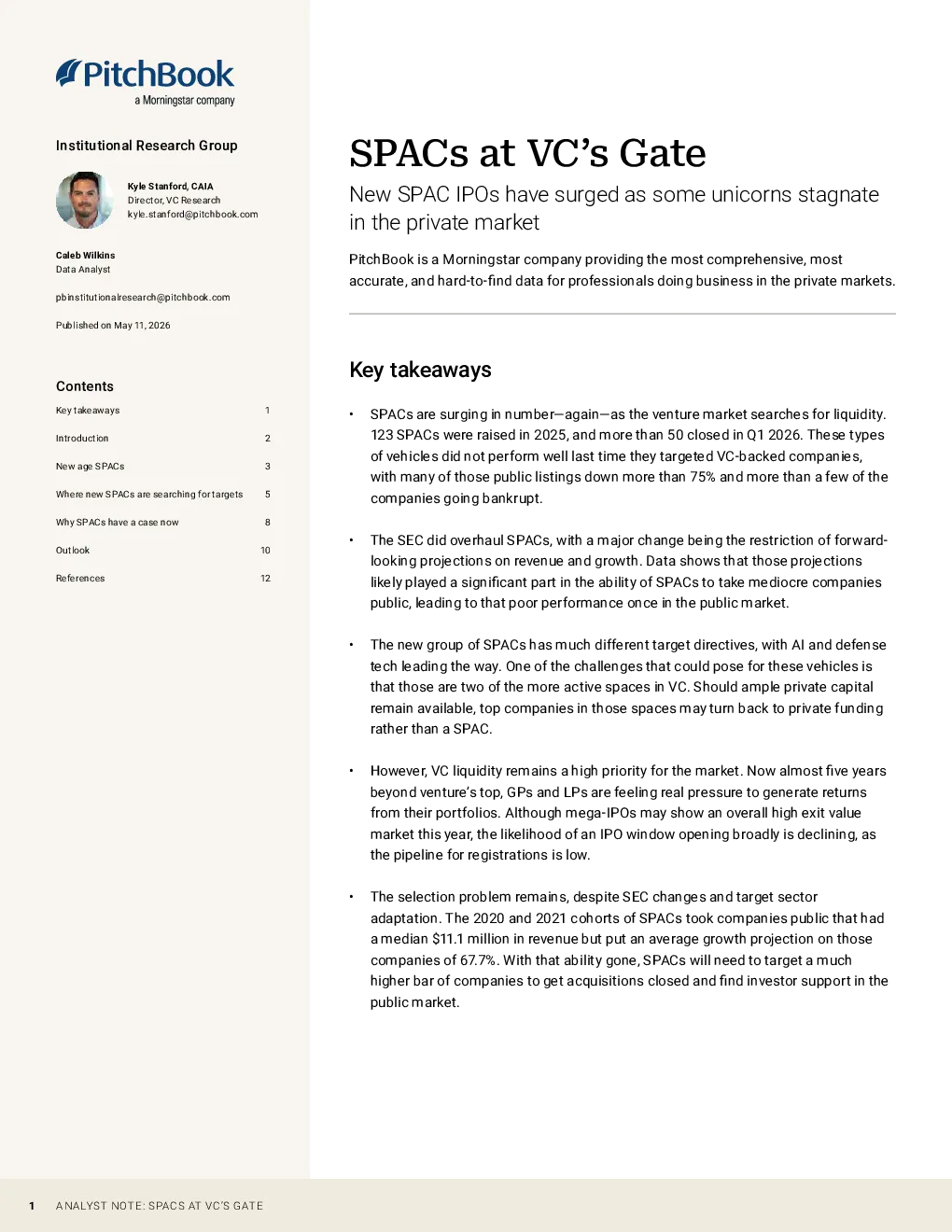
SPACs at VC’s Gate Institutional Research Group New SPAC IPOs have surged as some unicorns stagnatein the private market Kyle Stanford, CAIADirector, VC Researchkyle.stanford@pitchbook.com Caleb WilkinsData Analystpbinstitutionalresearch@pitchbook.com PitchBook is a Morningstar company providing the most comprehensive, mostaccurate, and hard-to-find data for professionals doing business in the private markets. Key takeaways Contents •SPACs are surging in number—again—as the venture market searches for liquidity.123 SPACs were raised in 2025, and more than 50 closed in Q1 2026. These typesof vehicles did not perform well last time they targeted VC-backed companies, Key takeaways •The SEC did overhaul SPACs, with a major change being the restriction of forward-looking projections on revenue and growth. Data shows that those projectionslikely played a significant part in the ability of SPACs to take mediocre companies •The new group of SPACs has much different target directives, with AI and defensetech leading the way. One of the challenges that could pose for these vehicles isthat those are two of the more active spaces in VC. Should ample private capital •However, VC liquidity remains a high priority for the market. Now almost five yearsbeyond venture’s top, GPs and LPs are feeling real pressure to generate returnsfrom their portfolios. Although mega-IPOs may show an overall high exit value •The selection problem remains, despite SEC changes and target sectoradaptation. The 2020 and 2021 cohorts of SPACs took companies public that hada median $11.1 million in revenue but put an average growth projection on those Introduction 123 SPACs were raised in 2025, and 2026 is on pace for more than 200 closings. Onthe other hand, the deSPAC index tracking companies taken public by the prior cohortis down 75% since 2022. Both facts are true simultaneously, and together they define The new cohort is structurally different and finds a market that may need thesevehicles more than in 2021. Regulations on forward-looking statements for pre-listing companies represent the most material change to how SPACs operate when Current market conditions also favor the structure. Five years of limited liquidity havebuilt real pressure on GPs to return capital to LPs. The IPO market remains tepid,and looming mega-IPOs (SpaceX, OpenAI, Anthropic) will weigh on available liquiditythrough portfolio rebalancing and sheer capital absorption. SPACs offer a negotiated, Target quality is a potential tailwind as well. The companies that defined the 2021cohort had, by historical standards, weak financials. Many of those companies havesince faced additional pressure from AI-native competitors that have undercut theirrevenue base. The middle market today contains better businesses, or at least has Most of the recently raised SPACs have not yet completed a deal, and the verdict onthis cycle will take years to form. But the poor historical performance of SPACs will bea challenge that each vehicle will need to ask investors to look past in order to acquire New age SPACs The structural differences between the new SPAC cohort and the prior one are largelyregulatory. Dilution disclosures appear upfront in prospectus filings. Target executivesare now co-registrants in the transaction, creating direct legal liability for falsestatements. Sponsor compensation and conflict disclosures have been tightened. The safe harbor had given SPACs a structural advantage over traditional IPOs forsome companies. It allowed targets to provide financial outlooks during the dealprocess, given appropriate cautionary language, which helped bolster investorappetite for the company and get the merger done. In practice, those projections were For current SPAC investors, the constraint is a net positive. It forces the market towardcompanies whose financials can stand on their own and may be more appealingto public market investors. Conviction now requires diligence on current-year The data from 2021 makes the case clearly. Average revenues for non-healthcarecompanies exiting through a SPAC that year were $109 million, with average An academic review of SPACs found that the firms projecting revenues for at least twoyears had median and average growth projections of 39.0% and 67.7%, respectively.1Firms with higher revenue forecasts were more likely to miss those projections andunderperformed peers, IPO comparables, and select indexes. In these cases, forward- Select rule changes by the SEC The SEC’s January 24, 2024, overhaul(effective July 1, 2024) representsthe most comprehensive regulatoryrestructuring of the SPAC vehicle in Our data shows the median exit size for reverse mergers in 2020 to 2022 was $839million. That included median step-ups of 1.7x from prior private valuations applied tocompanies with $11.1 million in median revenue. For IPOs in the same period, medianvaluations were higher and step-ups smaller, while revenues were both higher and