您的浏览器禁用了JavaScript(一种计算机语言,用以实现您与网页的交互),请解除该禁用,或者联系我们。 [OECD]:地方认同、自豪感和品牌转型:塑造地方的故事 - 发现报告

地方认同、自豪感和品牌转型:塑造地方的故事

文化传媒 2026-05-23 OECD LIHUYUN
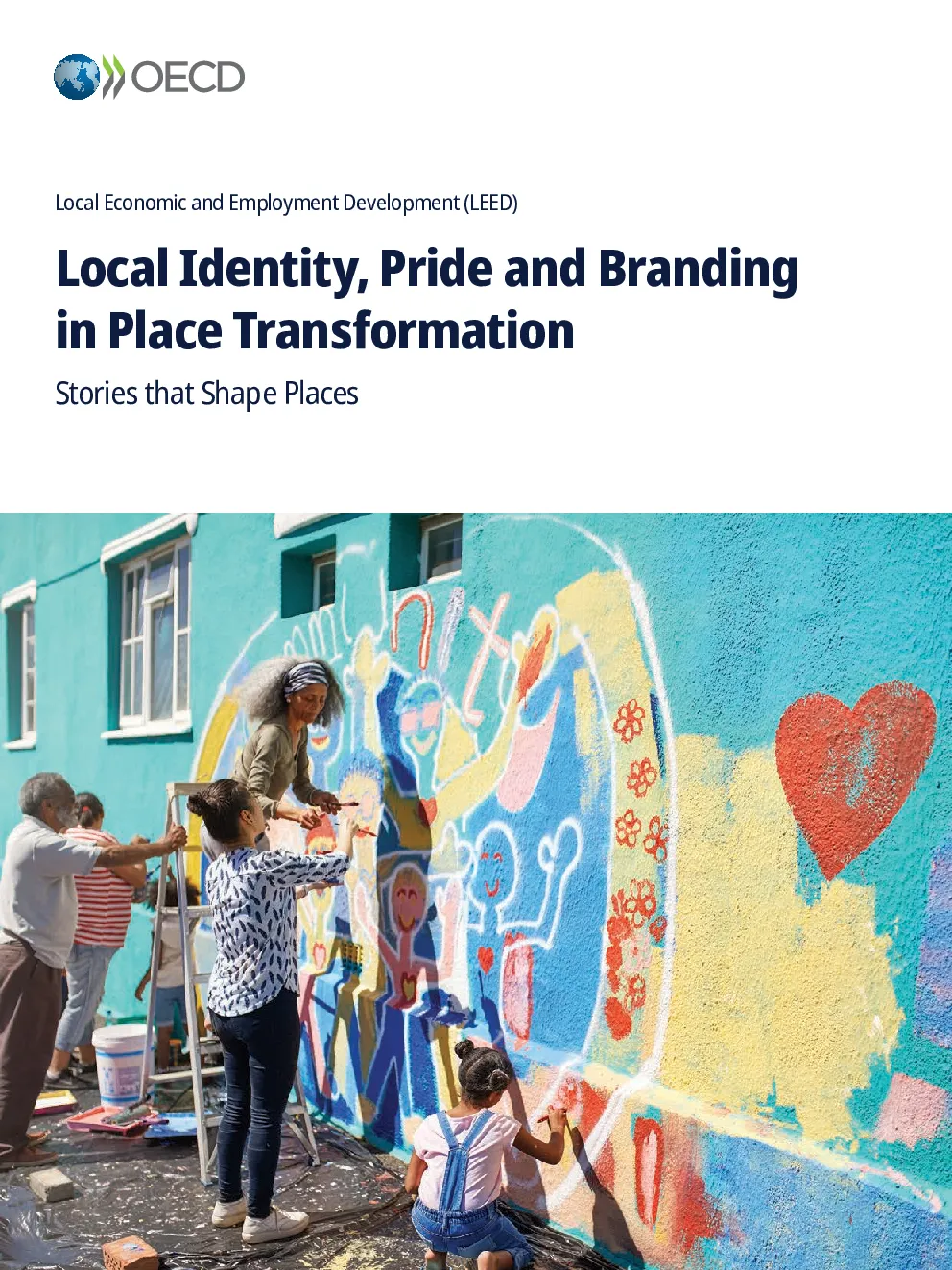
报告封面

Local Identity, Pride andBrandinginPlace Transformation Stories that Shape Places Local Economic and Employment Development (LEED) Local Identity, Prideand Branding in PlaceTransformation STORIES THAT SHAPE PLACES This work is issued under the responsibility of the Secretary-General of the OECD, and does not necessarily reflect theofficial views of OECD Member countries. This document, as well as any data and map included herein, are without prejudice to the status of or sovereignty overany territory, to the delimitation of international frontiers and boundaries and to the name of any territory, city or area. ISBN 978-92-64-36240-6 (print)ISBN 978-92-64-79787-1 (PDF)ISBN 978-92-64-79320-0 (HTML) Local Economic and Employment Development (LEED)ISSN 1990-1100 (print)ISSN 1990-1097 (online) Photo credits:Cover © Caia Image/Getty Images. Attribution 4.0 International (CC BY 4.0) This work is made available under the Creative Commons Attribution 4.0 International licence. By using this work, you accept to be bound by the terms of this licence(https://creativecommons.org/licenses/by/4.0/).Attribution– you must cite the work.Translations– you must cite the original work, identify changes to the original and add the following text:In the event of any discrepancy between the original work and thetranslation, only the text of the original work should be considered valid.Adaptations– you must cite the original work and add the following text:This is an adaptation of an original work by the OECD. The opinions expressed and arguments employed inthis adaptation should not be reported as representing the official views of the OECD or of its Member countries.Third-party material– the licence does not apply to third-party material in the work. If using such material, you are responsible for obtaining permission from the third party and forany claims of infringement.You must not use the OECD logo, visual identity or cover image without express permission or suggest the OECD endorses your use of the work.Any dispute arising under this licence shall be settled by arbitration in accordance with the Permanent Court of Arbitration (PCA) Arbitration Rules 2012. The seat of arbitration shallbe Paris (France). The number of arbitrators shall be one. Foreword Across OECD countries, the geography of opportunity is fractured. Access to good jobs, quality of life andeconomic dynamism varies considerably from one place to another,and when shocks hit, not allcommunities are equally equipped to respond. For places facing economic restructuring, transformationmeans more than restoring what was lost. It requiresreshaping industries, renewing institutions andrebuilding identities around new sources of prosperity. Many places that have undergone major industrialtransitions find themselves at a crossroads,caught between a legacy that defined them for generationsand a future that has yet to take shape. Insome of these places,the prevailing identity narrative can actually become part of the problem,reinforcing a sense of decline that makes transformation harder to imagine andharderto achieve.But theoppositecan also be true: whencommunitiescanreconnect withand communicatewhat makes themdistinctive, articulate a credible and forward-looking vision, and harness local pride as a resource, identitycan help feedrenewal. This report provides concrete actions for how policymakers can better integrate place identity, pride andbranding into their local development toolkit.It represents a first-of-its kind effort to bridge a recent andgrowing body of academic literature with emerging experiences from policy actors, including from thepractice of place branding. In addition to bringing these different strands of discourse and practice together,this report adds value by translating theoretical discussions about place identityinto practical policy andprogramme implications, through the use of concrete cases. In this way, place identity can be betterleveraged as a new tool that can serve both economic and social goals. The upside to doing so can be illustrated through some well-known examples. In Bilbao (Spain) forinstance, culture was the main character in the story of the city’s reinvention, following economic declinedriven by industrial restructuring. The iconicGuggenheim Museum symbolises Bilbao’s cultural andcreative renewal, helping to put the city on the global map and attract visitors and investment, whichtranslated into new economic and social opportunities. The city’s wider façade pays homage to itsshipbuilding heritage, anchoring Bilbao’s identity in its industrial history, while reframing it through a hopefulstory of renewal.A similar dynamic can be observed in the Ruhr Valley (Germany), where a shared regionalidentity was strengthened through its reinvention as a “Green Metropolis”. Its flagship cultural siteZollverein Nature Park combined the restoration of natural vegetation and wildlife with striking artworksbuiltaround its former