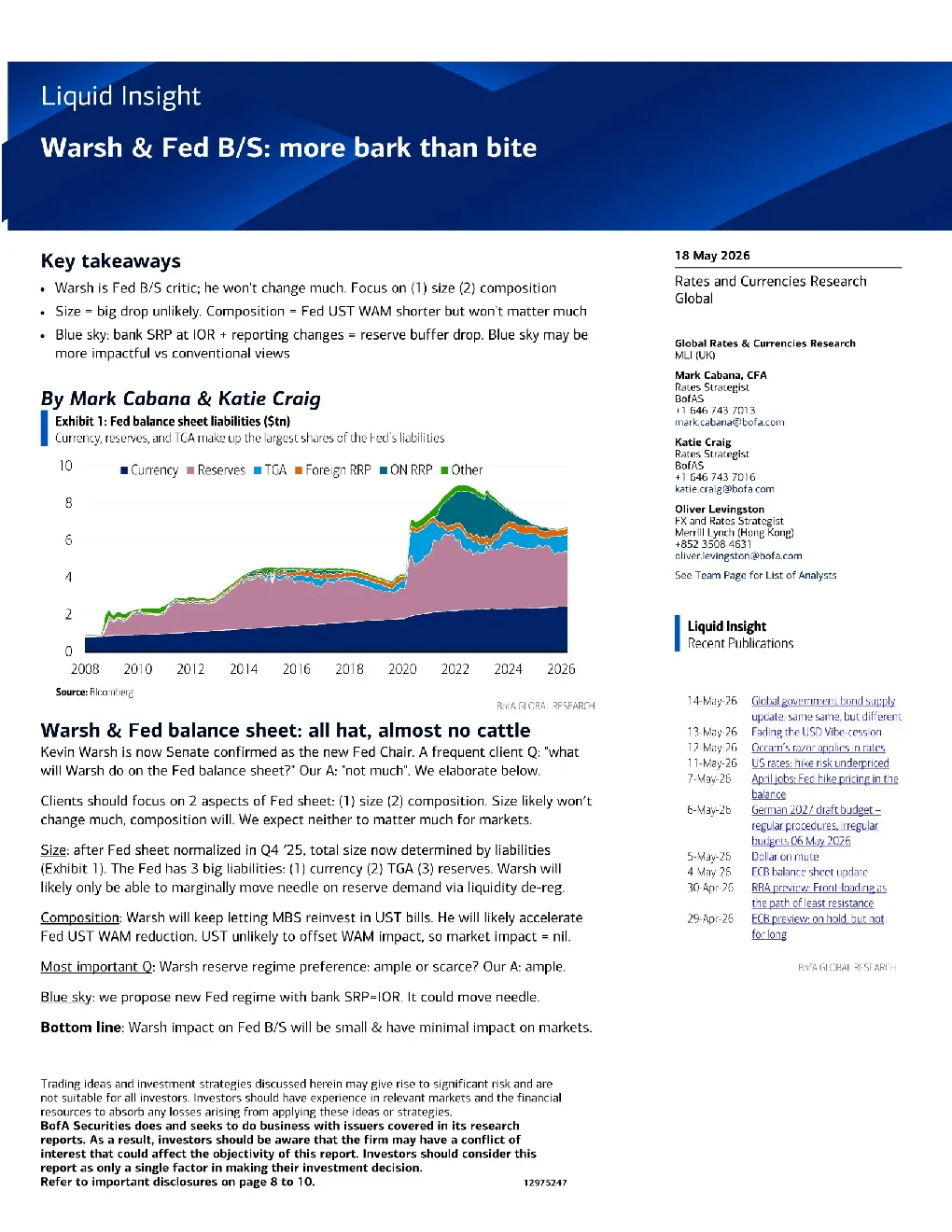
Global . Size = big drop unlikely. Composition = Fed UST WAM shorter but won't matter much Global Rates & Currencies ResearchMLI (UK) moreimpactfulvsconventional viewsBy Mark Cabana & Katie Craig Rates StrategistBofAS+1 646 743 7013 mark.cabana@bofa.comKatie CraigRates StrategistBofAS Currency, reserves, and TGA make up the largest shares of the Fed's liabilities 10CurrencyReservesTGAForeignRRPONRRPOther +1 646 743 7016katie.craig@bofa.comOliver LevingstonFX and Rates StrategistMerill Lynch (Hong Kong) +85235084631oliver.levingston@bofa.comSee Team Page for List of Analysts Recent Publications update: same same, but different13-May-26Fading the USD Vibe-cession12-May-26Occam's razor applies in rates11-May-26US rates: hike risk underpriced7-May-26Apriljobs: Fed hike pricing in thebalance6-May-26German 2027 draft budget-regular procedures, regularbudgets 06 May 20265-May-26Dollar on mute4-May-26ECB balance sheet update30-Apr-26RBA preview: Front-loading asthe path of least resistance29-Apr-26ECB preview: on hold,but notfor long Kevin Warsh is now Senate confirmed as the new Fed Chair.A frequent client Q:"what will Warsh do on the Fed balance sheet?" Our A:"not much".We elaborate below.Clients should focus on 2 aspects of Fed sheet: (1) size (2) composition. Size likely won't change much, composition will. We expect neither to matter much for markets.Size: after Fed sheet normalized in Q4 '25, total size now determined by liabilities (Exhibit 1). The Fed has 3 big liabilities: (1) currency (2) TGA (3) reserves. Warsh willlikely only be able to marginally move needle on reserve demand via liquidity de-reg Fed UST WAM reduction. UST unlikely to offset WAM impact, so market impact = nil. Most important Q: Warsh reserve regime preference: ample or scarce? Our A: ample. Blue sky: we propose new Fed regime with bank SRP=lOR. It could move needle. Bottom line:Warsh impact on Fed B/S willbe small &haveminimal impact onmarkets. Incoming Fed Chair Warsh is a longstanding critic of the Fed balance sheet. We expect he would quickly establish “working groups" to examine ways to shrink Fed sheet. Warshwill try to impact 2 parts of Fed B/S: (1) size (2) composition. Market impact likely small. Central bank balance sheet sizes, once right sized, are determined by their liabilities. The Fed right sized its sheet via QT until money markets reflected tightness in Q4 '25.To reduce sheet further the Fed needs to shrink one of its key 3 liabilities: (1) currency (2) TGA (3) reserves. We offer thoughts (TL;DR: reserves are the only shot; Exhibit 2). Fed assets = mostly UST assets, Fed liabilities = mostly reserves + currency AssetsLiabilities are beyond the central banks control. To reduce currency the Fed could tax or eliminatecurrency / large denomination bills (ECB cut EUR5OO notes). It won't happen in the US. TGA: UST cash balance could be reduced. UST has signaled minimal interest or desire toreduce TGA (TGA expected to rise: end Q2 $90Ob, end Q3 $95Ob). UST could considermarginal adjustments, such as excess cash investment in repo or TT&L (see: TGA repo Reserves: lower reserves are Warsh best shot to reduce sheet. There are 2 conventionalways for Warsh to reduce reserves (1) bank unfriendly (2) bank friendly. Bank unfriendly: Warsh can tell banks that reserves are capped or tiered (tier = somereserves not fully paid IOR). Reserve caps or tiers would make banks sub-optimally liquid.Sub-optimally liquid banks likely less willing to take risk (i.e. less market making, lessloan growth willingness). Less bank risk = slower economy. Warsh unlikely to do it. Bank friendly: Warsh likely to pursue bank friendly ways to reduce reserve demand viade-reg. This will include allowing banks to pre-pledge collateral to Fed discount windowfor instant monetization. Pre-pledging collateral will expand bank HQLA. More HQLA = Bank friendly approach will shift the“reserve demand curve". Lower reserve demand willfirst put downward pressure on funding (Exhibit 3). Fed can later grow sheet slower /reduce sheet to normalize funding (Exhibit 4). Importantly, bank de-reg reserve demanddrop will not tighten fin conditions (FCl). If no FCI tightening, no need for rate cuts. Other: foreign repo pool adjustment is possible but small peas.Warsh could lower orcap foreign RRP rate to push cash out of Fed into repo or bills. We have long argued thiswould diminish USD reserve currency status & hurt national interest (see: RRP&national interest). Warsh may see smaller sheet > national interest. We advise otherwise. Warsh will also likely have a high bar to intervene in disorderly markets. His initialintuition is likely to remain out of markets but could be forced to act depending onextent of market dysfunction (he did support Fed emergency actions post GFC). Warshmarket invention bar will be high but not insurmountable depending on shock extent. Size summary: Warsh likely to find Fed B/S reduction hard via conventional means. Best