您的浏览器禁用了JavaScript(一种计算机语言,用以实现您与网页的交互),请解除该禁用,或者联系我们。 [联合国]:再生塑料及替代食品接触材料的食品安全影响 - 发现报告

再生塑料及替代食品接触材料的食品安全影响

食品饮料 2026-05-07 联合国 曾阿牛
报告封面

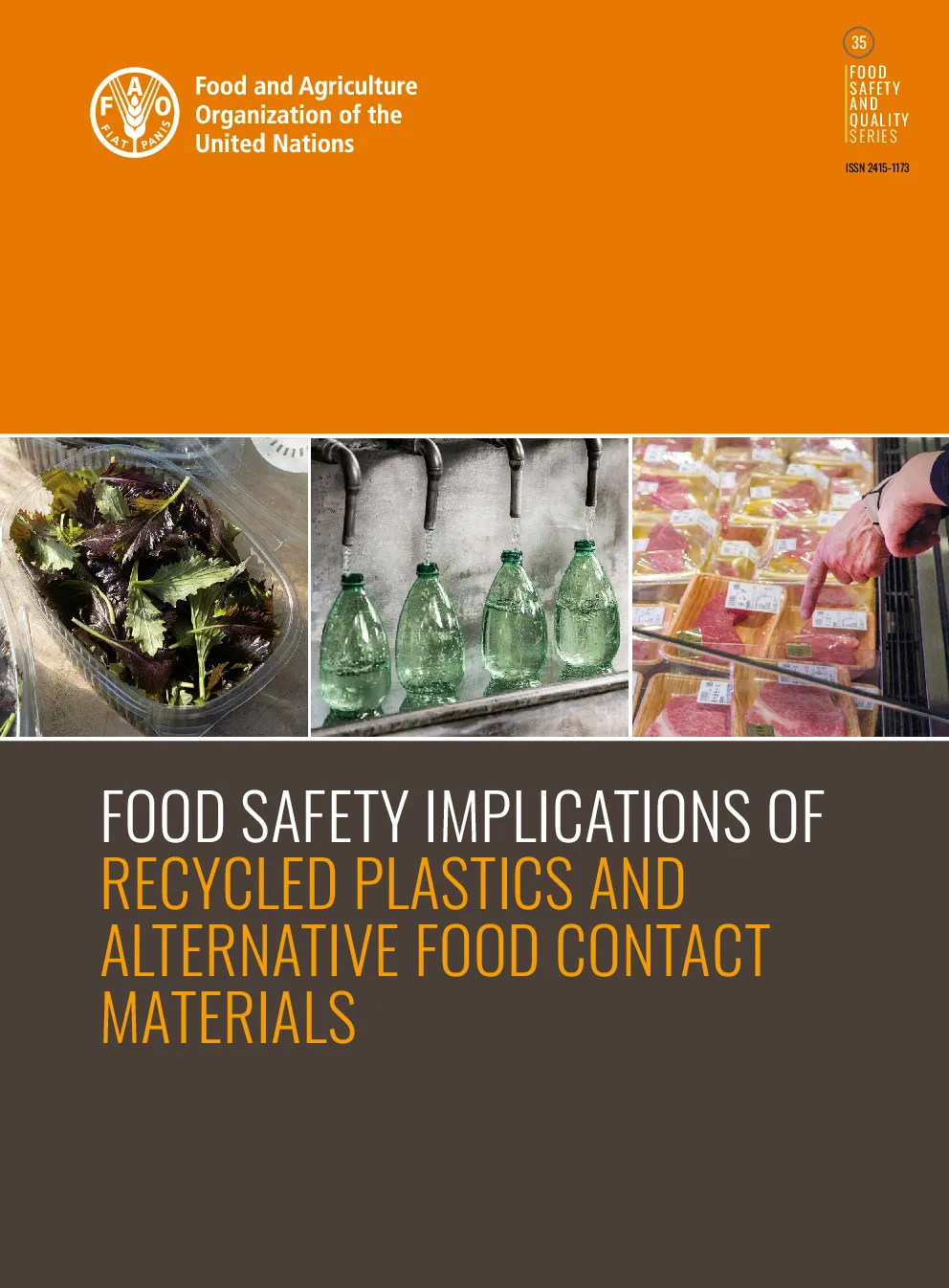
FOOD SAFETY IMPLICATIONS OFRECYCLED PLASTICS ANDALTERNATIVE FOOD CONTACTMATERIALS FOOD SAFETY IMPLICATIONS OFRECYCLED PLASTICS ANDALTERNATIVE FOOD CONTACTMATERIALS byMark FeeleyMagdalena Niegowska ConfortiVittorio FattoriandMarkus Lipp Required citation: Feeley, M., Niegowska Conforti, M., Fattori, V., & Lipp, M.2026.Food safety implications of recycled plastics andalternative food contact materials. Food Safety and Quality Series, No. 35. FAO, Rome.https://doi.org/10.4060/cd9357en The designations employed and the presentation of material in this information product do not imply the expressionof any opinion whatsoever on the part of the Food and Agriculture Organization of the United Nations (FAO)concerning the legal or development status of any country, territory, city or area or of its authorities, or concerningthe delimitation of its frontiers or boundaries. The mention of specific companies or products of manufacturers,whether or not these have been patented, does not imply that these have been endorsed or recommended by FAOin preference to others of a similar nature that are not mentioned. The views expressed in this information product are those of the author(s) and do not necessarily reflect the viewsor policies of FAO. ISSN 2415-1173 [Print]ISSN 2664-5246 [Online] ISBN 978-92-5-140651-9© FAO, 2026 Some rights reserved. This work is made available under the Creative Commons Attribution- 4.0 Internationallicence (CCBY 4.0: https://creativecommons.org/licenses/by/4.0/legalcode.en). Under the terms of this licence, this work may be copied, redistributed and adapted, provided that the work isappropriately cited. In any use of this work, there should be no suggestion that FAO endorses any specific organization,products or services. The use of the FAO logo is not permitted. If a translation or adaptation of this work is created,it must include the following disclaimer along with the required citation: “This translation [or adaptation] was notcreated by the Food and Agriculture Organization of the United Nations (FAO). FAO is not responsible for thecontent or accuracy of this translation [or adaptation]. The original English edition shall be the authoritative edition.” Any dispute arising under this licence that cannot be settled amicably shall be referred to arbitration in accordance withthe Arbitration Rules of the United Nations Commission on International Trade Law (UNCITRAL). The parties shallbe bound by any arbitration award rendered as a result of such arbitration as the final adjudication of such a dispute. Third party materials.This Creative Commons licence CC BY 4.0 does not apply to non-FAO copyright materialsincluded in this publication. Users wishing to reuse material from this work that is attributed to a third party, suchas tables, figures or images, are responsible for determining whether permission is needed for that reuse and forobtaining permission from the copyright holder. The risk of claims resulting from infringement of any third party-owned component in the work rests solely with the user. FAO photographs.FAO photographs that may appear in this work are not subject to the above-mentioned CreativeCommons licence. Queries for the use of any FAO photographs should be submitted to: photo-library@fao.org. Sales, rights and licensing.FAO information products are available on the FAO website (www.fao.org/publications)and print copies can be purchased through the distributors listed there. For general enquiries about FAO publicationsplease contact: publications@fao.org. Queries regarding rights and licensing of publications should be submittedto: copyright@fao.org. Cover photographs [from left to right]:© FAO/Riccardo De Luca – Salad cultivated by aquaponic system in a plastic package.© FAO/Giulio Napolitano – Reusing plastic bottles for drinking water at a source.© FAO/Giulio Napolitano – A customer choosing packaged meat in a food store. Acknowledgements..............................................................................................................ivAbbreviations.........................................................................................................................vExecutive summary..............................................................................................................vii CHAPTER 1 1.1 Global context of FCMs use....................................................................................... 4 CHAPTER 2FOOD CHEMICAL SAFETY ISSUES RELATED TO FCMs........................................... 7 2.1 Food safety considerations related to micro- and nanoplastics in FCMs.............. 112.2 Nanomaterials in food packaging............................................................................. 132.3 Intelligent FCMs........................................................................................................ 152.4 Recycled plastics and food safety considerations.............................................