您的浏览器禁用了JavaScript(一种计算机语言,用以实现您与网页的交互),请解除该禁用,或者联系我们。 [PitchBook]:欧洲杠杆贷款指数月度总结(英) - 发现报告

欧洲杠杆贷款指数月度总结(英)

金融 2026-05-01 PitchBook Joken Hu
报告封面

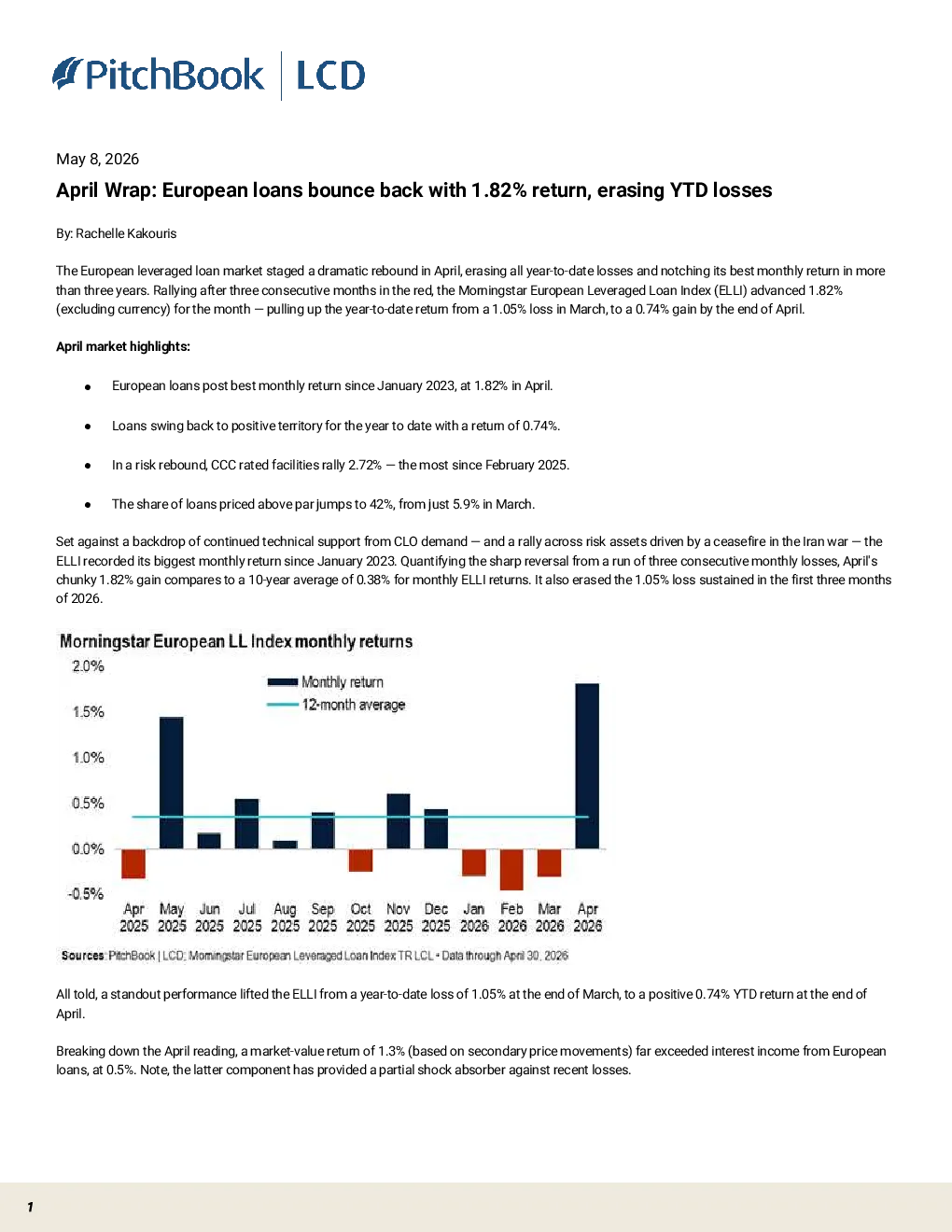
May 8, 2026 April Wrap: European loans bounce back with 1.82% return, erasing YTD losses By: Rachelle Kakouris The European leveraged loan market staged a dramatic rebound in April, erasing all year-to-date losses and notching its best monthly return in morethan three years. Rallying after three consecutive months in the red, the Morningstar European Leveraged Loan Index (ELLI) advanced 1.82%(excluding currency) for the month — pulling up the year-to-date return from a 1.05% loss in March, to a 0.74% gain by the end of April. April market highlights: •European loans post best monthly return since January 2023, at 1.82% in April.•Loans swing back to positive territory for the year to date with a return of 0.74%.•In a risk rebound, CCC rated facilities rally 2.72% — the most since February 2025.•The share of loans priced above par jumps to 42%, from just 5.9% in March. Set against a backdrop of continued technical support from CLO demand — and a rally across risk assets driven by a ceasefire in the Iran war — theELLI recorded its biggest monthly return since January 2023. Quantifying the sharp reversal from a run of three consecutive monthly losses, April'schunky 1.82% gain compares to a 10-year average of 0.38% for monthly ELLI returns. It also erased the 1.05% loss sustained in the first three monthsof 2026. All told, a standout performance lifted the ELLI from a year-to-date loss of 1.05% at the end of March, to a positive 0.74% YTD return at the end ofApril. Breaking down the April reading, a market-value return of 1.3% (based on secondary price movements) far exceeded interest income from Europeanloans, at 0.5%. Note, the latter component has provided a partial shock absorber against recent losses. Software sector A partial recovery in the software sector further helped Europe's loan market, where AI disruption fears have opened up a sharp divide in pricing.Though still dragging on the overall performance, losses across software loans eased from a trough of 7.9% on March 3, to 2.9% by April 30. Having traded at a near-consistent premium to the broader ELLI through most of 2025, software loans suffered a sharp and severe dislocation asinvestors sold the sector amid growing fears of AI disruption. While the worst of that volatility has eased from its February peak, the near-1,000bpsdecline in software loan prices between February 2025 and February 2026 underscores the extent to which market support for the sector eroded overthe course of the year. This sector has retraced some losses, however, with the weighted average bid of software loans in the ELLI climbing from a low of 89.9 at the end ofFebruary, to 92.8 in April. Average bid prices for software loans remain more than 600 bps below the February 2025 post-rate-hiking cycle peak of99.1. Broad bid Looking at the market more broadly, the weighted average bid of the ELLI across all sectors recovered modestly in April to 95.8, from 94.5 at the endof March. However, loan prices remain roughly 3.5 points below the mid-2024 peak above 99. The average yield-to-maturity in the ELLI tightened to 6.9% in April, having jumped back above 7% in March — the first time it had exceeded thisthreshold since January 2025. Meanwhile, the LBO cohort had an average yield-to-maturity of 7.1% in the month — and remains materially wider than the February 2025 cycle-tightsof 6.7% on this measure. Risk compensation The risk compensation required by investors to hold a loan versus the base rate, as measured by the average spread-to-maturity of European loans,tightened to 468 bps in April, from 504 bps in March. While there has been a sustained move tighter in European loan spreads from a cycle peak of 724 bps in late 2022, they remain above the average443 bps run-rate of 2025. Asset allocation As for how European loans stack up against other asset classes, the ELLI caught up to its US counterpart in April, with the European benchmarkreturning 0.74% in the year to date, versus 0.73% for the Morningstar LSTA US Leveraged Loan Index. Loans continue to significantly underperformequities, however, with the FTSE 100 gaining 4.51% YTD. Triple-C rated assets roared back — with the riskier cohort returning 2.72% in April, following a 1.95% loss in March. The moves were more broad-based in April, as single-B loans returned 1.86%, and double-B loans returned 1.17%. Par market April's bid distribution shows a meaningful rotation back towards par as market bifurcation eased. The share of loans trading at par or above — awidely watched gauge of investor demand — recovered to 42% in April, up sharply from March's multi-year low of just 5.9%. The proportion of loans trading below 90 fell to 12.5%, from 16.4% in March, as software loans staged a partial recovery and hopes of a ceasefire inthe Iran war improved demand for deeply discounted loans. Distress ratio Further down the price scale, distress levels in the ELLI remain elevated by recent standards, though some respi