您的浏览器禁用了JavaScript(一种计算机语言,用以实现您与网页的交互),请解除该禁用,或者联系我们。[PitchBook]:欧洲杠杆贷款指数月度总结(英)2026 - 发现报告

欧洲杠杆贷款指数月度总结(英)2026

金融2026-03-16PitchBook光***
欧洲杠杆贷款指数月度总结(英)2026

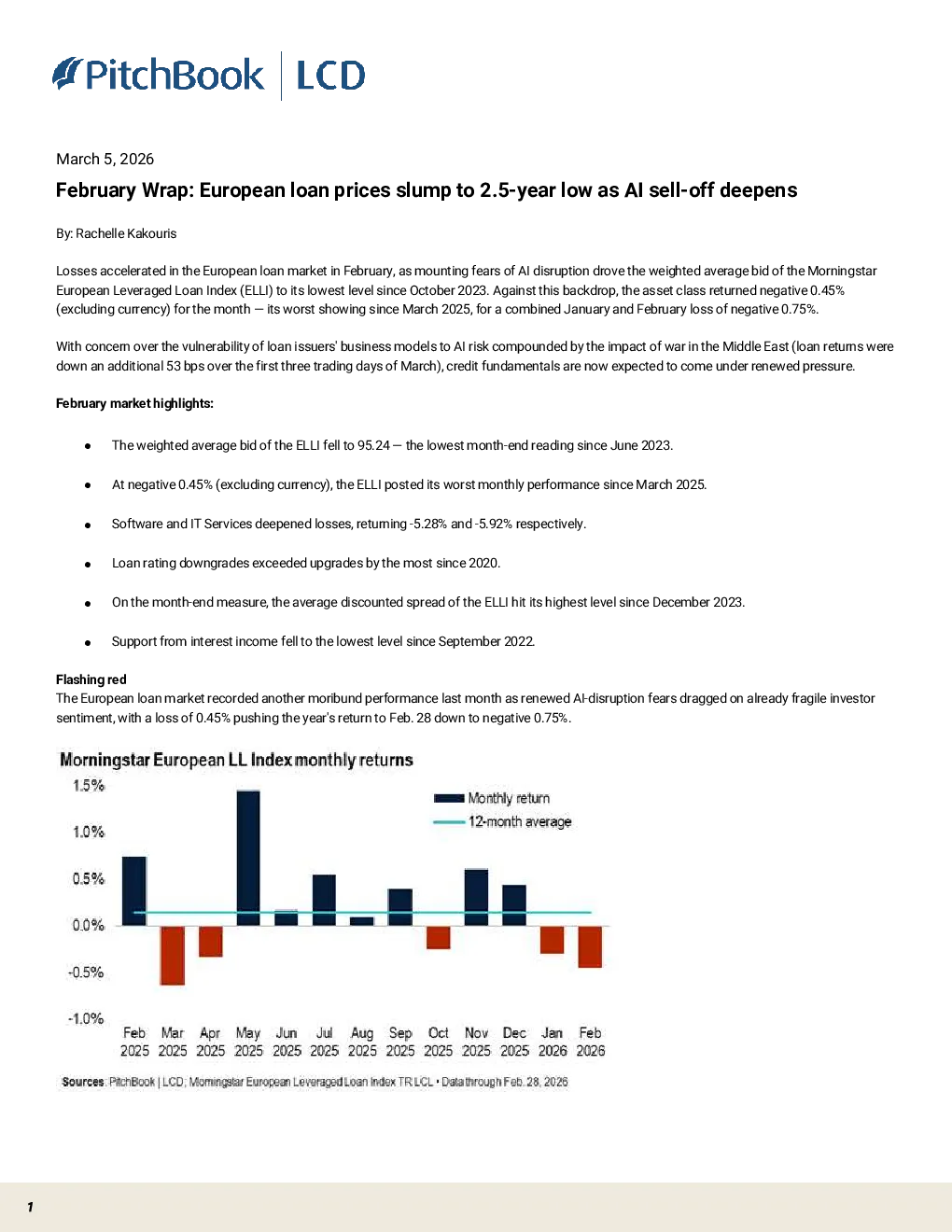
March 5,2026 February Wrap: European loan prices slump to 2.5-year low as AI sell-off deepens By: Rachelle Kakouris Losses accelerated in the European loan market in February, as mounting fears of AI disruption drove the weighted average bid of the MorningstarEuropean Leveraged Loan Index (ELLI) to its lowest level since October 2023. Against this backdrop, the asset class returned negative 0.45%(excluding currency) for the month — its worst showing since March 2025, for a combined January and February loss of negative 0.75%. With concern over the vulnerability of loan issuers' business models to AI risk compounded by the impact of war in the Middle East (loan returns weredown an additional 53 bps over the first three trading days of March), credit fundamentals are now expected to come under renewed pressure. February market highlights: •The weighted average bid of the ELLI fell to 95.24 — the lowest month-end reading since June 2023.•At negative 0.45% (excluding currency), the ELLI posted its worst monthly performance since March 2025.•Software and IT Services deepened losses, returning -5.28% and -5.92% respectively.•Loan rating downgrades exceeded upgrades by the most since 2020.•On the month-end measure, the average discounted spread of the ELLI hit its highest level since December 2023.•Support from interest income fell to the lowest level since September 2022. Flashing red The European loan market recorded another moribund performance last month as renewed AI-disruption fears dragged on already fragile investorsentiment, with a loss of 0.45% pushing the year's return to Feb. 28 down to negative 0.75%. Amid a sharp unwinding of risk that resumed in earnest during the final week of February, the ELLI on Feb. 24 recorded achunky loss of 21 bps(at the time, the largest single-day fall since April 11, 2025). After hitting 95.21 on Feb. 25 — the lowest print since October 2023 — the index endedFebruary at 95.24, a 2.5-year low for the month-end reading. Accordingly, the market-value component of the loan performance was negative 0.91%, denoting the largest loss on this measure since the tariff-induced sell-off in March 2025. With the interest component of floating-rate loans still holding some sway, carry from income added 0.45% in February — down from 0.50% inJanuary, but narrowing February’s final loss to negative 0.45% on the overall reading. The benefit of interest carry has declined markedly in recent years. From its late-2023 high of 0.71%, February’s interest income was the lowest sinceSeptember 2022. Software malfunction While Europe is outperforming the US so far in 2026, the Software fallout has hit both markets. The Morningstar LSTA US Leveraged Loan Indexreturn was negative 1.08% in the year to end-February, versus negative 0.75% for the ELLI. Tracking back to January, Software lost 1.83% in Europe,versus a 2.97% loss in the US. In February, however, Software lost 5.28% in Europe, versus a 4.17% loss in the US. Software loans are now down7.02% YTD in both regions. Quantifying the drag of sliding software valuations on the broader loan market — and using a measure that includes currency — the total YTD indexreturn was negative 0.77% at the end of February, with the Software sector accounting for 0.51% of that loss. As loan prices softened again in February, the yield to maturity on loans tracked by the ELLI rose 16 bps on the month to 6.93% — a 3.5-year high onthe month-end measure. Risk compensation Looking at risk compensation versus the base rate, the average discounted spread to maturity of the ELLI rose for a third consecutive month, toE+482 bps — its highest level since April 2025, or December 2023 at the month-end reading. While there has been a sustained march tighter in European loan spreads from a cycle peak of E+724 bps in late 2022, spreads are now sittingroughly in line with the 10-year average of E+483 bps. Asset classes As for how European loans stack up against other asset classes, the US loan market took a harder hit in February, losing 0.78%. Players moved away from technology-related assets, with high-yield bonds and the FTSE 100 providing a shelter for risk investing, contributing topositive performances of 0.32% and 6.72%, respectively. Quality street Meanwhile, there was a clear gravitation from single-B rated risk to the double-B rated section of the ELLI. While the habitual flight to quality during times of volatility partly explains this move, it is worth noting the high concentration (8%) of Software loansin the single-B cohort, versus a total absence of such loans in the double-B bracket. The growing bifurcation in ratings performance for European loans also played out in February’s price migration. An eye-watering 16.8% of ELLI loansare now priced below 90 — the highest share for this cohort since December 2022. In February 2025, just 3.8% of loans were trading below 90. Distress levels Further down the price scale, distress levels in the E