您的浏览器禁用了JavaScript(一种计算机语言,用以实现您与网页的交互),请解除该禁用,或者联系我们。 [美银证券]:欧洲股票策略:摆脱能源冲击 - 发现报告

欧洲股票策略:摆脱能源冲击

2026-05-15 美银证券 张彦男 Tim
报告封面

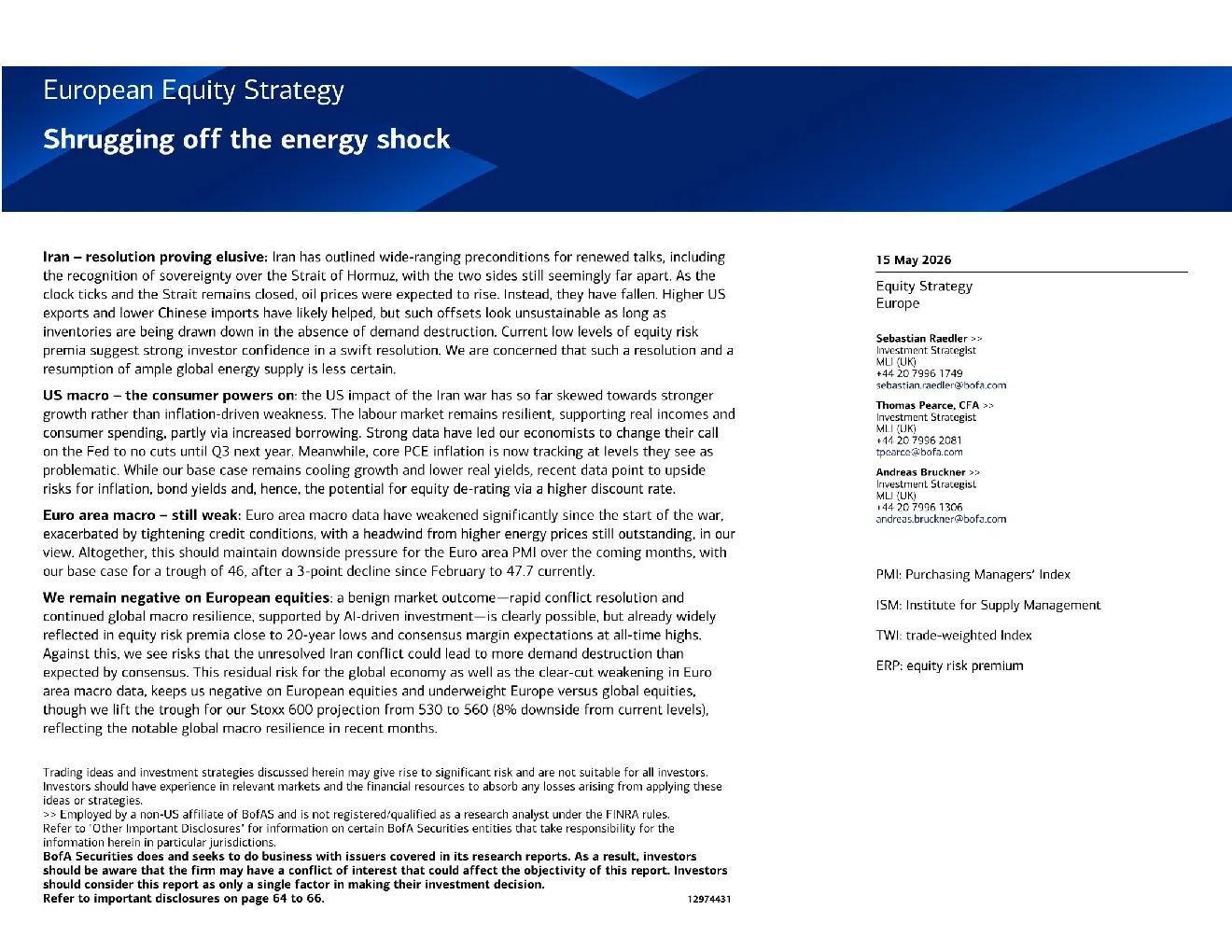
exports and lower Chinese imports have likely helped, but such offsets look unsustainable as long asinventories are being drawn down in the absence of demand destruction. Current low levels of equity riskpremia suggest strong investor confidence in a swift resolution. We are concerned that such a resolution and aresumption of ample global energy supply is less certain.US macro - the consumer powers on: the US impact of the Iran war has so far skewed towards strongergrowth rather than inflation-driven weakness. The labour market remains resilient, supporting real incomes and Europe Sebastian Raedler >>Investment Strategist +44 20 7996 1749sebastian.raedler@bofa.comThomas Pearce, CFA >>Investment StrategistMLI (UK) consumer spending, partly via increased borrowing. Strong data have led our economists to change their callon the Fed to no cuts until Q3 next year. Meanwhile, core PCE inflation is now tracking at levels they see asrisks for inflation, bond yields and, hence, the potential for equity de-rating via a higher discount rate.Euro area macro-still weak: Euro area macro data have weakened significantly since the start of the war, +442079962081tpearce@bofa.comAndreas Bruckner >>Investment StrategistMLI (UK) +44 20 7996 1306andreas.bruckner@bofa.com exacerbated by tightening credit conditions, with a headwind from higher energy prices still outstanding, in ourview. Altogether, this should maintain downside pressure for the Euro area PMl over the coming months, withour base case for a trough of 46, after a 3-point decline since February to 47.7 currently.We remain negative on European equities:a benign market outcome-rapid conflict resolution and ISM: Institute for Supply Management reflected in equity risk premia close to 20-year lows and consensus margin expectations at all-time highs.Against this, we see risks that the unresolved Iran conflict could lead to more demand destruction thanexpected by consensus. This residual risk for the global economy as well as the clear-cut weakening in Eurothough we lift the trough for our Stoxx 600 projection from 530 to 560 (8% downside from current levels),reflecting the notable global macro resilience in recent months. TWI: trade-weighted Index ERP: equity risk premium 12974431 preconditions for a next round of peace talks. These included an end to fighting on all fronts (i.e. including for Israel inLebanon), a lifting of economic sanctions, the release of frozen funds, the payment of war reparations, as well as theacceptance of Iranian sovereignty over the Strait of Hormuz (SoH). With the two sides still seemingly far apart, thequestion is whether one side will come under enough pressure to ease their demands. From the Iranian perspective, oureconomistshavearguedthattheregime'sabilitytoremaincohesivecouldbesustainedevenunderthescenarioof asignificant decline in oil revenues (see: Iran Watch, May 1). From the US side, agreement with China at the ongoingsummit on key issues such as SoH free passage and no Iranian nuclear weapons could help to improve the USadministration's leverage, but the means through which China would exert effective pressure on Iran remain unclear.BofA's house view remains for an end to the war by the end of the month and for oil flows through the SoH to mostlynormalise by Q3 (see: Global Energy Weekly,Apr 27) -a timeline that now looks tight. Brent (based on contracts for 10-25 days ahead, making it a good proxy for physical oil market prices) is instead downby around $2o/bbl over thepast month.Levers such as a significant ramp in US exports and a majorreduction in Chinaimports have likely helped to ease physical oil market tightness, but ultimately these factors are difficult to besustained as long as global inventories continue to be drawn down in the absence of the type of demand destructionthat would normally help to bring demand back into line with the lower levels of supply caused by the SoH closure. Wecontinue to see the currently low levels of risk premia priced into the equity market as reflecting a high degree ofwould result once serious demand destruction starts to set in. Against this, we remain concerned that a resolution -and, hence, a resumption of plentiful global energy supplies - is less certain than equity markets are discounting. Us macro -the consumer powers on: even though oil prices have stayed lower than could have been feared morethan two months into the closure for the SoH, the Iran war has nonetheless generated a significant negative oil supplyshock, implying stagflationary pressure for the global economy -i.e. weaker growth and stronger inflation. Yet therelative magnitude of the respective growth and inflation risks are set to differ by region. In the US, the impact appearsso far to be skewing towards the hotter end of the spectrum. The labour market showed resilience again in April. Forthe four months this year so far, private payrolls growth has averaged 86k, up from only 5k in August and the thirdst