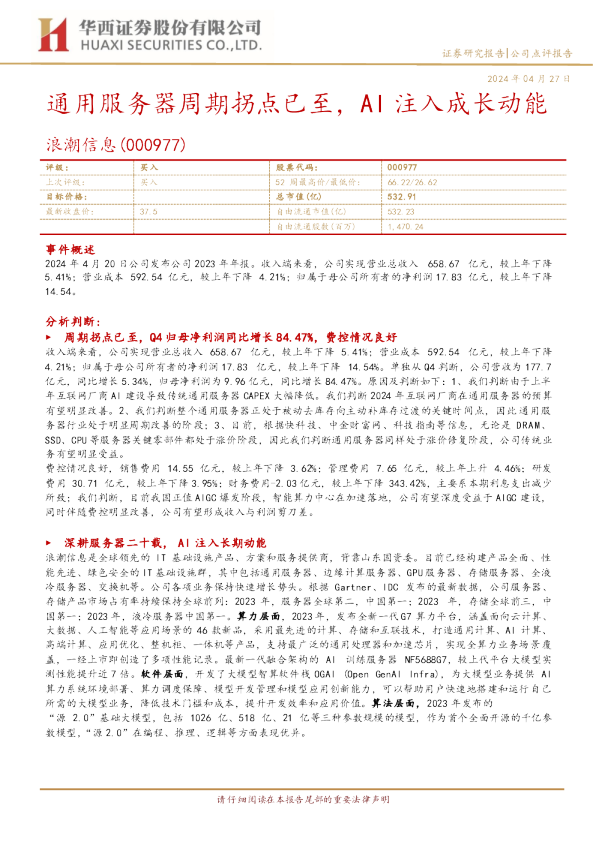
真正的AI繁荣已至,拥抱全新周期
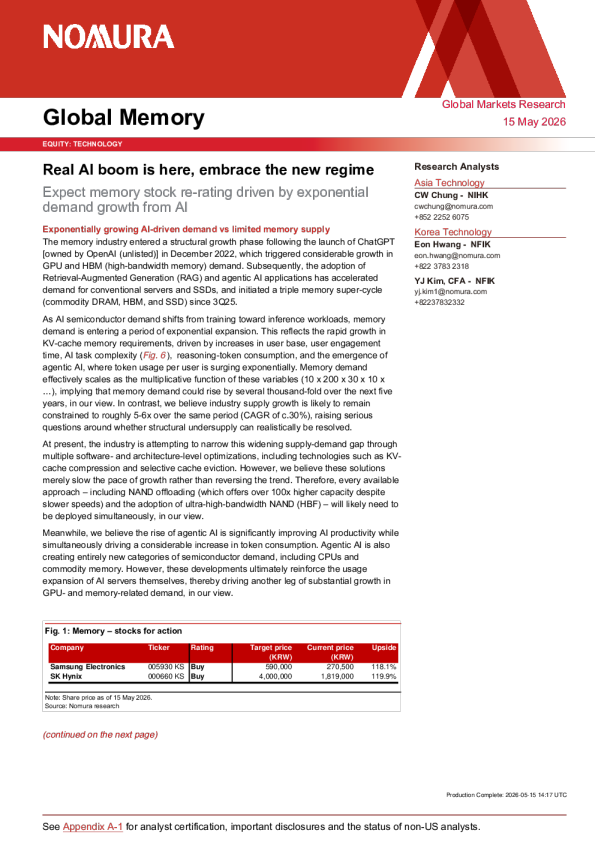
Global Memory EQUITY: TECHNOLOGY Real AI boom is here, embrace the new regime Research Analysts Asia Technology Expect memory stock re-rating driven by exponentialdemand growth from AI CW Chung - NIHKcwchung@nomura.com+852 2252 6075 Exponentially growing AI-driven demand vs limited memory supply Korea Technology The memory industry entered a structural growth phase following the launch of ChatGPT[owned by OpenAI (unlisted)] in December 2022, which triggered considerable growth inGPU and HBM (high-bandwidth memory) demand. Subsequently, the adoption ofRetrieval-Augmented Generation (RAG) and agentic AI applications has accelerateddemand for conventional servers and SSDs, and initiated a triple memory super-cycle(commodity DRAM, HBM, and SSD) since 3Q25. Eon Hwang - NFIKeon.hwang@nomura.com+822 3783 2318 YJ Kim, CFA - NFIKyj.kim1@nomura.com+82237832332 As AI semiconductor demand shifts from training toward inference workloads, memorydemand is entering a period of exponential expansion. This reflects the rapid growth inKV-cache memory requirements, driven by increases in user base, user engagementtime, AI task complexity (Fig. 6),reasoning-token consumption, and the emergence ofagentic AI, where token usage per user is surging exponentially. Memory demandeffectively scales as the multiplicative function of these variables (10 x 200 x 30 x 10 x…), implying that memory demand could rise by several thousand-fold over the next fiveyears, in our view. In contrast, we believe industry supply growth is likely to remainconstrained to roughly 5-6x over the same period (CAGR of c.30%), raising seriousquestions around whether structural undersupply can realistically be resolved. At present, the industry is attempting to narrow this widening supply-demand gap throughmultiple software- and architecture-level optimizations, including technologies such as KV-cache compression and selective cache eviction. However, we believe these solutionsmerely slow the pace of growth rather than reversing the trend. Therefore, every availableapproach – including NAND offloading (which offers over 100x higher capacity despiteslower speeds) and the adoption of ultra-high-bandwidth NAND (HBF) – will likely need tobe deployed simultaneously, in our view. Meanwhile, we believe the rise of agentic AI is significantly improving AI productivity whilesimultaneously driving a considerable increase in token consumption. Agentic AI is alsocreating entirely new categories of semiconductor demand, including CPUs andcommodity memory. However, these developments ultimately reinforce the usageexpansion of AI servers themselves, thereby driving another leg of substantial growth inGPU- and memory-related demand, in our view. AI-based innovations are actually happening and will create a self-reinforcinginvestment cycle The advancement of agentic AI could finally unlock a step-function improvement inenterprise productivity. Combined revenue for leading AI software and service vendorssuch as Anthropic (unlisted), Gemini (provided by Google [GOOGL US, Not rated]), andOpen AI could potentially expand by more than 100x over the next five years from thecurrent level of approximately USD70bn, in our view. Until recently, such forecastsappeared detached from reality, but they are increasingly becoming plausible. Anthropicis reportedly expected to achieve a breakeven point by 2027E, while Open AI is targetingprofitability around 2029E (link). Despite still generating losses today, these companiesare already raising capital at unprecedented valuations, with aggregate equity values nowapproaching the trillion-dollar range (link 1,link 2). We believe the revenues and capital generated by these AI service providers will, in turn,flow back to hyperscalers and CSPs such as Amazon (AMZN US, Not rated), Google, andMicrosoft (MSFT US, Not rated) through cloud infrastructure spending, thereby creating apowerful self-reinforcing investment cycle in data center expansion. We believe the trueFourth Industrial Revolution is now beginning. In our view, this transition represents an unprecedented new regime, including AI robotsand autonomous driving. We believe the resulting wealth disparities, cross-country gaps,and social/political impacts are likely to exceed current expectations, while institutionaland regulatory preparedness remains extremely limited. Nevertheless, AI appears to bean irreversible trend, and the Rubicon has already been crossed. AI’s growth trajectory isunlikely to slow organically, in our view. In fact, leading AI experts are increasingly lessconcerned about whether AI will succeed, and more concerned about whether AI couldbecome excessively powerful. LTAs and structural supply shortage to reduce risk premiums and drive re-ratingfor memory suppliers Until recently, investors questioned whether LTAs between memory vendors and CSPs(cloud service providers) could truly differ from unsuccessful LTA structures seen inprevious cycles, and whether