中国通胀:PPI上涨,CPI稳定
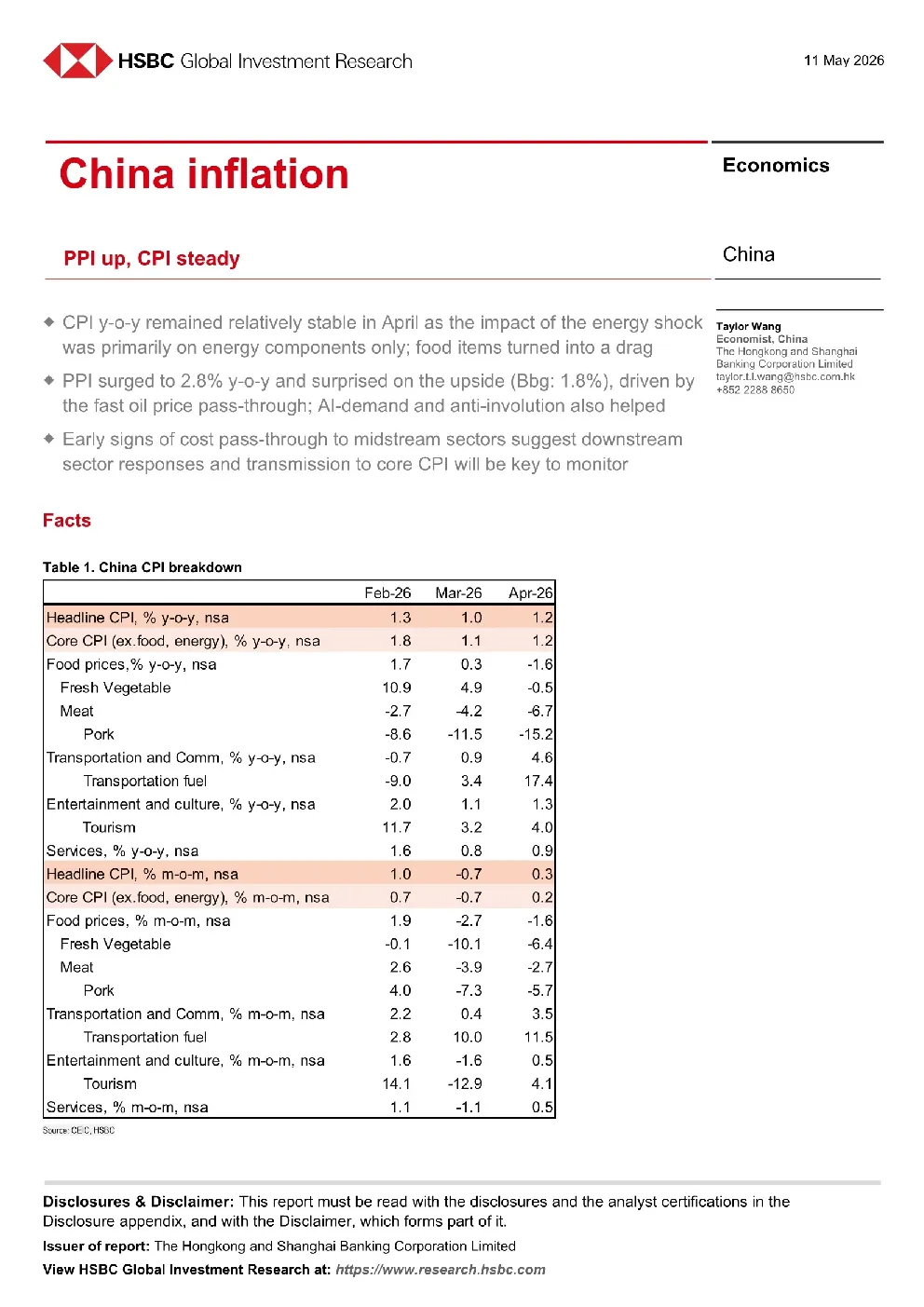
Economist,ChinThe Hongkong and ShanghaiBanking Corporation Limitedtaylor.t.i.wang@hsbc.com.hk+8522288 8650 + PPl surged to 2.8% y-0-y and surprised on the upside (Bbg: 1.8%), driven bythe fast oil price pass-through; Al-demand and anti-involution also helped sector responses and transmission to core CPl will bekey to monitor Facts Implications April's inflation data indicated that energy cost pass-through became more pronounced in industrial sectors, as evidenced by thedomestic oil-related upstream and midstream sectors was a key driver. Looking ahead, if energy prices remain elevated, we thinkmidstream firms will likely need to pass on more costs to buyers, even if this risks market share losses. On the consumer side, theneeded to gauge the full impact of the oil shock. In other words, it will be important to monitor for signs of PPI feeding into core CPI incoming months and quarters, which may prompt additional policy support for hard-hit groups. Headline CPl y-o-y showed a very mixed story in April, as energy components were primarily boosted by surging global oil priceswhile food items turned into a drag. In particular, vehicle fuel prices recorded the highest y-0-y increase since Oct 2022 (up 17.4% y-o-y). However, the NDRC's pricing regulations have already provided a much-needed buffer, as increases in domestic vehicle fuelonly averaged USD 64 per barrel in May 2025), energy is likely to remain a key contributor to CPI growth this month. For food items, while vegetables and fruit prices m-o-m appeared weaker than the seasonal trend due to warmer weather this year,between supply and demand has also drawn the attention of policymakers, particularly as the April Politburo meeting explicitly calledfor stabilising prices of live hogs (Xinhua, 28 April). The Ministry of Agriculture and Rural Affairs and the NDRC have recently pattern, and the y-o-y increase remained relatively stable. The impact of the energy shock appeared muted at this juncture. Insteaddespite slower y-o-y price growth, gold products (up 47%) still added 0.2ppts to headline CPI y-o-y inflation (NBS, 11 May). Excludingthat, some growth momentum is likely shifting from goods consumption towards services now. For one, the waning impact of trade-ins was stll reflected by household appliance prices, which only rose 2.6% y-o-y in April versus 4.8% in Q1. A modest uplift wasrecorded in culture and entertainment, with prices rising 1.3% y-o-y in April versus 1.0% in Q1, supported by ongoing policymeasures (including spring breaksfor primaryand secondary students)and fiscal supportannounced at the Two Sessions.Goingforward, policymakers have pledged to further unlock services consumption potential, while the NDRC's refined oil pricing regulationsshouldcontinuetopartiallymitigatecostpressuresacrosstransport-relatedsectors. For PPl, several key observations are worth highlighting. First, the most direct impact still came from oil-related upstream sectors(chart 1).Our estimates showedthat thecombined contribution of petroleum&natural gas extractions, coal mining,and petroleum&coal processing to PPl y-o-y growth increased by c1.1ppts compared with the previous month. Given these sectors' stronger linkageto global oil prices, a prolonged Middle East conflict is likely to keep their prices elevated. Second, some midstream sectors that usepetroleum asraw inputs also raised their output prices.In particular, chemical products &materials and chemical fibres saw positivey-o-y price growth for the first time since August and September 2024 (chart 2). We estimated that their combined contribution to PPl sectors, this may stll suggest a risk of profit margin compression. Third, downstream consumer-facing sectors have not yet seen amaterial impact, as price responses remained muted (Chart 4). As a result, pass-through to core CPl appeared contained at thisstage.Lookingahead,wecontinuetoexpectmidstreamanddownstreamplayerswill needtopassmorecostsontocustomersifenergy prices stay elevated for an extended period, given the significant hit to their profit margins. Lastly, excluding the oil impact,strong Al-driven demand, rising global copper prices, domestic electrification and anti-involution measures were also key drivers. Themostimpacted sectors were electrical machinery,computers and communications,and non-ferrous metals (mining and Disclosureappendix The following analyst(s), who is(are) primarily responsible for this document, certifies(y) that the opinion(s), views or forecasts expressed herein accurately reflect their personal view(s) and that no part of their compensation was, is or will be directly orindirectly related to the specific recommendation(s) or views contained in this research report: Taylor WangThis document has been prepared and is being distributed by the Research Department of HSBC and is intended solely for the This document does not provide individually tailored investment advice and should not be construed as an offer or th