塔吉克斯坦:2026-2030年国家抗菌素耐药性路线图和实施计划
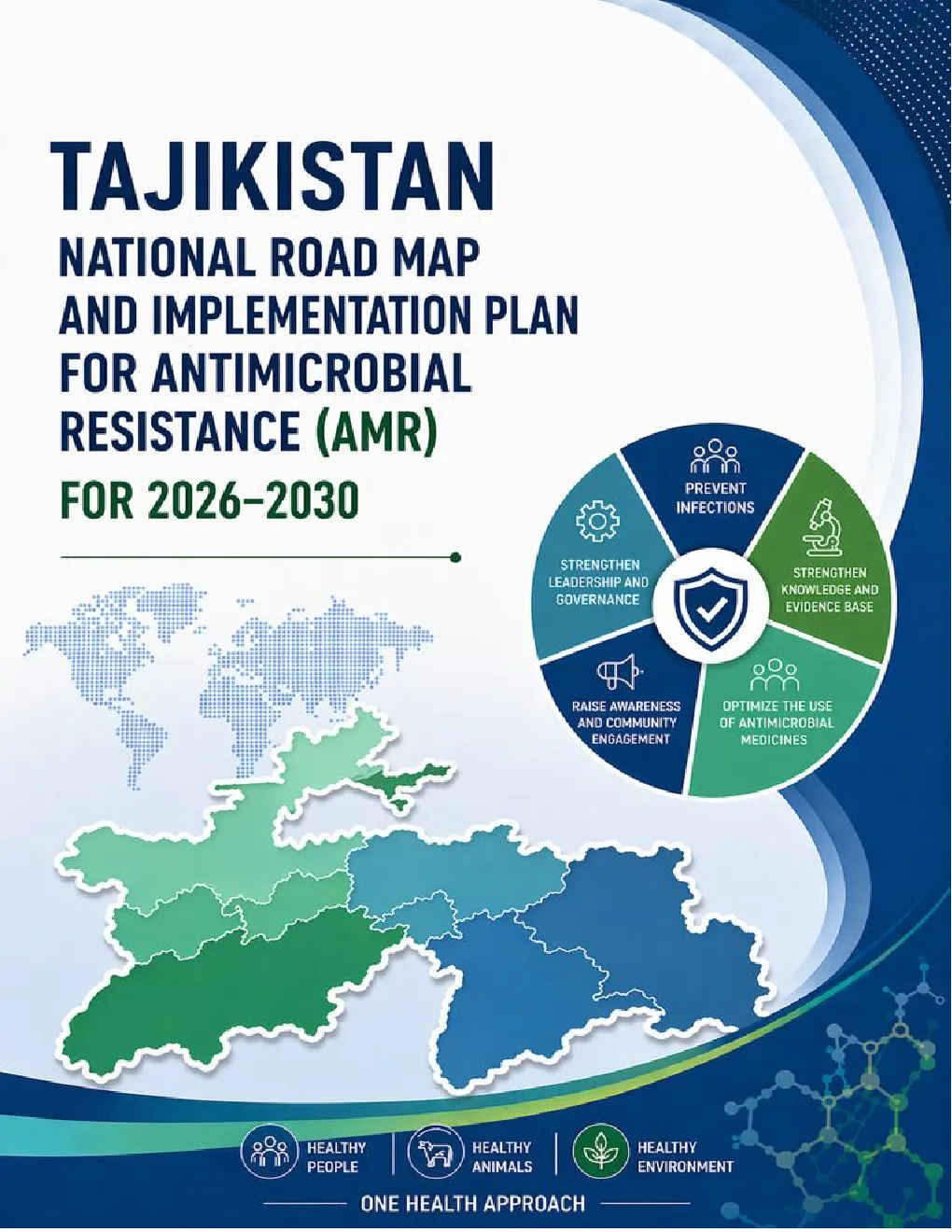
TAJIKISTAN NATIONAL ROAD MAP ANDIMPLEMENTATION PLAN FOR ANTIMICROBIALRESISTANCE (AMR)FOR 2026–2030 FOREWORD Tajikistan National Road Map and Implementation Plan on Antimicrobial Resistance (AMR), for2026–2030 has been developed in accordancewith the national legislative and regulatoryframework of the Republic of Tajikistan. Its primary legal foundation is rooted in the Health Codeof the Republic of Tajikistan, adopted on 18 May 2017, No. 374. In particular, Chapter 17, Article110, Paragraph 2 mandates the development and implementation of national, state and regionalprogrammes aimed at ensuring sanitary-epidemiological safety, strengthening population health,preventing diseases, and improving living and working conditions. This mandate provides thelegal basis for formulating and implementing national strategies and programmes, including thisTajikistan National Road Map and Implementation Plan on Antimicrobial Resistance (AMR), for2026–2030. Furthermore, the development of the Tajikistan National Road Map and Implementation Plan onAntimicrobialResistance(AMR),for 2026–2030 is grounded in additional sector-specificlegislation that reinforces the One Health approach. The Law of the Republic of Tajikistan “OnVeterinary” (adopted on 29 December 2010, No. 674) outlines the principles of veterinaryprotection, disease prevention and control, regulation of veterinary medicinal products, andbiosecurity measures—core elements for addressing antimicrobial resistance in the animal healthsector. The Law of the Republic of Tajikistan “On Environmental Protection” (adopted on 2 August2011, No. 760) provides the legal basis for environmental monitoring, safe management of wasteand chemicals, and prevention of environmental pollution. These provisions directly supportnational efforts to reduce the environmental dimensions of antimicrobial resistance, including thecontrol of antimicrobial residues and surveillance of resistant microorganisms in the environment. The Law of the Republic of Tajikistan “On Food Safety” (adopted on 1 August 2012, No. 890)establishes the legal framework for ensuring the safety of food products throughout the productionchain. It sets standards and control measures for the use of veterinary medicinal products in food-producing animals, monitoring and prevention of antimicrobial residues in food, and oversight bytheauthorized executive body—addressing a major pathway of antimicrobial resistancetransmission to humans. Aligned with theselaws, the Tajikistan National Road Map and Implementation Plan onAntimicrobial Resistance (AMR), for 2026–2030 also reflects the mandates and regulatory acts ofgovernment authorities central to the One Health framework, including: •Ministry of Agriculture of the Republic of Tajikistan, responsible for shaping andimplementing state agricultural policy, including livestock policy;•Ministry of Health and Social Protection of the Population of the Republic ofTajikistan, responsible for shaping and implementing national health policy, coordinatingpublic health programs, regulating the use of antimicrobial medicines in human healthcare,overseeing infection prevention and control, and leading surveillance of antimicrobialresistance in the human health sector; •Committee for Environmental Protectionunder the Government of the Republic ofTajikistan, responsible for environmental monitoring, waste management, and mitigationof environmental risks associated with antimicrobial resistance;•Committee for Food Security under the Government of the Republic of Tajikistan,theauthorized executive body for food safety and veterinary oversight,includingveterinary sanitary supervision, registration and control of veterinary medicinal products,border veterinary inspection, prevention of antimicrobial residues in food products, andproviding sectoral coordination of veterinary services at the policy level. Together, these legislative and regulatory instruments form a comprehensive national frameworkfor the development, implementation and monitoring of antimicrobial resistance-related activitiesin Tajikistan, consistent with the One Health approach. This Tajikistan National Road Map and Implementation Plan on Antimicrobial Resistance (AMR),for 2026–2030 was developed by national experts from the Ministry of Health and SocialProtection of the Population Republic of Tajikistan, the Ministry of Agriculture of the Republic ofTajikistan, the Committee for Food Security under the Government of the Republic of Tajikistan,and the Committee for Environmental Protection under the Government of the Republic ofTajikistan, under the technical leadership of Dr. Arash Alaei, Director of the Center for GlobalHealth at California State University–Long Beach, and under the guidance of the NationalMultisectoral Working Group on AMR. The National Multisectoral Working Group expresses its sincere appreciation to the World Bank,Asian Development Bank and the World Health Organization for their review and va