您的浏览器禁用了JavaScript(一种计算机语言,用以实现您与网页的交互),请解除该禁用,或者联系我们。 [ACT]:11年级英语学习者的课程模式:来自一个国家的证据 - 发现报告

11年级英语学习者的课程模式:来自一个国家的证据

文化传媒 2026-05-06 ACT 张博卿
报告封面

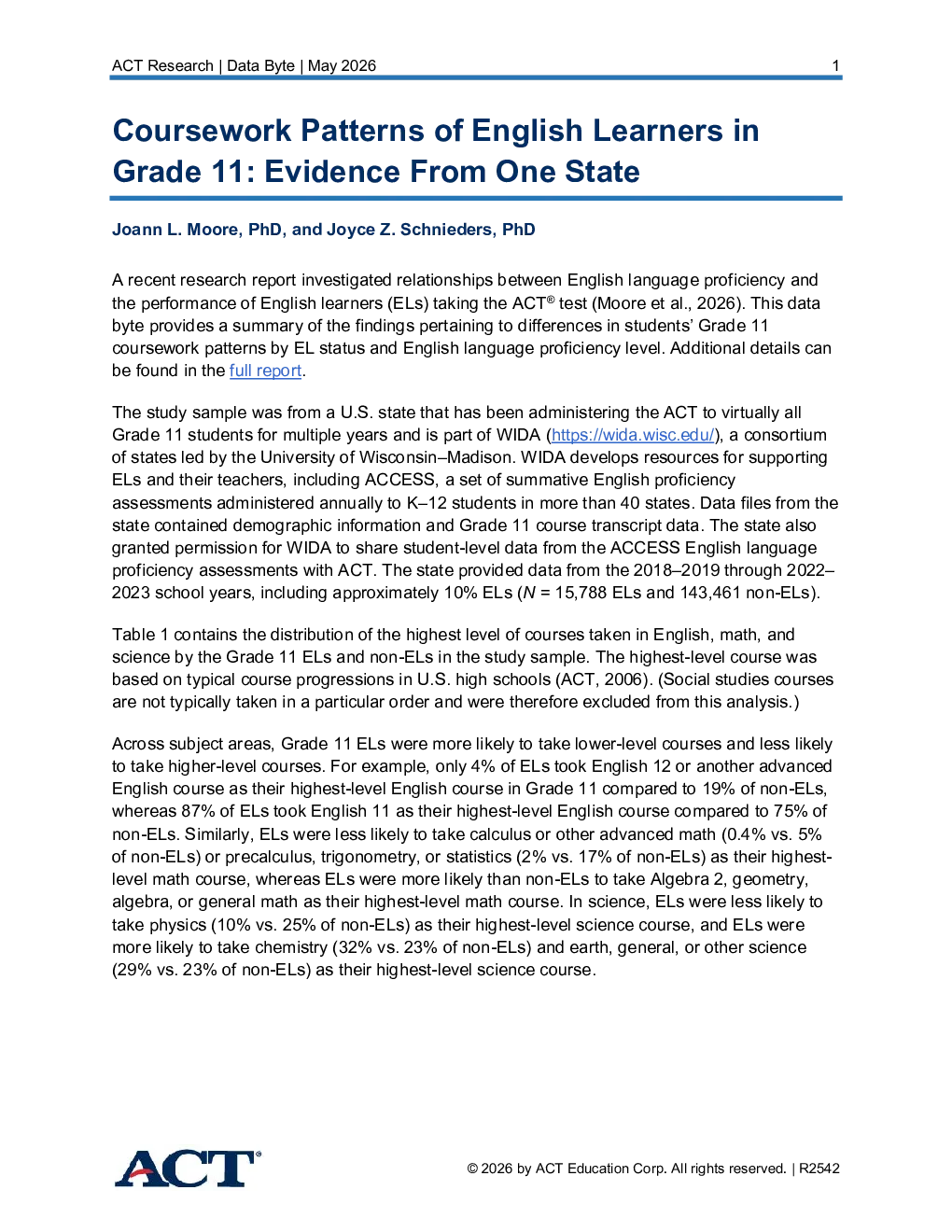
Joann L. Moore, PhD,and Joyce Z. Schnieders, PhD A recent research report investigated relationships between Englishlanguageproficiency andtheperformance of English learners (ELs) taking the ACT®test (Mooreet al.,2026). This databyte provides a summary of the findings pertaining todifferences instudents’Grade 11courseworkpatternsby EL status and Englishlanguageproficiency level. Additional details canbe found in thefull report. The study samplewasfrom aU.S.state that hasbeen administering the ACT to virtually allGrade 11 studentsfor multiple yearsandispart ofWIDA (https://wida.wisc.edu/),a consortiumof states led by the University of Wisconsin–Madison.WIDA develops resources for supportingELs and their teachers, includingACCESS, asetof summative English proficiencyassessments administered annually to K–12 students inmore than 40states.Datafilesfrom thestatecontaineddemographic informationandGrade 11 course transcript data.The state alsogranted permission for WIDA to share student-leveldata from theACCESSEnglish languageproficiency assessmentswith ACT.The state provided data from the 2018–2019 through 2022–2023 school years, including approximately 10% ELs (N=15,788 ELs and 143,461 non-ELs). Table1contains the distribution of the highest level of courses taken in English, math, andsciencebytheGrade 11ELs and non-ELs in the study sample.The highest-levelcourse wasbased on typical course progressions in U.S.high schools (ACT, 2006).(Social studies coursesare nottypicallytaken in a particular order and were therefore excluded from this analysis.) Across subject areas,Grade 11ELs were more likely to take lower-level courses and less likelyto take higher-level courses. For example,only 4% ofELs took English 12 or another advancedEnglish courseas their highest-levelEnglish courseinGrade 11 compared to19% ofnon-ELs,whereas87% of ELs took English 11 as their highest-level English course compared to75% ofnon-ELs. Similarly, ELs werelesslikely to take calculus or other advanced math (0.4% vs.5%ofnon-ELs) or precalculus, trigonometry, or statistics (2% vs.17% ofnon-ELs)as their highest-level math course, whereas ELs were more likely than non-ELs to takeAlgebra 2, geometry,algebra, or general mathas their highest-level math course. In science, ELs werelesslikely totake physics (10% vs.25% ofnon-ELs)as their highest-level science course,and ELs weremore likely to takechemistry (32% vs. 23% of non-ELs) andearth, general, or other science(29% vs. 23% of non-ELs)as their highest-level science course. Note.Studentswho did not take a course in a given subject area orwith missing data for thisvariable were excluded from thesecalculations(11%and14%in English, 8%and9% in math,and 13%and16% in sciencefor ELs and non-ELs, respectively). Table2contains the distribution of themost rigorous courseacross subject areas for coursestaken inGrade 11bytheELs and non-ELs in the study sample.Course rigor was based on avariable provided by the state and defined as themost rigorouscourse taken by the studentduringGrade 11. For example,students whotook one or more collegeordual enrollmentcourseswere classified as “college/dualenrollment,”and students whosecourses were generaleducation or below were classified as “general.”ELs were less likely to take college or dualenrollment courses (2% vs. 10%non-ELs) or advanced or honors courses (34% vs. 51%non-ELs)astheir most rigorouscourseand more likely to take general education courses (61% vs.37%non-ELs). Table3contains the distribution of the highest level of courses taken in English, math, and science by ACCESS Reading level. Asimilar pattern emerged thatGrade 11ELswith higher levels ofEnglishreading proficiency were more likely to take higher-levelcourses such as English 12,other advanced English,calculus,other advanced math, precalculus, trigonometry, statistics,Algebra 2,orphysicsas their highest-level courses.Conversely, students with lower levels of reading proficiency were more likely to take lower-level courses such asthosebelow English 11;algebra or lower math;general or other math;biology;or earth, general, or otherscienceas their highest-level courses. Table4contains the distribution of themost rigorous courseacross subject areas for coursestaken inGrade 11 by ACCESS Reading level.ELswith higher levels of reading proficiency weremore likely to take college or dual enrollment coursesandadvanced or honors courses and lesslikely to take general education coursesas theirmostrigorouscourse thanELswith lower levelsof reading proficiency. The results of this study indicate that, compared to their non-EL peers,ELs were less likely totake higher-level courses—defined as courses further along in the sequence of high schoolcourses in a given subject area orascollege-level, dual-enrollment, advanced,or honorscourses. Thisfindingis consistent with the findings of a previous study of ACT-tested ELs thatrelied on self-reported data (Moore, 2021).Among ELs,astheir English reading level increases,