您的浏览器禁用了JavaScript(一种计算机语言,用以实现您与网页的交互),请解除该禁用,或者联系我们。 [HID Global]:成功发行大容量分布式卡的关键因素 - 发现报告

成功发行大容量分布式卡的关键因素

信息技术 2026-04-27 HID Global yuAner
报告封面

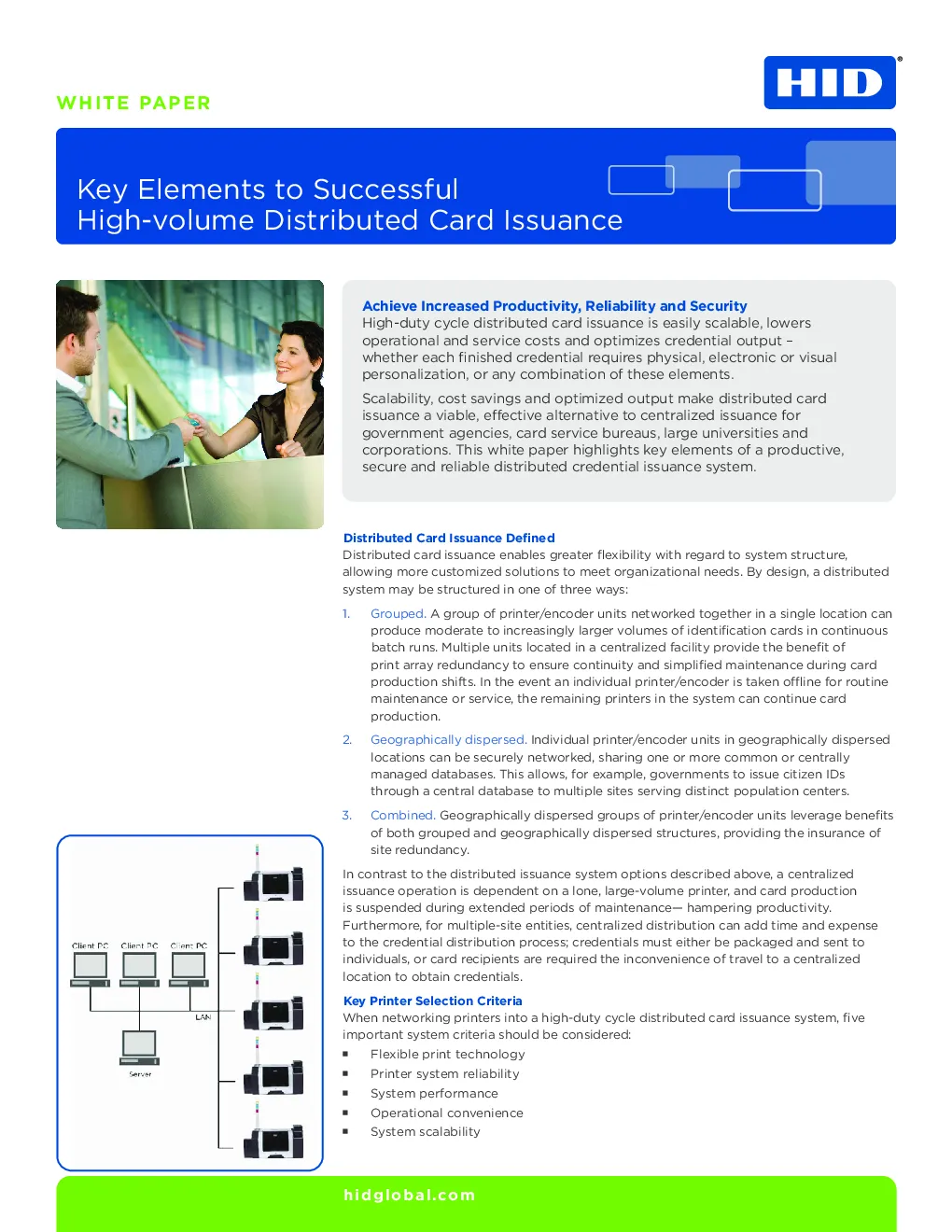
Key Elements to SuccessfulHigh-volume Distributed Card Issuance Achieve Increased Productivity, Reliability and SecurityHigh-duty cycle distributed card issuance is easily scalable, lowers operational and service costs and optimizes credential output –whether each finished credential requires physical, electronic or visualpersonalization, or any combination of these elements. Scalability, cost savings and optimized output make distributed cardissuance a viable, effective alternative to centralized issuance forgovernment agencies, card service bureaus, large universities andcorporations. This white paper highlights key elements of a productive,secure and reliable distributed credential issuance system. Distributed Card Issuance Defined Distributed card issuance enables greater flexibility with regard to system structure,allowing more customized solutions to meet organizational needs. By design, a distributedsystem may be structured in one of three ways: 1.Grouped.A group of printer/encoder units networked together in a single location canproduce moderate to increasingly larger volumes of identification cards in continuousbatch runs. Multiple units located in a centralized facility provide the benefit ofprint array redundancy to ensure continuity and simplified maintenance during cardproduction shifts. In the event an individual printer/encoder is taken offline for routinemaintenance or service, the remaining printers in the system can continue cardproduction. 2.Geographically dispersed.Individual printer/encoder units in geographically dispersedlocations can be securely networked, sharing one or more common or centrallymanaged databases. This allows, for example, governments to issue citizen IDsthrough a central database to multiple sites serving distinct population centers. 3.Combined.Geographically dispersed groups of printer/encoder units leverage benefitsof both grouped and geographically dispersed structures, providing the insurance ofsite redundancy. In contrast to the distributed issuance system options described above, a centralizedissuance operation is dependent on a lone, large-volume printer, and card productionis suspended during extended periods of maintenance— hampering productivity.Furthermore, for multiple-site entities, centralized distribution can add time and expenseto the credential distribution process; credentials must either be packaged and sent toindividuals, or card recipients are required the inconvenience of travel to a centralizedlocation to obtain credentials. Key Printer Selection Criteria When networking printers into a high-duty cycle distributed card issuance system, fiveimportant system criteria should be considered: ƒFlexible print technologyƒPrinter system reliabilityƒSystem performanceƒOperational convenienceƒSystem scalability hidglobal.com WHITE PAPER Flexible Print Technology When building a high-duty cycle distributed card issuance system, it is important to specifyprinters that seamlessly integrate all relevant printing and encoding elements for thefinished credentials. This will ensure maximum productivity, reliability and security. A broad spectrum of identification card materials and electronic components are in usetoday. Composite card materials are often used to lengthen card life—including PVC, PET,PETG, ABS, and PC. New configurations are always on the horizon. Organizations shouldconsider both current needs and future expectations for ID card composition. Accordingly,the selected printers should accommodate potential variations in card composition,material or thickness. Organizations must also consider the embedded electronic elements of the ID card –contact and contactless smart chips or combination technologies – to ensure encodingrequirements are met. When it comes to print technology, retransfer or high definition printing (HDP®), offersdistinct advantages over traditional direct-to-card printing. With HDP, a dye image isreverse-printed onto the underside of an adhesive film. The film is then transferred to thecard surface, adding a durable layer of protection to the card and its components. TheHDP process, wherein the printhead avoids direct contact with the card surface and anyembedded electronics, is preferred for personalizing technology cards and mitigates therisk of damage within the card as well as the printer’s printhead. In addition, retransfer filmconforms to ridges and indentations in the card surface, making it compatible with a widerarray of card materials and thicknesses. Printer System Reliability Most card printers are not deployed into contaminant-free, climate-controlledenvironments. High-duty cycle printing systems are generally at high risk for exposure tocontaminants, pollutants and debris. These conditions can reduce the quality of finishedcards, resulting in lower yields from batch card printing operations, and can causepremature wear on printer systems. In fact, internal printer environments are subject to hig