“印度制造”如何加强印度制造业
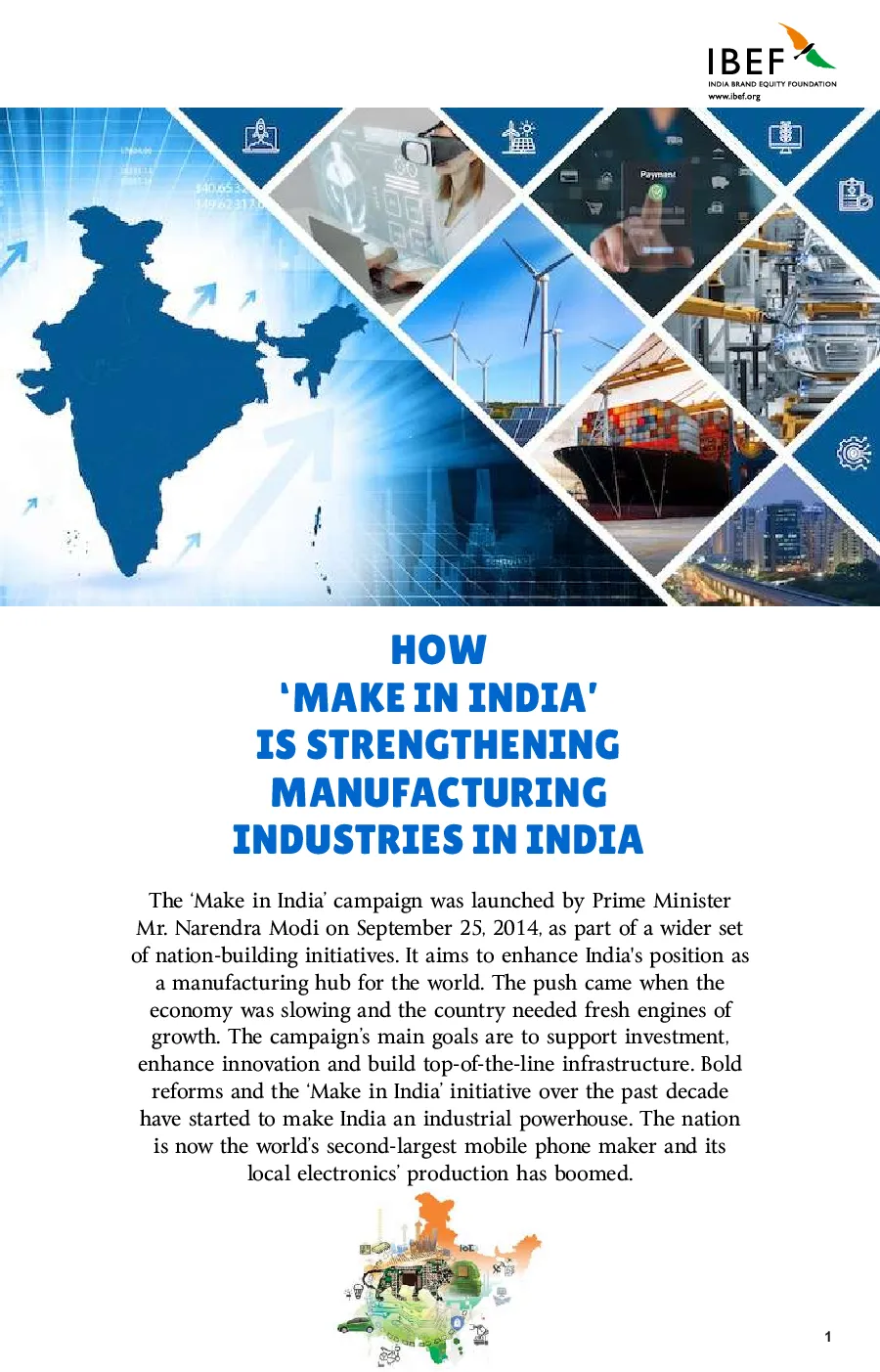
The ‘Make in India’ campaign was launched by Prime MinisterMr. Narendra Modi on September 25, 2014, as part of a wider setof nation-building initiatives. It aims to enhance India's position asa manufacturing hub for the world. The push came when theeconomy was slowing and the country needed fresh engines ofgrowth. The campaign’s main goals are to support investment,enhance innovation and build top-of-the-line infrastructure. Boldreforms and the ‘Make in India’ initiative over the past decadehave started to make India an industrial powerhouse. The nationis now the world’s second-largest mobile phone maker and itslocal electronics’ production has boomed. •New mindset:Positioning the Indiangovernmentas a partner rather than aregulator.Enabling public agencies toworkmore closely with industry andembracing “Vocal for Local”. Also, pursuingzerotolerance for corruption,to buildinvestor confidence. Cutting bureaucraticred tape, and enabling policymakers toactively woo investors through roadshowsand single-window clearance systems. ‘Makein India’is built on four pillarsaimedat improving competitiveness.These are: •N e wp r o c e s s e s :S t r e a m l i n i n gregulationsand enhancing the ease ofdoingbusiness.This involves digitisingapprovals, reducing compliance burdensa n ds i m p l i f y i n g p r o c e d u r e s f o renterprises. •N e wi n f r a s t r u c t u r e :Bu i ld i n gindustrialcorridors,smart cities andmoderntransport networks to providefactorieswith state-of-the-art facilities.Upgrading rail, road, ports, airports andc o m m u n i c a t i o nne t w o r k s u n d e rprogrammessuch as PM GatiShakti toplug logistical gaps. These reforms have yielded early wins.FDI inflow into manufacturing increased:duringFY14-FY25,India received Rs.16,62,036crore(US$184.2 billion)ofmanufacturingFDI.Electronic hubs inPune(Maharashtra)and Bengaluru(Karnataka) and smartphone factories inChennai (Tamil Nadu) and Noida (UttarPradesh) were among the new factoriest h a ts p r u n g u p a c r o s s s t a t e s .Complementary policies have also beenintroducedby the government:theNational Logistics Policy (2022) to reducethe cost of logistics and improve globalrankingsand Startup India(2016)toestablishthe third-largest startupecosystemin the world,which hasgenerated more than 17.69 lakh jobs byJanuary 2025. By the 10th anniversary, theMake in India campaign had established •Newsectors:Opening previouslyrestrictedareas to foreign investment.Liberalisingforeign direct investment(FDI)rules in sectors such as defence,insurance, railways and medical devices,and inviting global companies to set upfactories.Introducing special incentives(suchas Production-Linked Incentives[PLI]) in 14 key sectors, from electronics topharmaceuticals to telecom to textiles, tospur large-scale investment. the manufacturing potential of India inthe world map. In 2021, the programmewasexpanded into Make in India 2.0,which includes 27 sectors and introduces a new focus on advanced technologies,further developing the initial agenda andbecominga new impulse towards self-reliance. Manufacturingis a critical pillar ofIndia’seconomy and development.Itcreateshigh-value jobs,boosts exportsandsupports innovation and skill-building.As NITI Aayog notes,thestrengthof India’s growth story is“inextricably linked” to the sophisticationof its factory sector. Globally, economiesthatexpanded manufacturing enjoyedfaster GDP growth: for example, manyE a s tA s i a n c o u n t r i e s r e a c h e dmanufacturing shares of GDP above 25-30%during their growth phases.Bycontrast, manufacturing in India todayaccounts for about 15-17% of GDP. Thisshare is roughly comparable to recentlevels (about 17.5% of gross value added(GVA) in 2023-24) but still below nationaltargets (25% of GDP by 2025). thepast decade.In constant prices,manufacturingvalue added increasedfromnearly Rs.15.6 lakh crore(US$172.89 billion) in 2013-14 to about Rs.28.25 lakh crore (US$ 313.90 billion) in2023-24. Merchandise exports have alsoaccelerated:in April-August 2025,mer c h a nd i s ee x p or t s to t a l le d R s .16,61,404 crore (US$ 184.13 billion), withmanufacturing(in electronics,autocomponentsand textiles in particular)leadingthe way.The“manufacturingengine” of India is gradually getting back:estimatesshow that the sector mayachievean annual output of~Rs.87.6lakh crore (~US$ 1 trillion) by FY26. Iftrue,it could add approximately Rs.45,11,500crore(US$500 billion)perannum to the world economy by 2030,emphasisingIndia’s prospects as aleading world producer. Yetwhile this gap has widened,thefootprintof manufacturing has beeng r ow i n g .P r o d u c t io n h a s r ou g h l ydoubled in both output and value over Manufacturing’sevolution also bringsbroaderbenefits.It provides formal- sectoremployment for millions:forexample,the textiles and apparelindustrydirectly employs over 45m i l l i o np e o p l e( s e c o n d o n l y t oagriculture).Expanding manufacturingthus means more higher-skilled jobs th