宁德时代2026技术日 - 1500公里电池与6分钟充电:我们还需要内燃机吗?
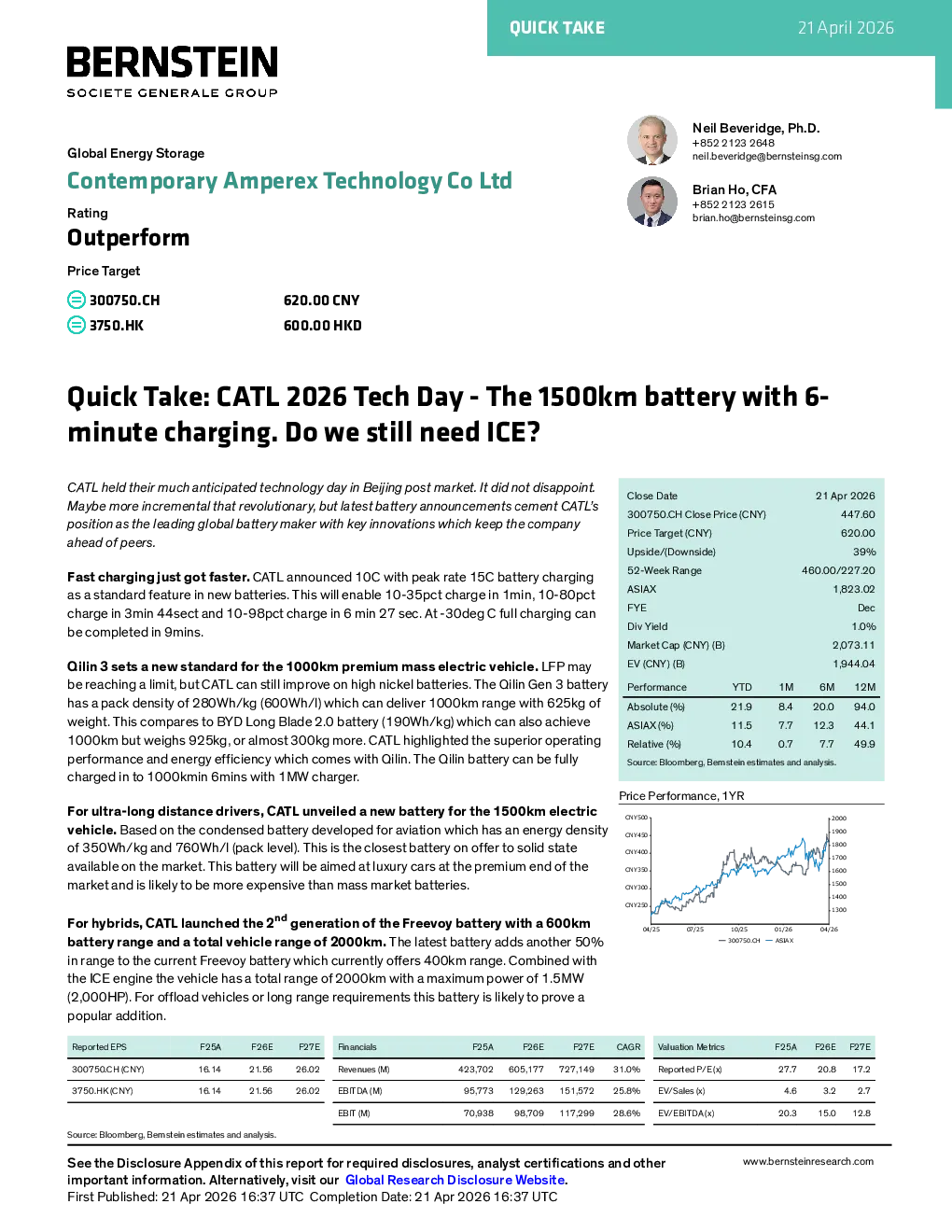
Contemporary Amperex Technology Co Ltd Brian Ho, CFA+852 2123 2615brian.ho@bernsteinsg.com Outperform Price Target Quick Take: CATL 2026 Tech Day - The 1500km battery with 6-minute charging. Do we still need ICE? CATL held their much anticipated technology day in Beijing post market. It did not disappoint.Maybe more incremental that revolutionary, but latest battery announcements cement CATL’sposition as the leading global battery maker with key innovations which keep the companyahead of peers. Fast charging just got faster.CATL announced 10C with peak rate 15C battery chargingas a standard feature in new batteries. This will enable 10-35pct charge in 1min, 10-80pctcharge in 3min 44sect and 10-98pct charge in 6 min 27 sec. At -30deg C full charging canbe completed in 9mins. Qilin 3 sets a new standard for the 1000km premium mass electric vehicle.LFP maybe reaching a limit, but CATL can still improve on high nickel batteries. The Qilin Gen 3 batteryhas a pack density of 280Wh/kg (600Wh/l) which can deliver 1000km range with 625kg ofweight. This compares to BYD Long Blade 2.0 battery (190Wh/kg) which can also achieve1000km but weighs 925kg, or almost 300kg more. CATL highlighted the superior operatingperformance and energy efficiency which comes with Qilin. The Qilin battery can be fullycharged in to 1000kmin 6mins with 1MW charger. For ultra-long distance drivers, CATL unveiled a new battery for the 1500km electricvehicle.Based on the condensed battery developed for aviation which has an energy densityof 350Wh/kg and 760Wh/l (pack level). This is the closest battery on offer to solid stateavailable on the market. This battery will be aimed at luxury cars at the premium end of themarket and is likely to be more expensive than mass market batteries. For hybrids, CATL launched the 2ndgeneration of the Freevoy battery with a 600kmbattery range and a total vehicle range of 2000km.The latest battery adds another 50%in range to the current Freevoy battery which currently offers 400km range. Combined withthe ICE engine the vehicle has a total range of 2000km with a maximum power of 1.5MW(2,000HP). For offload vehicles or long range requirements this battery is likely to prove apopular addition. Sodium ion batteries are about to start mass production. With lithium price rising again,now is the perfect time to commercialize sodium ion. While costs today are still higher thanLFP, the expectation is that they will be 30-50% cheaper in the long run and could potentiallydis-intermediate LFP in ESS. CATL have already developed 50GWh of capacity (c.5% of totalcapacity) and will scale up in 2H26. Battery swapping stations have a dual use as ESS stations and could turn CATL intoa Power Co.For consumers who want cheaper EV’s battery swapping is one way to achievethis. CATL have built a network of over 1400 stations across 190 cities, with 25 modelsoffering battery swapping on the CATL platform. Consumers will have the ability to chargebatteries at night and swap them out for partially charged batteries during the day to earnRMB40/day which could turn swapping stations into mini ESS stations. CATL held their much anticipated technology day in Beijing post market. It did not disappoint. Maybe more incremental thatrevolutionary, but latest battery announcements cement CATL’s position as the leading global battery maker with key innovationswhich keep the company ahead of peers. This notes highlights the key technology announcements from the battery day, 1. 3RD-GENERATION SHENXING FAST CHARGING BATTERY (15C PEAK RATE) •The third-generation Shenxing battery delivers equivalent 10C charging with a peak rate of 15C, further strengthening CATL’sleadership in ultra-fast charging. It can charge from 10% to 35% in just one minute, 10% to 80% in less than four minutes, and10% to 98% in around 6.5 minutes, while still retaining 90% battery capacity after more than 1,000 charging cycles. •Even under -30°C conditions, it can charge from 20% to 98% in less than 10 minutes, which meaningfully expands itsapplication range, particularly in cold-weather markets. For comparison, BYD requires around 10 minutes to charge from 10%to 70%. •From a technical perspective, this improvement appears to come mainly from physical and structural optimization, includinglower internal resistance, reduced interfacial reaction impedance, SEI gene-directed editing technology, and layered graphitetechnology, rather than from a major breakthrough in new materials. 2. 3RD-GENERATION QILIN BATTERY AND 1000KM RANGE •The third-generation Qilin battery is clearly targeted at the premium EV segment and also supports fast charging. It offers 280Wh/kg gravimetric energy density and 600 Wh/L volumetric energy density, with a driving range of around 1,000 km. •A 125 kWh battery pack weighs only 625 kg (255kg lower than peers), which is lighter than comparable industry solutions andshould translate into better handling and efficiency. •From a physical-design