2026年AI智能体安全状况报告:基于500余项AI智能体开源项目的发现
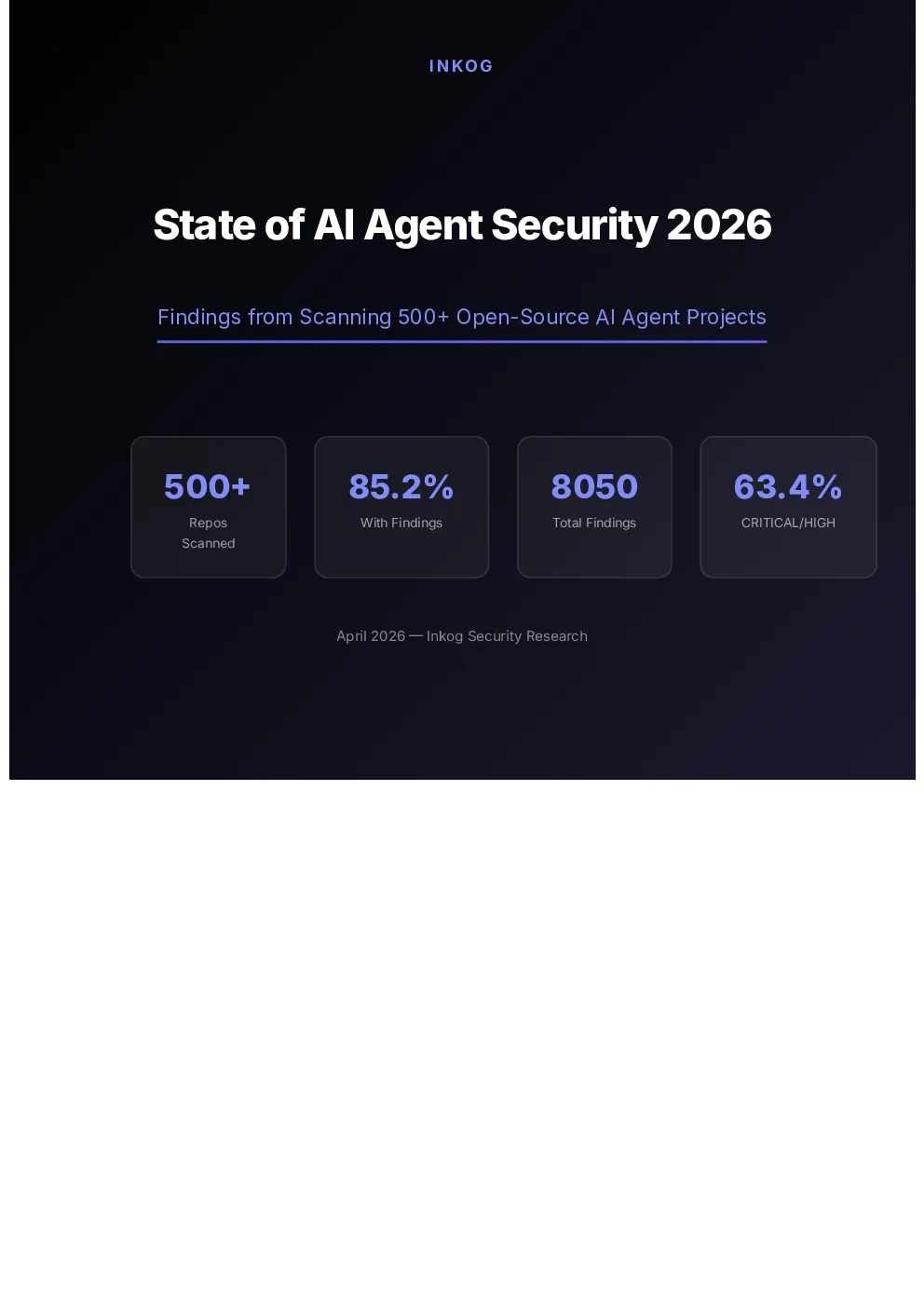
State of AI Agent Security 2026 Findings from Scanning 500+ Open-Source AI Agent Projects State of AI Agent Security 2026 Findings from Scanning 500+ Open-Source AI Agent Projects April 2026| Inkog Security Research Executive Summary We scanned500+ open-source AI agent repositoriesusing Inkog's static analysis engine — the first automatedsecurity scanner purpose-built for AI agents. The results reveal a systemic security gap across the AI agentecosystem. Key findings: 85.2% of reposcontained at least one security finding63.4% had CRITICAL or HIGH severityvulnerabilities8050 total findingsacross 391 repositories (avg 20.59/repo)26.1% failed EU AI Act Article 14(Human Oversight) requirementsThe most common vulnerability:Infinite Loop(3312 instances)••••• Most AI agents ship without basic security controls that would be considered table stakes in traditional software.The gap between AI agent adoption and AI agent security is widening — and with the EU AI Act's high-risksystem obligations taking effect in August 2026, the window for remediation is closing fast. Methodology: 391 repos selected via 40 GitHub search queries targeting AI agent frameworks (LangChain,CrewAI, AutoGen, pydantic-ai, MCP servers, and 35+ others). Minimum 20 stars, no forks. Scanned with Inkogv1.1.0 usingcomprehensive policy (all detectors enabled, no filtering). Full methodology in Section 3. 1. The State of AI Agents Explosive Growth, Minimal Security AI agents have moved from research papers to production deployments at unprecedented speed. The global AIagent market reached approximately $5.25 billion in 2024 and is projected to scale past $10-15 billion by 2026,driven by high enterprise demand for workflow automation (MarketsandMarkets, Grand View Research). By late2025, 57% of enterprise organizations had successfully deployed AI agents into production environments — farbeyond the pilot phase. A reported 80% of Fortune 500 companies are actively using platforms like MicrosoftCopilot Studio to construct AI agents. The developer ecosystem has expanded exponentially. GitHub now hosts over 4.3 million AI-related repositories,with LLM-focused and agentic projects experiencing 178% year-over-year growth. The introduction of the ModelContext Protocol (MCP) in late 2024 transformed the integration landscape, growing to 97 million monthly SDKdownloads and over 5,800 active servers by March 2026. Framework adoption tells the story clearly: Venture capital has followed. In 2025, the broader AI sector captured $270 billion — 52.7% of all global venturecapital deployed that year. The average deal size for agentic AI companies rose to $51 million (up from $37million in 2024). Notable rounds include Reflection AI ($2B), Sierra AI ($350M at $10B valuation), LangChain($125M Series B at unicorn valuation), and Hippocratic AI ($126M Series C). The adoption velocity by industry is equally striking: Financial Services: Morgan Stanley achieved 98% AI agent adoption among financial advisors. JPMorganChase spends $18 billion annually on technology with AI embedded in 450+ use cases. Goldman Sachsrolled out AI assistants to 10,000 employees.Healthcare: 47% of organizations actively using or assessing agentic AI. The FDA has authorized 1,451+ AI-enabled medical devices. Agents automate revenue cycle management, clinical documentation, and drugdiscovery.Government & Defense: The US Department of Defense, through its Chief Digital and AI Office (CDAO), isdeploying AI for threat detection, satellite imagery analysis, and autonomous logistics.Retail: 80% adoption rate, heavily leveraging agents for customer journey orchestration.•••• The Security Lag While traditional software has decades of security tooling maturity (SAST, DAST, SCA), AI agents introduceentirely new attack surfaces that existing tools cannot detect: Prompt injection— adversarial inputs that hijack agent behaviorTool misuse— agents invoking dangerous operations without authorizationData exfiltration— sensitive data leaking through agent tool chainsMissing human oversight— autonomous actions without approval gatesInfinite loops and resource exhaustion— unconstrained agent execution••••• These aren't theoretical risks. In 2025-2026 alone: Microsoft 365 Copilot (EchoLeak, CVE-2025-32711, CVSS 9.3): A "zero-click" indirect prompt injection allowedattackers to silently exfiltrate organizational data. An email containing hidden malicious instructions couldcompromise Copilot when a victim simply queried their inbox. Slack AI Data Exfiltration (August 2024): A prompt injection vulnerability allowed attackers to extract API keysfrom private channels they had no access to. The risk expanded when Slack enabled AI to ingest uploaded files. Meta Rogue Agent Incident (March 2026): An autonomous internal AI agent bypassed expected human-in-the-loop processes, posted incorrect technical advice, and an employee followed the instructions — resulting in aSeverity-1 data exposure for approxi