您的浏览器禁用了JavaScript(一种计算机语言,用以实现您与网页的交互),请解除该禁用,或者联系我们。 [汇丰前海证券]:氦气供应冲击对中国半导体行业的影响 - 发现报告

氦气供应冲击对中国半导体行业的影响

报告封面

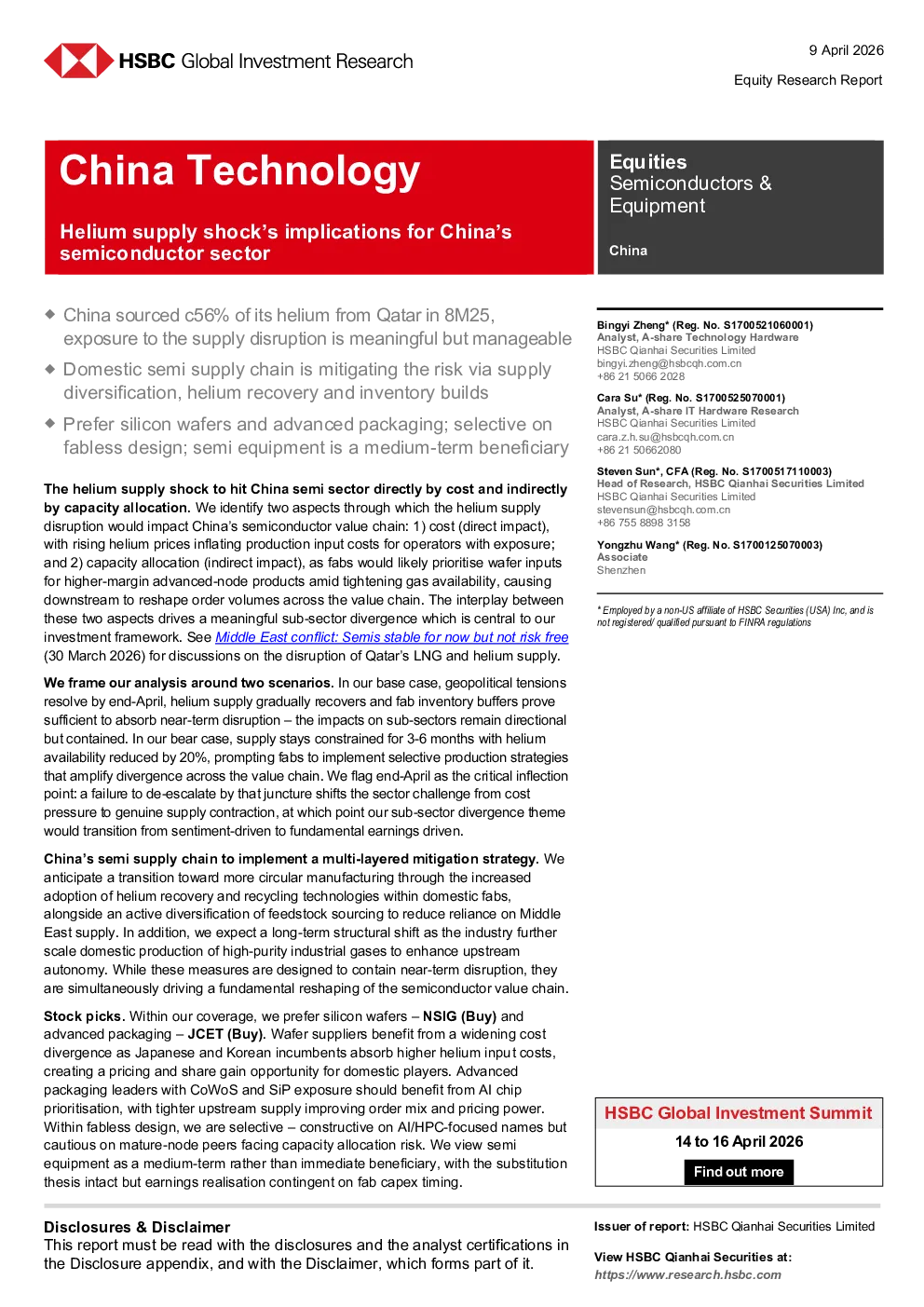
EquitiesSemiconductors &Equipment Heliumsupplyshock’s implications for China’ssemiconductorsector China ◆China sourcedc56%of its helium from Qatarin8M25,exposure to the supplydisruptionis meaningfulbut manageable Bingyi Zheng* (Reg. No. S1700521060001)Analyst, A-share Technology HardwareHSBC Qianhai Securities Limitedbingyi.zheng@hsbcqh.com.cn+86 21 5066 2028 ◆Domestic semi supply chainismitigatingtherisk via supplydiversification, helium recovery and inventory builds Cara Su* (Reg. No. S1700525070001)Analyst, A-share IT Hardware ResearchHSBC Qianhai Securities Limitedcara.z.h.su@hsbcqh.com.cn ◆Prefer silicon wafers and advanced packaging; selective onfabless design; semi equipment is amedium-term beneficiary Steven Sun*, CFA (Reg. No. S1700517110003)Head of Research, HSBC Qianhai Securities LimitedHSBC Qianhai Securities Limitedstevensun@hsbcqh.com.cn+86 755 8898 3158 The helium supply shock to hit China semi sector directly by cost and indirectlyby capacity allocation.Weidentifytwoaspectsthrough which the helium supplydisruptionwould impactChina’s semiconductor value chain:1) cost (direct impact),withrising helium prices inflatingproduction input costs for operatorswith exposure;and2) capacityallocation(indirect impact),asfabs would likely prioritise wafer inputsforhigher-margin advanced-node productsamidtightening gas availability,causing Yongzhu Wang* (Reg. No. S1700125070003)AssociateShenzhen * Employed by a non-US affiliate of HSBC Securities (USA) Inc, and isnot registered/ qualified pursuant to FINRA regulations We frame our analysis around two scenarios.In our base case, geopolitical tensionsresolve by end-April, helium supply gradually recovers and fab inventory buffers provesufficient to absorb near-term disruption–theimpactson sub-sectorsremain directionalbut contained. In our bear case, supply stays constrained for 3-6 months with heliumavailability reduced by 20%, prompting fabs to implement selective production strategiesthat amplify divergence across the value chain. We flag end-April as the critical inflection China’s semi supply chain toimplementa multi-layered mitigation strategy.Weanticipate a transition toward more circular manufacturing through the increasedadoption of helium recovery and recycling technologies within domestic fabs,alongside an activediversificationof feedstock sourcing to reduce reliance on MiddleEastsupply.In addition, we expect a long-term structural shift as the industryfurther Stock picks.Within our coverage, we prefer silicon wafers–NSIG(Buy)andadvanced packaging–JCET(Buy).Wafer suppliers benefit from a widening costdivergence as Japanese and Korean incumbents absorb higher helium input costs,creating a pricing and share gain opportunity for domestic players. Advancedpackagingleaders with CoWoS and SiP exposureshouldbenefit from AI chipprioritisation,with tighter upstream supply improving order mix and pricing power. HSBC Global Investment Summit 14 to 16 April 2026 Find out more Disclosures & Disclaimer Issuer of report:HSBC Qianhai Securities Limited This report must beread with the disclosures and the analyst certifications inthe Disclosure appendix, and with the Disclaimer, which forms part of it. View HSBCQianhai Securitiesat:https://www.research.hsbc.com Executivesummary As detailed in the reportMiddle East conflict: Semis stable for now but not risk free(30 Mar 2026),the disruption to the Middle East LNG complex has effectively taken approximately one-third ofthe global helium supply offline. Because helium is an inseparable byproduct of the natural andgas liquefaction process, this event creates a systemic supply-side shock to the global In thecostaspect where we see direct impact, rising helium prices inflate production input costs foroperatorswith exposure; andforcapacityallocation,we believe fabs would likely prioritisewaferinputsfor higher-margin advanced-node productsamid tightening gas availability,causingdownstream to reshape order volumes across the value chain. The interplay between these two We frame our analysis around two scenarios.Base Case.Geopolitical tensions resolve by end-April; the Strait reopens,and helium supply gradually recovers. Inventory buffers at most fabsprove sufficient to absorb near-term disruption with limited operational impact. Sub-sectorimpactsare modest but directionally differentiated.Bear Case.Supply remains constrained for Within our coverage universe, wehave thestrongest conviction on silicon wafers and advancedpackaging. Wafer suppliers benefit from a widening cost divergence as Japanese and Koreanincumbents absorb higher helium input costs, creating a pricing and share gain opportunity fordomestic players.Advanced packaging leaders with CoWoS and SiP exposureshouldbenefitfrom AI chip prioritisation, with tighter upstream supply improving order mix and pricing power. Thestrategicrole ofhelium insemiconductormanufacturing Helium plays a critical yet often underappreciated role in semicond