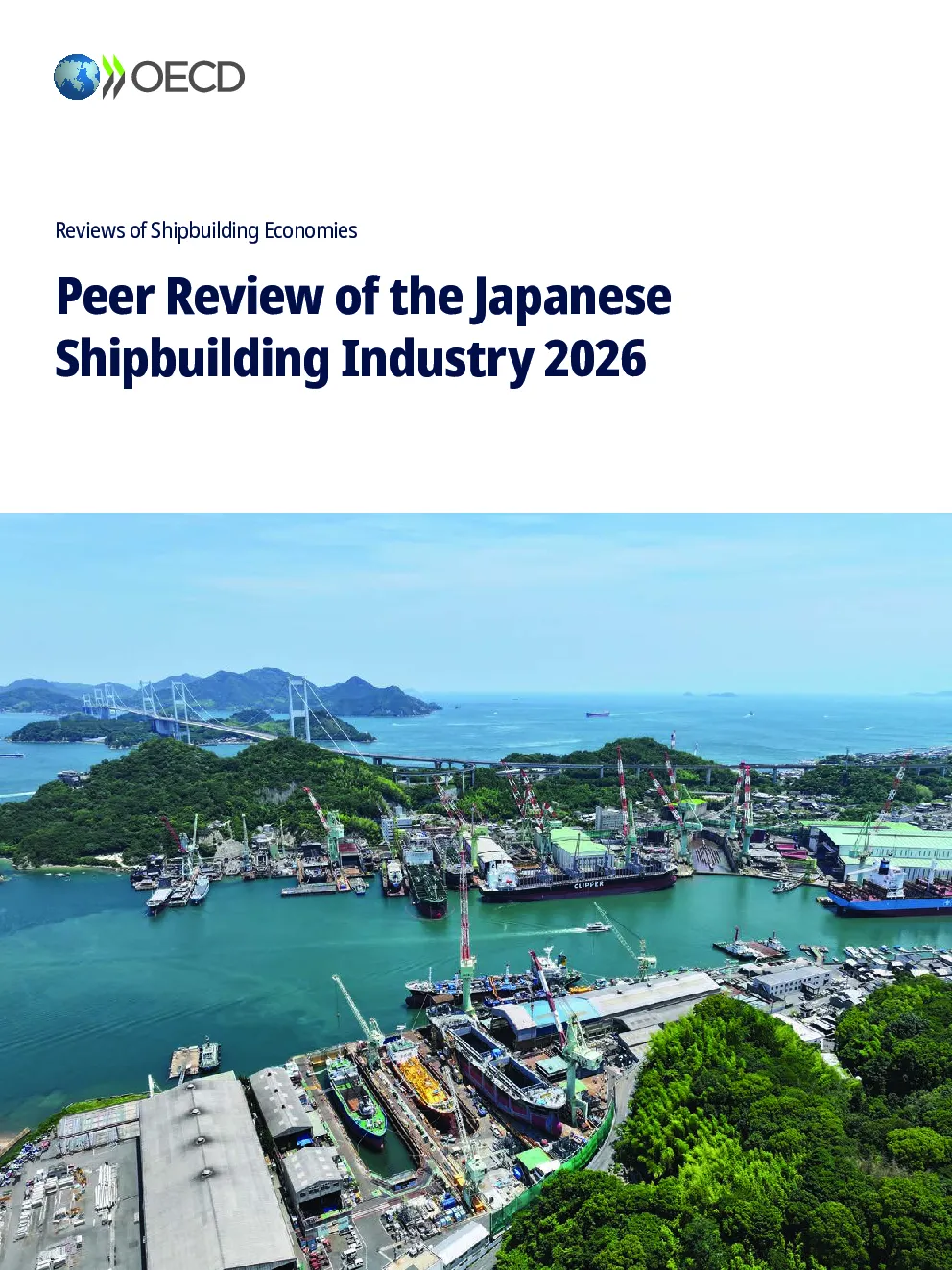
Peer Review oftheJapaneseShipbuilding Industry 2026 Reviews of Shipbuilding Economies Peer Review of the JapaneseShipbuilding Industry2026 This work was approved and declassified by the Shipbuilding Committee on 25/11/2025. This document, as well as any data and map included herein, are without prejudice to the status of or sovereignty overany territory, to the delimitation of international frontiers and boundaries and to the name of any territory, city or area. Photo credits:Cover © Imabari Shipbuilding Co., Ltd. Attribution 4.0 International (CC BY 4.0) This work is made available under the Creative Commons Attribution 4.0 International licence. By using this work, you accept to be bound by the terms of this licence(https://creativecommons.org/licenses/by/4.0/).Attribution– you must cite the work.Translations– you must cite the original work, identify changes to the original and add the following text:In the event of any discrepancy between the original work and thetranslation, only the text of the original work should be considered valid.Adaptations– you must cite the original work and add the following text:This is an adaptation of an original work by the OECD. The opinions expressed and arguments employed inthis adaptation should not be reported as representing the official views of the OECD or of its Member countries.Third-party material– the licence does not apply to third-party material in the work. If using such material, you are responsible for obtaining permission from the third party and forany claims of infringement.You must not use the OECD logo, visual identity or cover image without express permission or suggest the OECD endorses your use of the work.Any dispute arising under this licence shall be settled by arbitration in accordance with the Permanent Court of Arbitration (PCA) Arbitration Rules 2012. The seat of arbitration shallbe Paris (France). The number of arbitrators shall be one. Foreword In 2012, the OECD Shipbuilding Committee introduced a Peer Review process to examine governmentpolicies and support measures affecting the shipbuilding industry. This process involves in-depth reviewsof the shipbuilding sectors of participating economiesand provides a structured platform for sharingexperiences, promoting transparency, and identifying practices that shape competitiveness in the globalshipbuilding market. While primarily focused on Shipbuilding Committee members, the process alsowelcomes participation from non-member economies, either as observers or as subjects of review. ThePeer Reviews combine policy analysis withdetailed industry context and are enriched through activediscussion and feedback among Committee participants. In 2024 and 2025,Japanis subject to an ad hoc Peer Review, following earlier reviews of Japan (2012),Portugal (2013), Korea (2014), Germany (2015), Norway (2016), Finland (2017), the Netherlands (2019),Türkiye (2021),several EU member states including Croatia, Denmark, Italy, Poland, Romania (2023), thePhilippines(2025) and the United Kingdon (2025). The main goal of the peer review process was to identify government policies, practices, and measuresaffecting the shipbuilding sector. However, given the increased transparencyofsupport measuresunderthe new Inventory procedure, the members agreed at the April 2022 meeting that peer reviews from 2024onwards would focuson industry and market topics. In this context, Japan’s second peer reviewfocuseson these industry and market dynamics, reflecting the rapidly evolving global landscape and policyenvironment. This report is based on multiple sources, including publicly available data, statistical series accessible tothe Secretariat, Japan’s official response to the Peer Review questionnaire, and stakeholder consultationsconducted during the OECD’s fact-finding mission to Japan in December 2024, as well as consultationswith selected stakeholders and the Ministry of Land, Infrastructure, Transport and Tourism (MLIT) of Japan. The report provides a timely and comprehensive assessment of the shipbuilding sector inJapan. Itprimarily covers shipbuilding and marine equipment manufacturingin Japan. The report is structured inthree parts: 1.a global perspective to situate the Japanese shipbuilding industry within international markettrends;2.a detailed overview of the structure and characteristics of the Japanese maritime industry; and3.an assessment of its competitiveness, including a SWOT analysis and acomparative analysisbetween Japan and Korea. Acknowledgements This report was prepared by Laurent Daniel,Kang Cheon,Shojiro Niwa,andMarina Daley, under theguidance ofStephan Raes. The Secretariat extends its gratitude to Yasufumi Onishi,Kazushige Iwamoto, and all colleagues from theMinistry of Land, Infrastructure, Transport and Tourism(MLIT) of Japan for their outstanding collaborationthroughoutthe peer review process. Their support during the mission toJapanand constructive feedbackduring the drafting phase we