AI智能总结
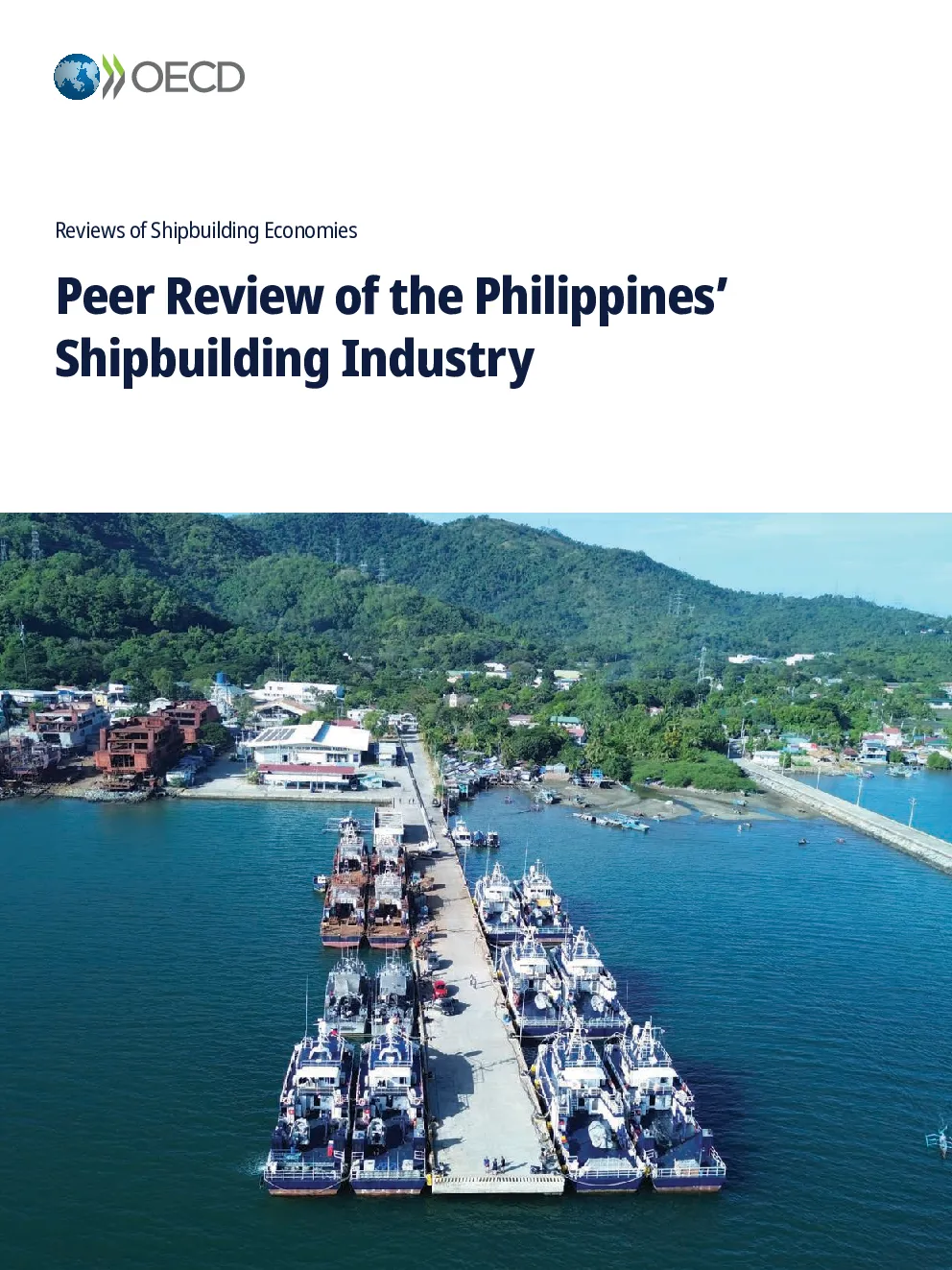
Peer Review ofthePhilippines’Shipbuilding Industry Reviews of Shipbuilding Economies Peer Reviewof the Philippines’Shipbuilding Industry This work was approved and declassified by the Shipbuilding Committee on 29/04/2025. This document, as well as any data and map included herein, are without prejudice to the status of or sovereignty overany territory, to the delimitation of international frontiers and boundaries and to the name of any territory, city or area. ISBN 978-92-64-92361-4 (print)ISBN 978-92-64-36911-5 (PDF)ISBN 978-92-64-62007-0 (HTML) Photo credits:Cover © JOSEFA SLIPWAYS, Inc. Corrigenda to OECD publications may be found at: https://www.oecd.org/en/publications/support/corrigenda.html.© OECD 2025 Attribution 4.0 International (CC BY 4.0) This work is made available under the Creative Commons Attribution 4.0 International licence. By using this work, you accept to be bound by the terms of this licence(https://creativecommons.org/licenses/by/4.0/).Attribution– you must cite the work.Translations– you must cite the original work, identify changes to the original and add the following text:In the event of any discrepancy between the original work and thetranslation, only the text of the original work should be considered valid.Adaptations– you must cite the original work and add the following text:This is an adaptation of an original work by the OECD. The opinions expressed and arguments employed inthis adaptation should not be reported as representing the official views of the OECD or of its Member countries.Third-party material– the licence does not apply to third-party material in the work. If using such material, you are responsible for obtaining permission from the third party and forany claims of infringement.You must not use the OECD logo, visual identity or cover image without express permission or suggest the OECD endorses your use of the work.Any dispute arising under this licence shall be settled by arbitration in accordance with the Permanent Court of Arbitration (PCA) Arbitration Rules 2012. The seat of arbitration shallbe Paris (France). The number of arbitrators shall be one. Foreword In 2012, the OECDShipbuilding Committee introduced a Peer Review process to examine governmentpolicies and support measures affecting the shipbuilding industry. This process involves in-depth reviewsof the shipbuilding sectors of participating economies and provides a structured platform for sharingexperiences, promoting transparency, and identifying practices that shape competitiveness in the globalshipbuilding market. While primarily focused on Shipbuilding Committee members, the process alsowelcomes participation from non-member economies, either as observers or as subjects of review. ThePeer Reviews combine policy analysis with detailed industry context and are enriched through activediscussion and feedback among Committee participants. In 2024and 2025, the Philippines is subject to an ad hoc Peer Review, following earlier reviews of Japan(2012), Portugal (2013), Korea (2014), Germany (2015), Norway (2016), Finland (2017), the Netherlands(2019), Türkiye (2021), and several EU member states including Croatia, Denmark, Italy, Poland, andRomania (2023). The Philippines’peer reviewis in line with theShipbuilding Committee’swishtoalsoreview selected non-member economies with significant shipbuilding activity, including the People’sRepublic of China (hereafter ‘China’), Indonesia, Malaysia, Singapore, Chinese Taipei, and Viet Nam. Anad-hocreport onChina’s shipbuilding sector and policies affecting itwas completed by the Secretariat in2020. This report is based on multiple sources, including publicly available data, statistical series accessible tothe Secretariat, the Philippines’ official response to the Peer Review questionnaire, and stakeholderconsultations conducted during the OECD’s fact-finding mission to the Philippines from 21–25 October2024and several virtual meetings with selected stakeholders and the Marine Industry Authority (MARINA)of the Philippines. The report provides a timely and comprehensive assessment of the shipbuilding and ship repair (SBSR)sector in the Philippines.It primarily covers shipbuilding and marine equipment manufacturing, while alsoaddressing ship repair, retrofitting, and conversion activities to offer a holistic picture of the maritimeindustrial base. Acknowledgements This report was prepared by Laurent Daniel,Emilie Berger, Juliana Gonzalez, Jiwon Choi, Anna Lafforgue,Hugo Vitrac, and Naveed Anjum, under the guidance of Stephan Raes.The author thank Pauline Barbetand Meral Gedik for their support for the publication process. The Secretariat extends its gratitude to Administrator Sonia Malaluan, Nannette Villamor-Dinopol, RamonHernandez, Maria Theresa Mamisao, Nikko Ariel Non, Jemeriah Perez, and all colleagues from theMaritime Industry Authority (MARINA) for their outstanding collaboration throughout the peer reviewprocess. Their support during the miss