您的浏览器禁用了JavaScript(一种计算机语言,用以实现您与网页的交互),请解除该禁用,或者联系我们。 [巴克莱银行]:人工智能走向实体:无人机:2035年将形成2500亿美元的市场 - 发现报告

人工智能走向实体:无人机:2035年将形成2500亿美元的市场

国防军工 2026-03-23 - 巴克莱银行 秋穆
报告封面

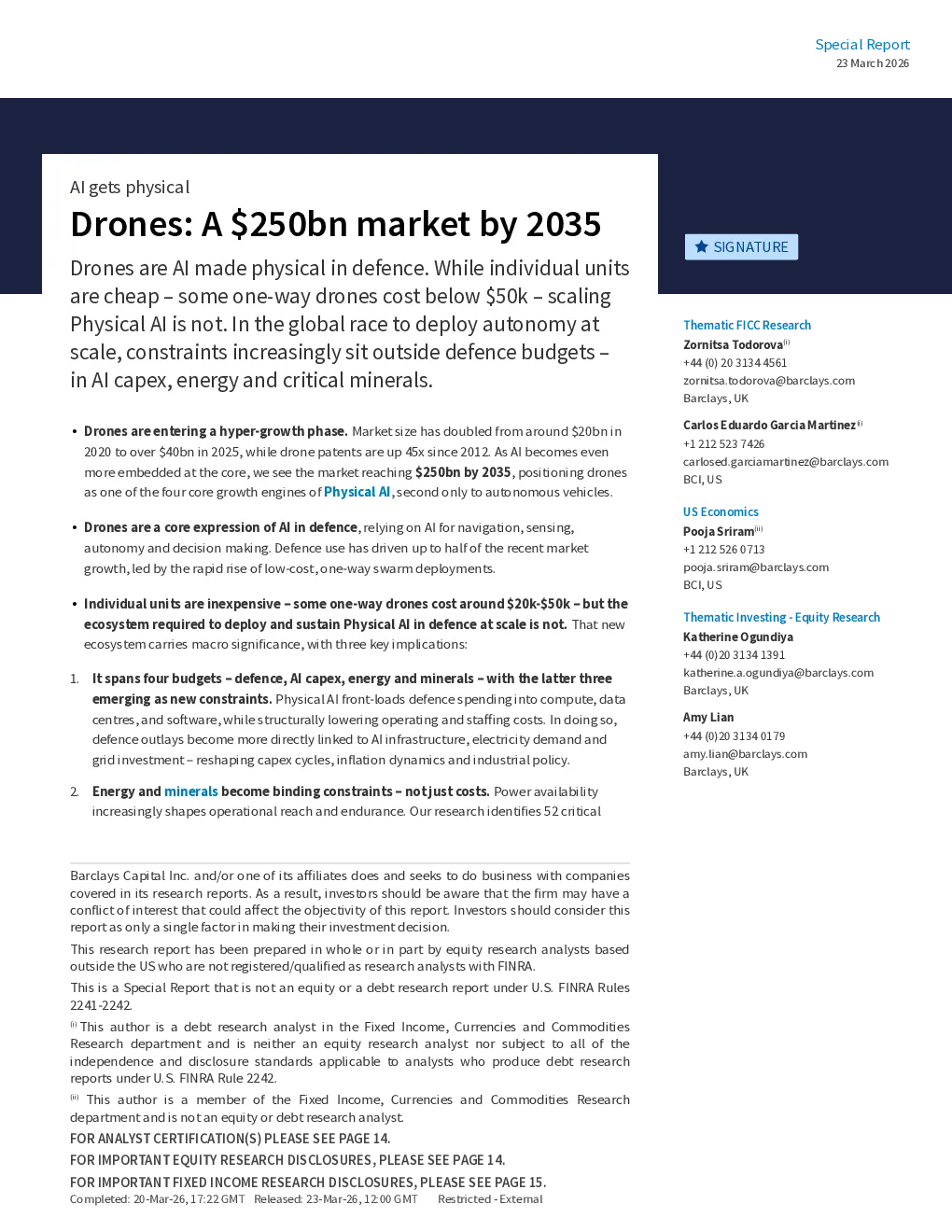
Drones: A $250bn market by 2035 Drones are AI made physical in defence. While individual unitsare cheap – some one-way drones cost below $50k – scalingPhysical AI is not. In the global race to deploy autonomy atscale, constraints increasingly sit outside defence budgets –in AI capex, energy and critical minerals. Thematic FICC Research Zornitsa Todorova(i)+44 (0) 20 3134 4561zornitsa.todorova@barclays.comBarclays, UK Carlos Eduardo Garcia Martinez(i)+1 212 523 7426carlosed.garciamartinez@barclays.comBCI, US •Drones are entering a hyper-growth phase.Market size has doubled from around $20bn in2020 to over $40bn in 2025, while drone patents are up 45x since 2012. As AI becomes evenmore embedded at the core, we see the market reaching$250bn by 2035, positioning dronesas one of the four core growth engines ofPhysical AI, second only to autonomous vehicles. US EconomicsPooja Sriram(ii)+1 212 526 0713pooja.sriram@barclays.comBCI, US •Drones are a core expression of AI in defence, relying on AI for navigation, sensing,autonomy and decision making. Defence use has driven up to half of the recent marketgrowth, led by the rapid rise of low-cost, one-way swarm deployments. •Individual units are inexpensive – some one-way drones cost around $20k-$50k – but theecosystem required to deploy and sustain Physical AI in defence at scale is not.That newecosystem carries macro significance, with three key implications: Thematic Investing - Equity Research Katherine Ogundiya+44 (0)20 3134 1391katherine.a.ogundiya@barclays.comBarclays, UK 1.It spans four budgets – defence, AI capex, energy and minerals – with the latter threeemerging as new constraints.Physical AI front-loads defence spending into compute, datacentres, andsoftware,while structurally lowering operating andstaffingcosts. In doing so,defence outlays become more directly linked to AI infrastructure, electricity demand andgrid investment –reshaping capex cycles, inflation dynamics and industrial policy. Amy Lian+44 (0)20 3134 0179amy.lian@barclays.comBarclays, UK 2.Energy and minerals become binding constraints – not just costs.Power availabilityincreasingly shapes operational reach and endurance. Our research identifies 52 critical Barclays Capital Inc. and/or one of itsaffiliatesdoes and seeks to do business with companiescovered in its research reports. As a result, investors should be aware that the firm may have aconflict of interest that couldaffectthe objectivity of this report. Investors should consider thisreport as only a single factor in making their investment decision. This research report has been prepared in whole or in part by equity research analysts basedoutside the US who are not registered/qualified as research analysts with FINRA. This is a Special Report that is not an equity or a debt research report under U.S. FINRA Rules2241-2242. (i)This author is a debt research analyst in the Fixed Income, Currencies and CommoditiesResearch department and is neither an equity research analyst nor subject to all of theindependence and disclosure standards applicable to analysts who produce debt researchreports under U.S. FINRA Rule 2242. (ii)This author is a member of the Fixed Income, Currencies and Commodities Researchdepartment and is not an equity or debt research analyst. FOR ANALYST CERTIFICATION(S) PLEASE SEE PAGE 14. FOR IMPORTANT EQUITY RESEARCH DISCLOSURES, PLEASE SEE PAGE 14. minerals, with China the dominant supplier for 40 of them, raising material questionsaround strategic autonomy and geopolitics. 3.Defence demand accelerates civiliandiffusion.Physical AI is inherently dual-use, withdefence investment driving spillovers into delivery, inspection and maintenance, andagriculture. By 2035, around 70% of the global drone market is expected to be civilian –reinforcing Physical AI as a productivity and growth driver, not just a defence cycle. So far in the AI gets physical series AI gets physical: The decade of the robot From humanoids and autonomous vehicles to industrial automation and drones, thePhysical AI market is scaling toward a trillion-dollar opportunity by 2035. AI gets physical: Humanoid robots AI's next frontier is physical: humanoid robots – robots in human form – are stepping out ofthe lab and into the real world. They could take on the tough, repetitive jobs humansincreasingly avoid in manufacturing, agriculture and healthcare – working alongside peopleand augmenting the workforce. Drones takeoff The global drones market has doubled in just five years We estimate the global drones market reached over $40bn in 2025, up from roughly $20bn in2020, and our projections point to $50bn in 2026 (Figure 1). Estimating market size precisely is challenging, as it requires aggregating data across publicand private companies, many of which do not report revenues by product line. Our figurestherefore reflect an average of multiple market value estimates drawn from company disclosures, industry research and presenta