您的浏览器禁用了JavaScript(一种计算机语言,用以实现您与网页的交互),请解除该禁用,或者联系我们。 [美国银行]:年轻一代的消费会影响汽油价格吗? - 发现报告

年轻一代的消费会影响汽油价格吗?

交运设备 2026-03-01 美国银行 董亚琴
报告封面

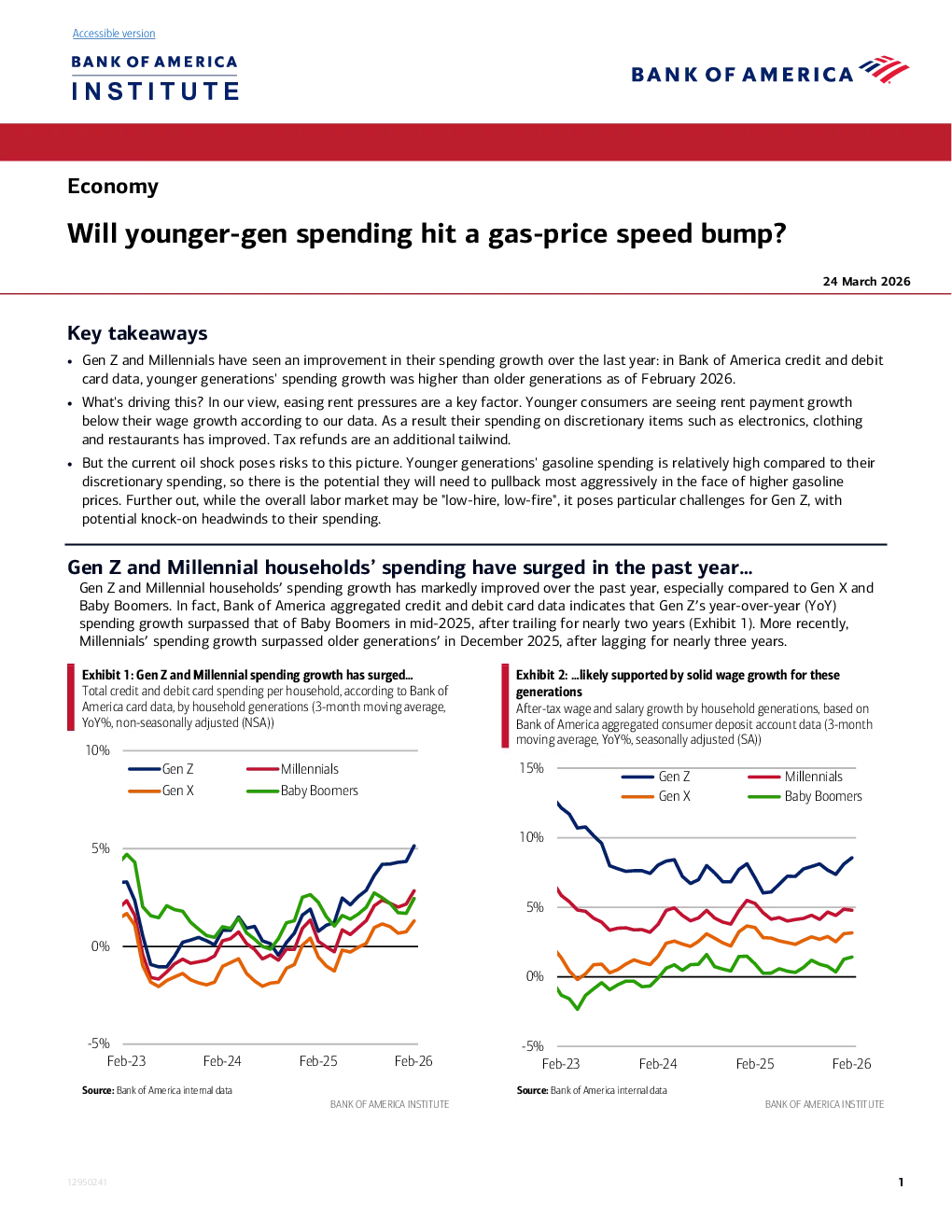
Will younger-gen spending hit a gas-price speed bump? 24 March 2026 Key takeaways •Gen Z and Millennials have seen an improvement in their spending growth over the last year: in Bank of America credit and debitcard data, younger generations' spending growth was higher than older generations as of February 2026. What's driving this? In our view, easing rent pressures are a key factor. Younger consumers are seeing rent payment growthbelow their wage growth according to our data. As a result their spending on discretionary items such as electronics, clothing But the current oil shock poses risks to this picture. Younger generations' gasoline spending is relatively high compared to theirdiscretionary spending, so there is the potential they will need to pullback most aggressively in the face of higher gasolineprices. Further out, while the overall labor market may be "low-hire, low-fire", it poses particular challenges for Gen Z, with Gen Z and Millennial households’ spending have surged in the past year…Gen Z and Millennial households’spending growth has markedly improved over the past year, especially compared to Gen X and Baby Boomers. In fact, Bank of America aggregated credit and debit card data indicates that Gen Z’s year-over-year (YoY)spending growth surpassed that of Baby Boomers in mid-2025, after trailing for nearly two years (Exhibit 1). More recently, Exhibit2:…likely supported by solid wage growth forthesegenerations Exhibit1:Gen Z and Millennialspending growth hassurged…Total credit and debit card spending per household, according to Bank of America card data, by household generations (3-month moving average,YoY%, non-seasonally adjusted (NSA)) After-tax wage and salary growth by household generations, based onBank of America aggregated consumer depositaccount data (3-monthmoving average, YoY%, seasonally adjusted (SA)) Part of the reason for this recent uptick is likely the continued strength in younger generations’after-tax wage growth. Bank ofAmerica data suggests that even though wage growth has cooled from the peaks seen three years ago, it remains fairly strong,up around 9% and 5% YoY for Gen Z and Millennials, respectively (Exhibit 2). However, Millennials do not appear to have …but will rising oil prices spoil the party?A hot topic for everyone right now is how rising gas prices, due to the conflict in Iran, might impact both the consumer and the wider economy. The average national gas price is up around 26% YoY, according to daily data from American Automobile In our view, the discretionary spending of younger generations may be most susceptible to rising gas prices. Before the recentcrisis, most generations had seen their gasoline spending, as a share of total card spending, fall compared to pre-pandemiclevels. But Gen Z’s remained relatively high and steady, while Millennials’share was above that of older generations (Exhibit 3).In our view, Gen Z’s elevated share likely reflects them entering the workforce and experiencing the daily (or mostly daily) Exhibit4:Younger generations’ discretionaryspending is most atrisk Gasoline spending relative to discretionary spending per household andby generation (12-month rolling average, %) Gasoline spending as a share of total card spending per household and bygeneration (12-month rolling average, %) A similar but more pronounced pattern exists across the generations for discretionary spending (i.e., travel, electronics,restaurants) (Exhibit 4). Even though Gen Z households spend less on both gasoline and discretionary items in dollar termscompared to other generations, their outlay on gasoline is highest relative to their discretionary spending. And Millennials spend parents/other relatives. Reflecting this, the Gen Z consumers we analyze are likely to be older than the overall cohort, while GenZers still living with parents may well experience less pressure on their budgets from gasoline. Accelerating spending growth has been aided by decelerating rent growthHowever, there is some“good news”that may help younger generations ride out the impact of higher gas prices–rent growth is cooling. In Bank of America data, median rent growth for Gen Z and Millennials slowed significantly in the 12 months toFebruary 2026 compared to 2024 and 2023. And, notably, wage growth for these generations is currently outpacing rent Exhibit5:Rental payment growthhas slowed relative to wage growth for Millennials and Gen ZMedian rent payments and average after-tax wages, based on Bank of America internal data, for Gen Z and Millennials (yearly 3-month moving average toFebruary, YoY%) Cooling rent growth disproportionately benefits the youngGiven that housing often makes up the largest share of a household’s expenses, cooling rent growth could give some younger consumers a cushion to offset part of the increase in gasoline prices. Additionally, slowing increases in rent are especially In fact, Bank of America card data shows that while Gen Z a