生命科学聚焦
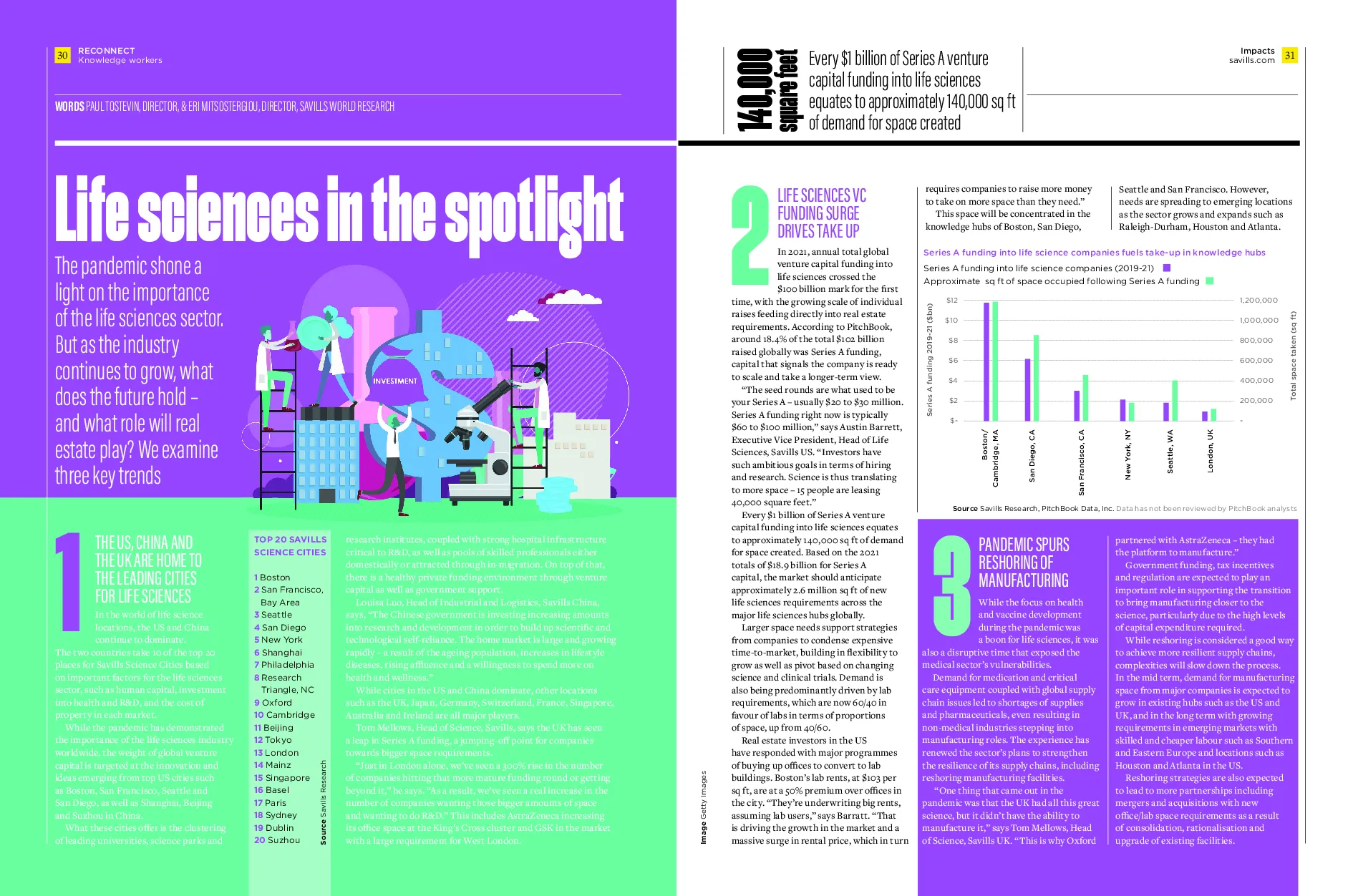
WORDSPAUL TOSTEVIN, DIRECTOR, & ERI MITSOSTERGIOU, DIRECTOR, SAVILLS WORLD RESEARCH LifesciencesinthespotlightThe pandemic shone a Seattle and San Francisco. However,needs are spreading to emerging locationsas the sector grows and expands such asRaleigh-Durham, Houston and Atlanta. requires companies to raise more moneyto take on more space than they need.”This space will be concentrated in theknowledge hubs of Boston, San Diego, LIFE SCIENCES VCFUNDING SURGEDRIVES TAKE UP2 In 2021, annual total globalventure capital funding intolife sciences crossed the$100 billion mark for the first light on the importanceof the life sciences sector.But as the industrycontinues to grow, whatdoes the future hold –and what role will realestate play? We examinethree key trends time, with the growing scale of individualraises feeding directly into real estaterequirements. According to PitchBook,around 18.4% of the total $102 billionraised globally was Series A funding,capital that signals the company is readyto scale and take a longer-term view. “The seed rounds are what used to beyour Series A – usually $20 to $30 million.Series A funding right now is typically$60 to $100 million,” says Austin Barrett,Executive Vice President, Head of LifeSciences, Savills US. “Investors havesuch ambitious goals in terms of hiringand research. Science is thus translatingto more space – 15 people are leasing40,000 square feet.” Every $1 billion of Series A venturecapital funding into life sciences equatesto approximately 140,000 sq ft of demandfor space created. Based on the 2021totals of $18.9 billion for Series Acapital, the market should anticipateapproximately 2.6 million sq ft of newlife sciences requirements across themajor life sciences hubs globally. THE US, CHINA ANDTHE UK ARE HOME TOTHE LEADING CITIESFOR LIFE SCIENCES research institutes, coupled with strong hospital infrastructurecritical to R&D, as well as pools of skilled professionals eitherdomestically or attracted through in-migration. On top of that,there is a healthy private funding environment through venturecapital as well as government support. TOP 20 SAVILLSSCIENCE CITIES partnered with AstraZeneca – they hadthe platform to manufacture.”Government funding, tax incentivesand regulation are expected to play animportant role in supporting the transitionto bring manufacturing closer to thescience, particularly due to the high levelsof capital expenditure required. PANDEMIC SPURSRESHORING OFMANUFACTURING 1Boston2San Francisco,Bay Area3Seattle4San Diego5New York6Shanghai7Philadelphia8ResearchTriangle, NC9Oxford10Cambridge11Beijing12Tokyo13London14Mainz15Singapore16Basel17Paris18Sydney19Dublin20SuzhouSourceSavills Research While the focus on healthand vaccine developmentduring the pandemic wasa boon for life sciences, it was Louisa Luo, Head of Industrial and Logistics, Savills China,says, “The Chinese government is investing increasing amountsinto research and development in order to build up scientific andtechnological self-reliance. The home market is large and growingrapidly – a result of the ageing population, increases in lifestylediseases, rising affluence and a willingness to spend more onhealth and wellness.” In the world of life sciencelocations, the US and Chinacontinue to dominate. Larger space needs support strategiesfrom companies to condense expensivetime-to-market, building in flexibility togrow as well as pivot based on changingscience and clinical trials. Demand isalso being predominantly driven by labrequirements, which are now 60/40 infavour of labs in terms of proportionsof space, up from 40/60. While reshoring is considered a good wayto achieve more resilient supply chains,complexities will slow down the process.In the mid term, demand for manufacturingspace from major companies is expected togrow in existing hubs such as the US andUK, and in the long term with growingrequirements in emerging markets withskilled and cheaper labour such as Southernand Eastern Europe and locations such asHouston and Atlanta in the US. The two countries take 10 of the top 20places for Savills Science Cities basedon important factors for the life sciencessector, such as human capital, investmentinto health and R&D, and the cost ofproperty in each market. also a disruptive time that exposed themedical sector’s vulnerabilities. Demand for medication and criticalcare equipment coupled with global supplychain issues led to shortages of suppliesand pharmaceuticals, even resulting innon-medical industries stepping intomanufacturing roles. The experience hasrenewed the sector’s plans to strengthenthe resilience of its supply chains, includingreshoring manufacturing facilities. While cities in the US and China dominate, other locationssuch as the UK, Japan, Germany, Switzerland, France, Singapore,Australia and Ireland are all major players. While the pandemic has demonstratedthe importance of the life sciences industryworldwide, the weight of global venturecap