您的浏览器禁用了JavaScript(一种计算机语言,用以实现您与网页的交互),请解除该禁用,或者联系我们。[世界银行]:20岁的计划:遗产、教训和未来之路(英)2026 - 发现报告

20岁的计划:遗产、教训和未来之路(英)2026

文化传媒2026-03-23世界银行华***
20岁的计划:遗产、教训和未来之路(英)2026

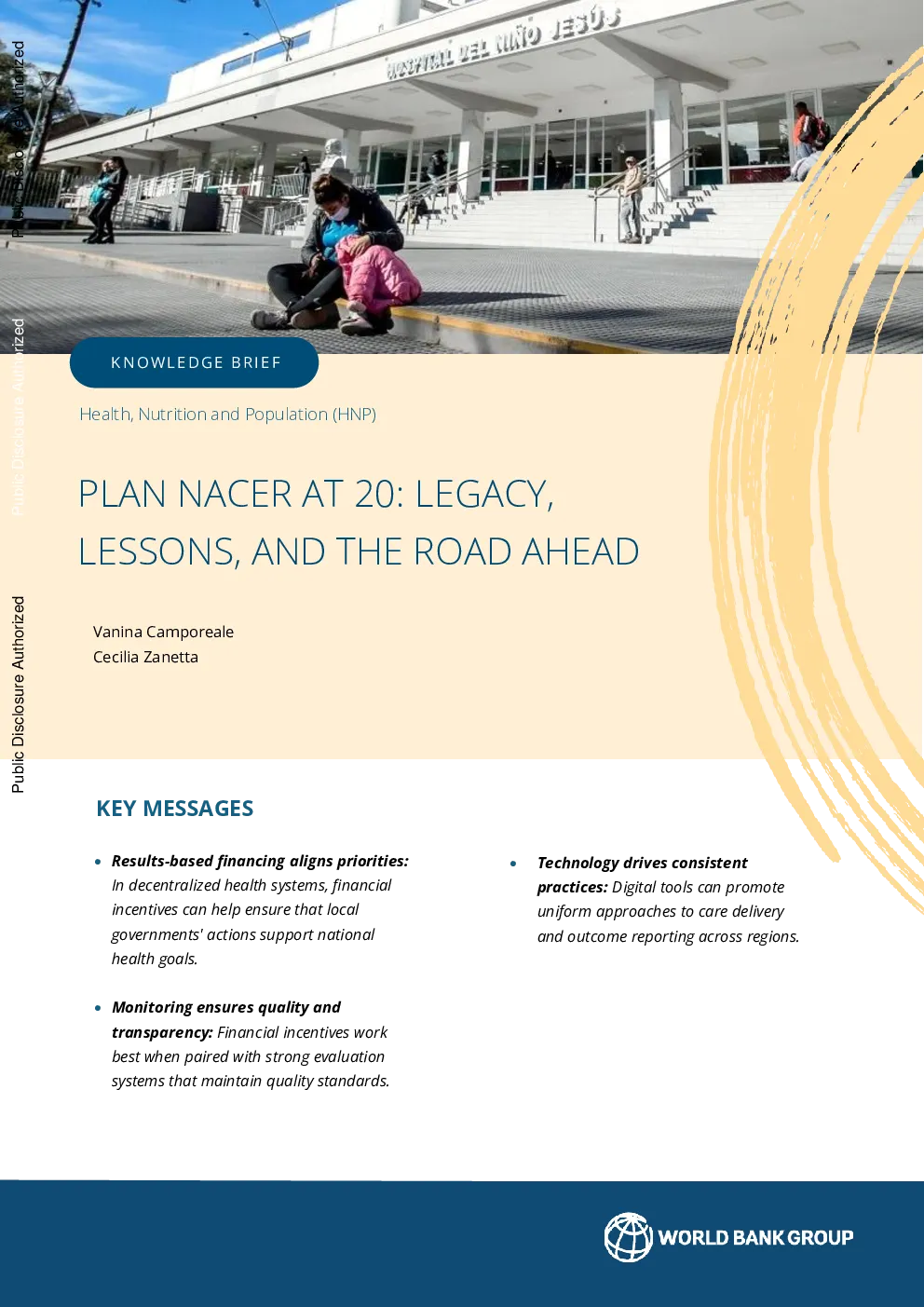
PLAN NACER AT 20: LEGACY,LESSONS, AND THE ROAD AHEADPublic Disclosure Authorized Vanina CamporealeCecilia Zanetta KEY MESSAGES •Results-based financing aligns priorities:In decentralized health systems, financialincentives can help ensure that localgovernments' actions support nationalhealth goals. •Technologydrives consistentpractices:Digital tools can promoteuniform approaches to care deliveryand outcome reporting across regions. •Monitoring ensures quality andtransparency:Financial incentives workbest when paired with strong evaluationsystems that maintain quality standards.Public Disclosure Authorized financial incentives to service delivery and theachievement of performance targets. This results-based financing (RBF) model proved successful inexpanding access to preventive maternal and childhealth services for uninsuredpopulations andcontributed to improvements in service quality. INTRODUCTION Reducing infant and maternal mortality becamea central policy priority in Argentina in the early2000s.Globally, the United Nations' MillenniumDevelopment Goals (MDGs) had drawn significantattention to child health, with MDG 4 specificallycalling for a two-thirds reduction in the under-fivemortality rate between 1990 and 2015. Argentina,one of the 189signatory countries, was makingsteady progress toward this goal: its infantmortality rate (IMR) declined from 25.6 per 1,000live births in 1990 to 16.3 in 2001, reflecting gradualimprovements in child health outcomes.i With continued support from the World Bank,the Plan Nacer model became the cornerstoneof Argentina's broader efforts to build auniversal public health insurance system-ensuring that all individuals, regardless ofgeographic location or socioeconomic status, haveaccess to health care that meets guaranteed qualitystandards. This positive trend was disrupted in 2002,following the severe economic crisis of 2001–2002, which pushed over half the populationinto poverty and led to a deterioration in keyhealth indicators.Nationally, the IMR rose from16.3 to 16.8 per 1,000 live births between 2001 and2002. The situation was far worse in the country'spoorest provinces, where the IMR approached 29per 1,000 live births.iiDisparities among provinceswere stark, with infant mortality rates varying up tothreefold between those with the lowest andhighest levels.iii This Knowledge Brief examines the legacy ofPlan Nacer, twenty years after its inception in2004.Specifically, it explains the key challengesfacing Argentina's health system and the innovativefeatures of the Plan Nacer model. It then traces theprogressive development of provincial publichealth insurance schemes under Plan Nacer and itssuccessor,the SUMAR Program, in terms ofgeographic coverage, target populations, benefitpackages, and service delivery strategies. It reflectson the strategic pillars that supported theirsuccessful implementation as well as the mainimplementation challenges. Finally, it summarizesthe main outcomes, the challenges still ahead, andlessons learned after two decades ofimplementation. In response to the worsening child healthoutcomes and the growing number of thoselacking insurance coverage, the Government ofArgentina (GoA) launched Plan Nacer in 2004with support from the World Bank.Thisinnovative program aimed to reduce infantmortality by addressing its "easily reducible"causes—those preventable through relatively low-cost interventions, such as improved access to andquality of prenatal andpost-natalcare. CHALLENGES FACING ARGENTINA’SHEALTH SYSTEM Argentina's health system faces severalpersistent challenges that hinder its overallperformance,including fragmented insurancemechanisms (horizontal fragmentation), verticalsegmentation driven by the country's federalstructure, and the limited authority of the NationalMinistry of Health (NMOH) to exercise effectivestewardship. Plan Nacer proved to be highly successful. Alongside improved macroeconomic conditions,the program helped reverse the increase in infantmortality, returning the country to a downwardtrajectory by the end of 2004. Justas importantly,Plan Nacer introduced a paradigm shift: linking transferring both responsibilities and financialresources to the provinces. While decentralizationallowed provinces to tailor services to local needs, itsignificantly weakened the NMOH's ability to designand implement cohesive national health policies.Although formally responsible for sectorcoordination, standard-setting, and national publichealth programs, the NMOH lacks the legalauthority and financial resources to enforcecompliance across provinces. Horizontal Fragmentation:Argentina's healthsystem is composed of three main subsystems:social security, public, and private. The socialsecurity system provides coverage to formal sectorworkers, retirees, and their families throughnumerous insurers. These include Obras SocialesNacionales and the National Institute for Retirees-PAMI (regulated at the federal level) and ObrasSociales