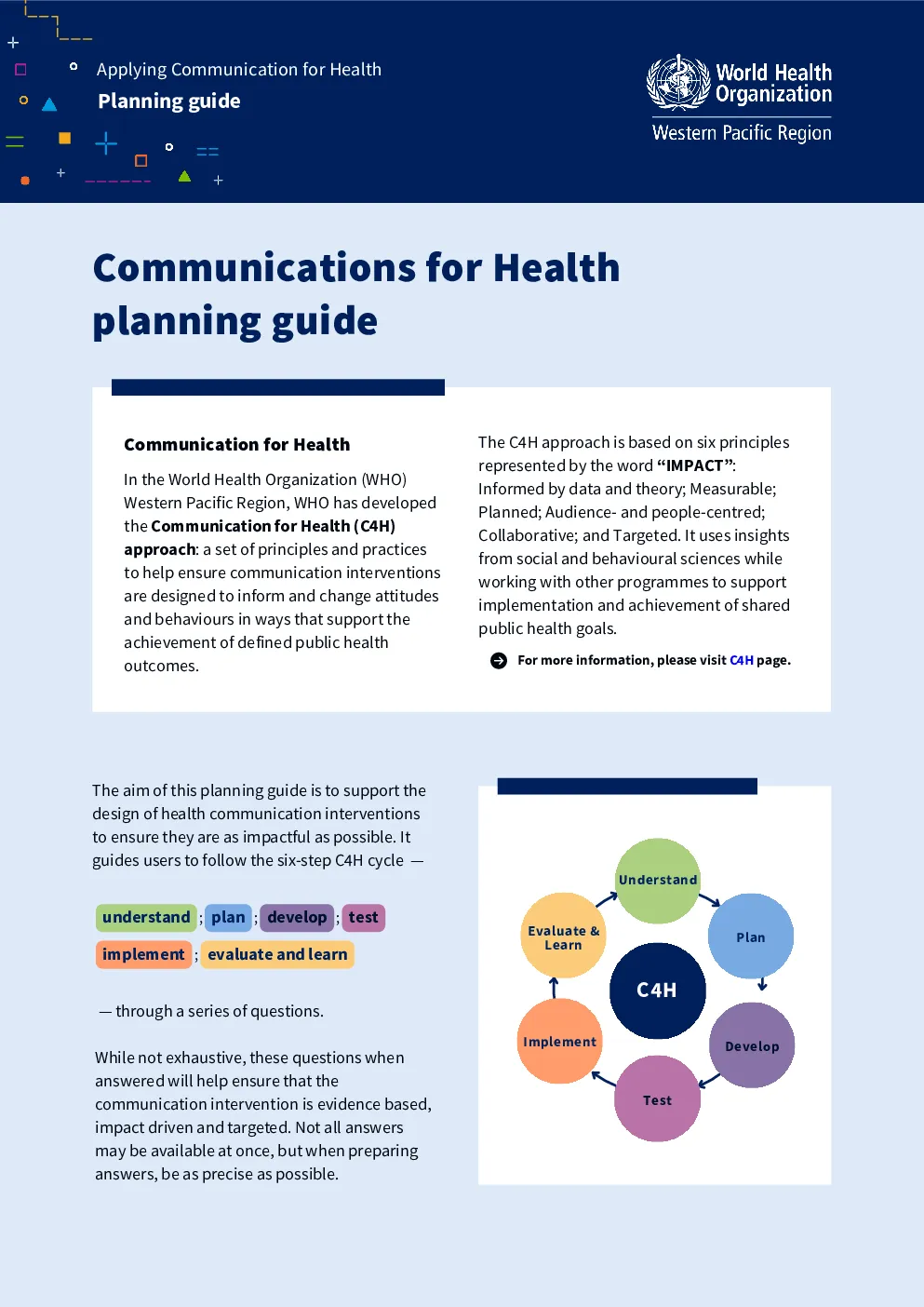
The C4H (Communication for Health) approach is a set of principles and practices developed by the World Health Organization (WHO) Western Pacific Region to ensure communication interventions effectively support public health goals. It is based on six core principles: Informed by data and theory, Measurable, Planned, Audience- and people-centred, Collaborative, and Targeted. The approach integrates insights from social and behavioural sciences to work with other programs in achieving shared public health outcomes.
The C4H cycle consists of six steps, guiding users through the design and implementation of impactful health communication interventions:
STEP 1: Understand
- Conduct a situation analysis to identify factors contributing to the health issue, including social, economic, environmental, policy, and individual behavioural elements.
- Establish a baseline of pre-existing conditions, knowledge, attitudes, and behaviours to measure progress and impact.
- Key questions include: defining the health issue, identifying target audiences, understanding the behavioural elements, identifying potential influencers, assessing information channels, and evaluating implementers' communication capacity.
STEP 2: Plan
- Define desired health outcomes and objectives, along with key measurement indicators.
- Develop a theory of change to explain how the desired health outcome will be achieved and how communication contributes.
- Establish SMART (Specific, Measurable, Attainable, Relevant, Time-bound) communication objectives.
- Determine evaluation methods and indicators to measure progress and effectiveness.
- Identify suitable communication approaches, channels, and activities to engage target audiences.
STEP 3: Develop
- Create targeted solutions combining specific techniques, channels, and approaches to achieve the desired health outcome.
- Develop concepts, messages, and products that address audiences' needs and are clear, actionable, and accessible.
- Key considerations include message relevance, behaviour change prompts, audience engagement strategies, and communication approaches and channels.
STEP 4: Test
- Test planned communication messages, products, or concepts to determine their effectiveness and identify reasons for success or failure.
- Conduct testing with target and non-target audiences in diverse contexts to ensure messages convey the intended meaning.
- Use testing insights to refine messages and products and inform the overall plan.
- Key questions include: what to test, how to run the test, and how to refine messages and products based on feedback.
STEP 5: Implement
- Translate the plan into concrete actions and products, tracking progress against the plan, baseline, and indicators.
- Address any issues that arise and adjust as needed.
- Key considerations include monitoring initial audience reactions, assessing progress towards objectives, and identifying additional audiences or channels.
STEP 6: Evaluate and Learn
- Measure the extent to which the health outcome has been achieved and identify lessons learned.
- Use insights to inform the next phase of the intervention or a similar C4H intervention.
- Key questions include: assessing the effectiveness of the intervention, identifying lessons learned, and incorporating lessons into planning for the next cycle or future interventions.