中东战争:情景分析
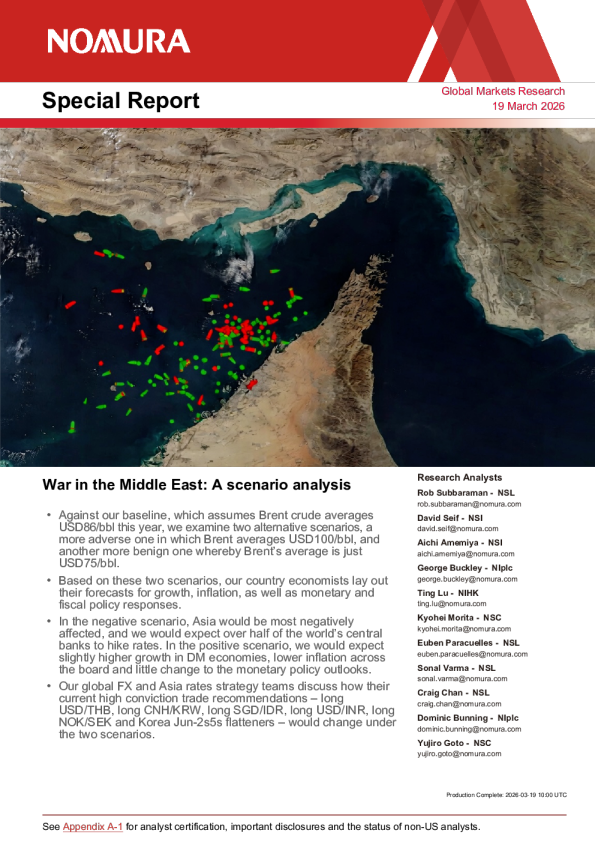
Special Report Research Analysts War in the Middle East: A scenario analysis Rob Subbaraman - NSLrob.subbaraman@nomura.com Against our baseline, which assumes Brent crude averagesUSD86/bbl this year, we examine two alternative scenarios, amore adverse one in which Brent averages USD100/bbl, andanother more benign one whereby Brent’s average is justUSD75/bbl.• David Seif - NSIdavid.seif@nomura.com Aichi Amemiya - NSIaichi.amemiya@nomura.com George Buckley - NIplcgeorge.buckley@nomura.com Based on these two scenarios, our country economists lay outtheir forecasts for growth, inflation, as well as monetary andfiscal policy responses. Ting Lu - NIHKting.lu@nomura.com Kyohei Morita - NSCkyohei.morita@nomura.com In the negative scenario, Asia would be most negativelyaffected, and we would expect over half of the world’s centralbanks to hike rates. In the positive scenario, we would expectslightly higher growth in DM economies, lower inflation across Euben Paracuelles - NSLeuben.paracuelles@nomura.comSonal Varma - NSLsonal.varma@nomura.comCraig Chan - NSLcraig.chan@nomura.com Our global FX and Asia rates strategy teams discuss how theircurrent high conviction trade recommendations – longUSD/THB, long CNH/KRW, long SGD/IDR, long USD/INR, longNOK/SEK and Korea Jun-2s5s flatteners – would change underthe two scenarios.• Dominic Bunning - NIplcdominic.bunning@nomura.comYujiro Goto - NSCyujiro.goto@nomura.com Production Complete: 2026-03-19 10:00 UTC Contents Research Analysts Introduction Global Economics Rob Subbaraman - NSLrob.subbaraman@nomura.com+65 6433 6548 We analyze two scenarios for Brent crude prices relative to our baseline forecast –one bearish and one bullish – and assess the economic impacts and policy David Seif - NSIdavid.seif@nomura.com+1 212 667 9180 Thousands of lives have already been lost, and our thoughts are with all those affected.Against our baseline, which assumes Brent crude averages USD86/bbl this year, weexamine two alternative scenarios, one more adverse, in which Brent averages North America Economics Aichi Amemiya - NSIaichi.amemiya@nomura.com+1 212 667 9347 A more negative scenario: Brent crude averages USD100/bbl this year. In this scenario, the conflict continues for several months, limiting transportation throughthe Strait of Hormuz, and/or harder-to-repair damage to critical GCC energy infrastructureoccurs, which significantly constrains the production of oil, gas and other commodities inthe Middle East. In this scenario, not only does Brent crude average USD100/bbl this year Jeremy Schwartz - NSIjeremy.schwartz@nomura.com+1 212 667 9637 European Economics George Buckley - NIplcgeorge.buckley@nomura.com+44 (0) 20 7102 1800 Simple historic rules of thumb on the impact of higher oil prices on growth and inflationmay be off the mark this time, given the unique nature of this shock and the background. Andrzej Szczepaniak - NIplcandrzej.szczepaniak@nomura.com+44 (0) 20 7102 3167 Most of the oil and gas that flows through the Strait of Hormuz is destined for Asia,and so the Far East will be hit disproportionately hard by this shockI. CEEMEA ResearchZumrut Imamoglu - NIplczumrut.imamogludemir@nomura.com Middle-East nations usually benefit the most from a demand-driven surge in oil prices,but this shock is supply driven and the crisis is in the Middle East, so other large netII. +44 20 710 24980Japan Economics Kyohei Morita - NSCkyohei.morita@nomura.com+81 3 6703 1395 The fiscal responses could be disproportionately large in countries run by populistgovernments, cushioning the impact on growth and inflation but at the expense ofIII. Asia Economics The muscle memory of firms and workers from the 2021-23 inflation surge couldresult in a swifter pass-through of cost pressures into prices, wages and inflationIV. Sonal Varma - NSLsonal.varma@nomura.com+65 6433 6527 Ting Lu - NIHKting.lu@nomura.com+852 2252 1306 What drives an energy price shock matters. For a demand-driven rise in energy prices,stronger exports can cushion the cost to net energy importers. But when supply shortagesdrive the rise in energy prices – as is the case now – it tends to be more damaging to netenergy importers because, in the absence of a strong pick up in exports, the higher importcost of energy could sharply worsen current account positions, compress profit margins Euben Paracuelles - NSLeuben.paracuelles@nomura.com+65 6433 6956Aurodeep Nandi - NFASLaurodeep.nandi@nomura.com+91 22 4037 4087 In this negative scenario, only the largest net energy and commodity exporters outside theMiddle East – Canada, Norway, Australia, Brazil and Russia – could be insulated andpossibly benefit. Most other economies will be negatively affected, particularly in Asia. Jeong Woo Park - NSLjeongwoo.park@nomura.com+65 6433 6197 Australia Economics In this negative scenario, there is also a greater likelihood of a significant tightening infinancial conditions and of credit defaults. Moreover,