您的浏览器禁用了JavaScript(一种计算机语言,用以实现您与网页的交互),请解除该禁用,或者联系我们。[汇丰银行]:中国“十五五”规划:高质量发展的三大支柱 - 发现报告

中国“十五五”规划:高质量发展的三大支柱

2026-03-18-汇丰银行等***
中国“十五五”规划:高质量发展的三大支柱

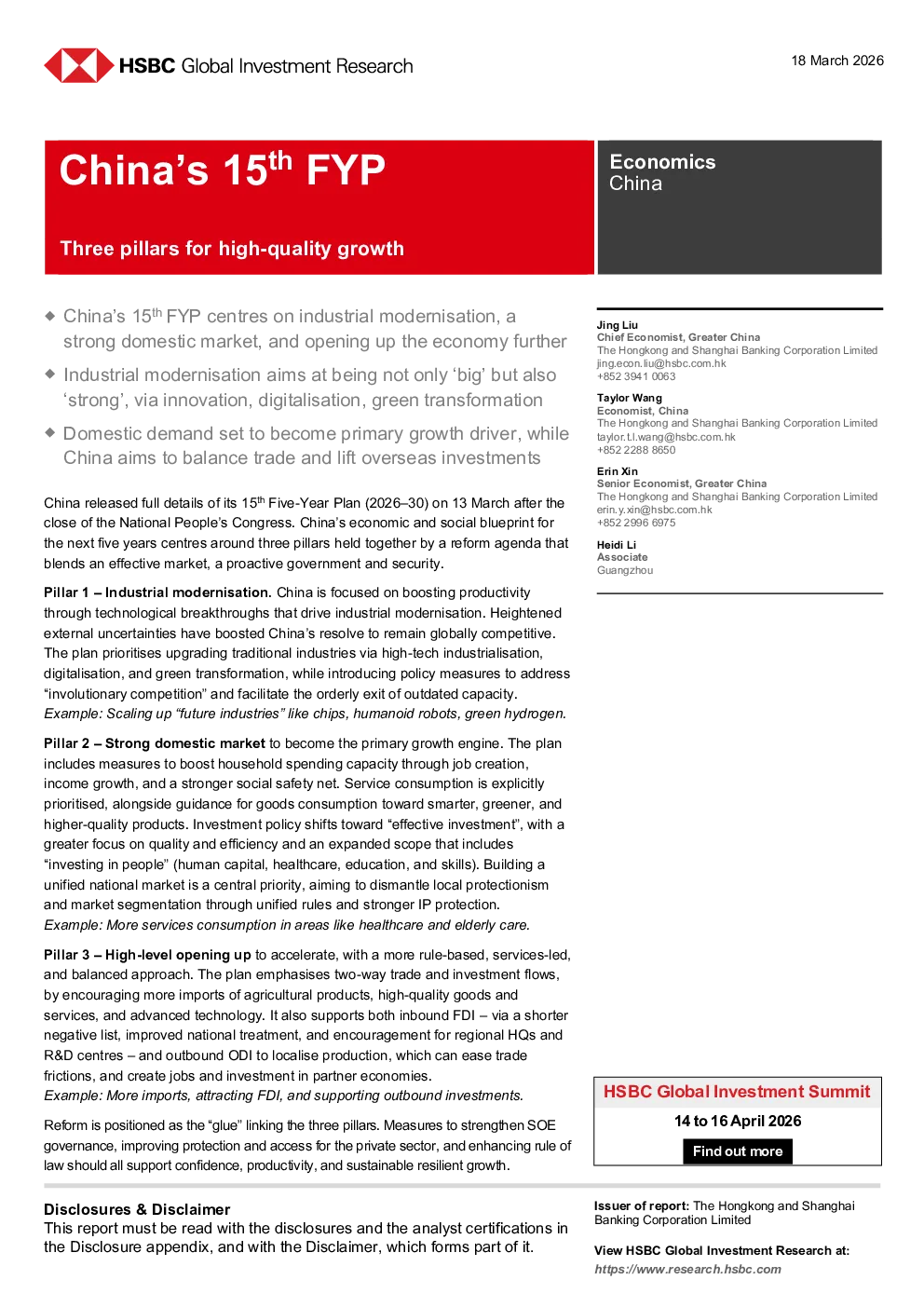
EconomicsChina Jing LiuChief Economist, Greater ChinaThe Hongkong and Shanghai Banking Corporation Limitedjing.econ.liu@hsbc.com.hk+852 3941 0063 ◆China’s 15thFYPcentres on industrial modernisation, astrong domestic market,and openinguptheeconomyfurther ◆Industrial modernisationaims at being not only ‘big’ but also‘strong’, via innovation,digitalisation,green transformation Taylor WangEconomist, ChinaThe Hongkong and Shanghai Banking Corporation Limitedtaylor.t.l.wang@hsbc.com.hk ◆Domestic demand set tobecome primary growth driver,whileChina aims to balance trade andlift overseas investments Erin XinSenior Economist, Greater ChinaThe Hongkong and Shanghai Banking Corporation Limitederin.y.xin@hsbc.com.hk+852 2996 6975 China released full details ofits15thFive-Year Plan (2026–30) on 13March after the close of the National People’s Congress. China’s economic and social blueprint forthe next five years centres around three pillarsheldtogether by a reform agendathat Heidi LiAssociateGuangzhou Pillar1–Industrialmodernisation.China is focused on boosting productivitythrough technological breakthroughs that drive industrial modernisation. Heightenedexternaluncertainties haveboostedChina’s resolve to remain globally competitive.The plan prioritises upgrading traditional industries via high-tech industrialisation, Pillar 2–Strong domestic markettobecome the primary growth engine. The planincludes measures to boost household spending capacity through job creation,income growth, and a stronger social safety net. Service consumption is explicitlyprioritised, alongside guidance for goods consumptiontoward smarter, greener,andhigher-quality products. Investment policy shifts toward “effective investment”, witha Pillar 3–High-level openingupto accelerate, with a more rule-based,services-led,and balanced approach. The plan emphasises two-way trade and investmentflows,byencouragingmore imports of agricultural products, high-quality goods andservices, and advanced technology. It also supports both inbound FDI–via a shorter negative list, improved national treatment, and encouragement for regional HQs and HSBC Global Investment Summit 14 to 16 April 2026 Reform is positioned as the “glue” linking the three pillars. Measurestostrengthen SOEgovernance, improvingprotection and access for the private sector,andenhancingrule of Find out more Issuer of report:The Hongkong and ShanghaiBanking Corporation Limited Disclosures & Disclaimer This report must be read with the disclosures and the analyst certifications inthe Disclosure appendix, and with the Disclaimer, which forms part of it. View HSBC Global Investment Research at:https://www.research.hsbc.com Growth blueprint:2026-30 ◆China’s economic and social development blueprint hinges on threeinterconnected pillars, gluedtogetherby reforms ◆Industrial modernisationfocuses on being“strong”,while innovationis no longer just eyeing ‘me too’or‘me better’, but also ‘first in class’ ◆Domestic demand is poised todrive growth,whileChina’s vast China’s 15thFYPOutline wasapproved on 12March at the close of the National People’s Congress, marking a pivotal step towardsthe country’s 2035 modernisation ambitions.Spanning 18 chapters andover 100pages, the Outline addresses a broad spectrum ofinterconnected economic and social priorities. Central to the economic strategy are threemutually reinforcing pillars: industrial modernisation;a strong domestic market;andhigh-levelopening up(seeAppendix A2 forhow the order of priorities has shifted between the two FYPs). The new FYP: key targets The 15thFYPoutlines a set of economic and social development targets for 2026-30, designed to lay the foundation for China’s 2035 vision of socialistmodernisationthat aims for asubstantial boost in overall national strength and per capita GDP reaching moderately developed country levels. This impliesa minimum average annual growth rate ofc4.2%,according to the official calculations (see100 Q&As on the proposed 15thFYP, published by Pillar 1–Industrial modernisationmeansadvanced manufacturing The 15thFYP places the real economy–especiallyadvanced manufacturing–at the heart ofChina’s modernisation drive. This is a direct response to bothexternal uncertainties and theneed for higher quality, sustainable growth. ThisFYP commits to “maintaining a reasonable share of manufacturing,”a subtle shift from the14thFYP’s language of keeping the manufacturing share of GDP “basically stable”.Thisadjustment signals a pragmatic approach, especially as China’s outbound direct investment isset to rise amid growing tensions with trading partners. Notably, both the 14thand 15thFYPs differ from the 12thand 13th, which explicitly targeted a higher services share of GDP. Therecent plans are more cautious about premature deindustrialisation and the risks of ‘industrial hollowing out’.According to the official100 Q&As on the proposed 15thFYP, there is an emphasis onoptimising the industrial layout ofcor