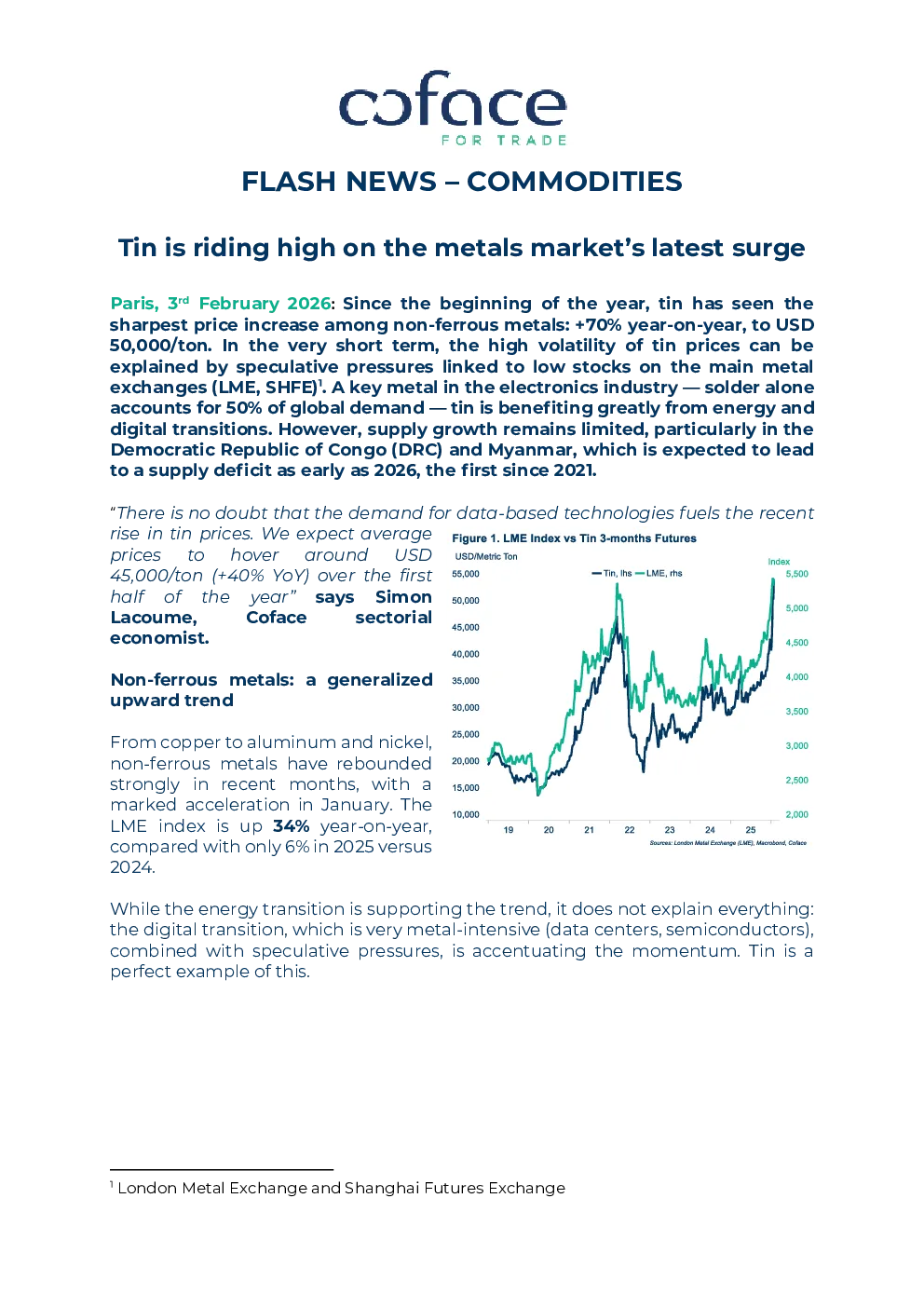
Tin is riding high on the metals market’s latest surge Paris,3rd February 2026:Since the beginning of the year, tin has seen the sharpest price increase among non-ferrous metals: +70% year-on-year, to USD50,000/ton. In the very short term, the high volatility of tin prices can beexplained by speculative pressures linked to low stocks on the main metalexchanges (LME, SHFE)1. A key metal in the electronics industry—solder aloneaccounts for 50% of global demand—tin is benefiting greatly fromenergyand “There is no doubt that thedemand fordata-based technologiesfuelsthe recent pricestohoveraroundUSD45,000/ton (+40% YoY) over the firsthalfoftheyear”saysSimonLacoume,Cofacesectorial Non-ferrous metals:a generalizedupward trend From copper toaluminumand nickel,non-ferrous metals have reboundedstronglyin recent months,with amarked acceleration in January. The While the energy transition is supporting the trend, it does not explain everything:the digital transition, which is very metal-intensive (datacenters, semiconductors), An emerging supply deficit and China's continued dominance Overall, refined tin production is expected to grow by3% in 2026, following 2%growth in 2025. This will be insufficient tooffsetthe expected 3.5%increase indemand in 2026. The market is thereforeFigure 2. Global production of tin ores (involume, 2025)ChinaIndonesiaMyanmarPeruBrazilDRC China accounts for50%of global refined tinproduction.Despiteanti-involution (+5%). Tin remains a strategic asset in China's quest for self-sufficiency in datamanagement infrastructure. Conversely, production inneighboring Indonesia2coulddecline,given regulatory constraints and growing aversion to mining The main vulnerability lies in tin ore supplies, particularly from the DemocraticRepublic of Congo (DRC) and Myanmar, which together account for20%of globalproduction and60%of Chinese tin ore imports. In the DRC, frequent skirmishesbetween M23 rebel forces and the Congolese regular army are having a negativeimpact on mining operations in North Kivu and regularly disrupting mining, An increasingly robust demand outlook, constrained by limited inventory cover In the very short term,following the surge incopper prices, speculative spillover effectshave amplified the upward trend in othermetal prices, including tin.In addition,2025low marketstockshave also supported thepriceincrease in the past few months. Over the longer term, industrial demand fortin is expected to keep trending higher.Thesurgeinelectronic componentsdemandwill technologiesrequestmetals-intensive infrastructures.Accordingto SEMI’s latestreport, global silicon wafer shipments are expected to rise by5.2% YoY in 2026 (after +5.4% in 2025), to13,500 million square inches(MSI).Innovation will improveefficiency,but not nearly enough to contain the surging demand driven by Strong demand, constrained by limited stocks In the very short term, the surge in copper prices spread to other metals, includingtin. In addition, relatively low levels on the main stock exchanges contributed to thissurge. The rebuilding of stocks at the same time as the bullish episode exacerbatedthe trend. However, price volatility should ease as speculative movements subside.In the longer term, demand for tin is expected to continue to grow, driven by theriseof semiconductors and data storage infrastructure,which are voracious COFACEPRESS OFFICE Adrien Billet: +33 6 59 46 59 15Malcolm Biiga : +33 6 47 09 92 66adrien.billet@coface.comLucie Bolelli : +33 6 42 18 30 82coface@havas.com COFACE: FOR TRADE As a global leading player in trade credit risk management for more than 75 years, Coface helpscompanies grow and navigate in an uncertain and volatile environment. Whatever their size, location or sector, Coface provides 100,000 clients across some 200 markets. with afull range of solutions: Trade Credit Insurance, Business Information, Debt Collection, Single Riskinsurance, Surety Bonds, Factoring. Every day, Coface leverages its unique expertise and cutting-edge