立即购买,稍后退货:零售商为客户忠诚度付费
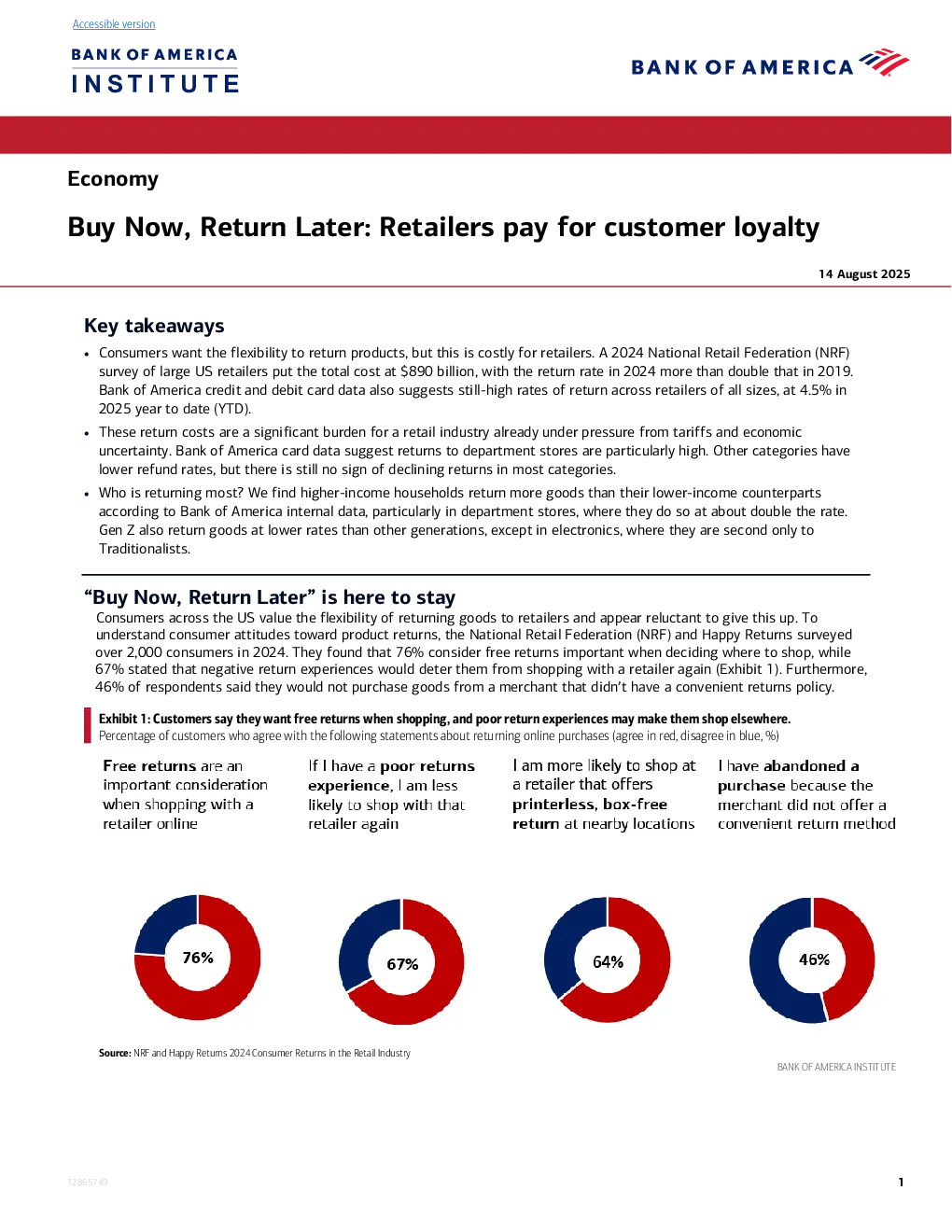
Buy Now, Return Later: Retailers pay for customer loyalty 14 August 2025 Key takeaways •Consumers want the flexibility to return products, but this is costly for retailers. A 2024 National Retail Federation (NRF)survey of large US retailers put the total cost at $890 billion, with the return rate in 2024 more than double that in 2019.Bank of America credit and debit card data also suggests still-high rates of return across retailers of all sizes, at 4.5% in2025 year to date (YTD). •These return costs are a significant burden for a retail industry already under pressure from tariffs and economicuncertainty. Bank of America card data suggest returns to department stores are particularly high. Other categories havelower refund rates, but there is still no sign of declining returns in most categories. •Who is returning most? We find higher-income households return more goods than their lower-income counterpartsaccording to Bank of America internal data, particularly in department stores, where they do so at about double the rate.Gen Z also return goods at lower rates than other generations, except in electronics, where they are second only toTraditionalists. “Buy Now, Return Later” is here to stayConsumers across the US value the flexibility of returning goods to retailers and appear reluctant to give this up. To understand consumer attitudes toward product returns, the National Retail Federation (NRF) and Happy Returns surveyedover 2,000 consumers in 2024. They found that 76% consider free returns important when deciding where to shop, while67% stated that negative return experiences would deter them from shopping with a retailer again (Exhibit 1). Furthermore,46% of respondents said they would not purchase goods from a merchant that didn’t have a convenient returns policy. Exhibit1: Customers say they want free returns whenshopping, and poor return experiences may make them shop elsewhere.Percentage of customers who agree with the following statements about returning online purchases (agree in red, disagree in blue, %) Large retailers pay a hefty price to satisfy consumer demands for flexible returnsBut while“buy now, return later”is a boon for consumers, it’s costly for retailers, pressuring them further at a time when their costs are already rising due to tariffs and they face uncertainty over the path of economic policy. The NRF survey alsopolled large retailers, with respondents estimating that nearly 17% of their annual sales would be returned in 2024 (Exhibit2). That is more than double the return rate in 2019 - leading NRF to estimate an $890 billion cost to retailers in the US(Exhibit 3). Despite these hefty costs and the challenges of managing the logistics, 68% of NRF survey respondents are prioritizingupgrades to their return capabilities, as consumer preferences dictate that retailers keep offering free returns as aretention tool. Exhibit2:Annual product return rates at large retailers wereapproaching 17% of sales in 2024Response to the question,“Of your total annual sales this year, what Exhibit3: Surveys of large retailers indicate that product returnscost the industry an estimated $890 billion in 2024Annual return levels ($bil) assuming $5.3 trillion direct and indirect percentage do you estimate will be returned?”, (%) impact of the retail sector on US GDP, per NRF What about smaller retailers? And how is 2025 going?The 2024 NRF survey sampled large US retailers with over $500 million in revenues, accounting for approximately 60% of revenues and employment in the retail sector based on the latest 2022 Census survey of firms by receipts andestablishment size. Bank of America credit and debit card data gives us a sense of how returns are impacting retailers of all sizes, as well asunderstanding recent 2025 trends, by analyzing how stores (both physical stores and online) are reimbursing consumers ontheir Bank of America cards. We define the‘retail return rate’as inflows from retail spending categories into Bank ofAmerica aggregated debit and credit card household accounts as a percentage of the total outflows consumers paid to thatcategory. Using this approach, Bank of America card data indicates that, since 2021, return rates at department stores (which tend tobe larger retailers) closely tracks the survey-based NRF return rate of around 16-17% (Exhibit 4). And in 2025 year-to-date,while we see no signs of a rise in the return rate, it remains above the 2019 rate, taking a bite out of these larger retailers’profits. Looking at all US retailers (including but not limited to department stores) regardless of size and excluding‘food’–groceries and restaurants–and gas, we find the overall return rate is significantly lower at around 4.5% (Exhibit 5). In ourview, this is likely because smaller retailers tend to have less generous returns policies. Many do not accept returns at all,while others give store credit instead. Nonetheless, Bank of America internal data shows that elevate