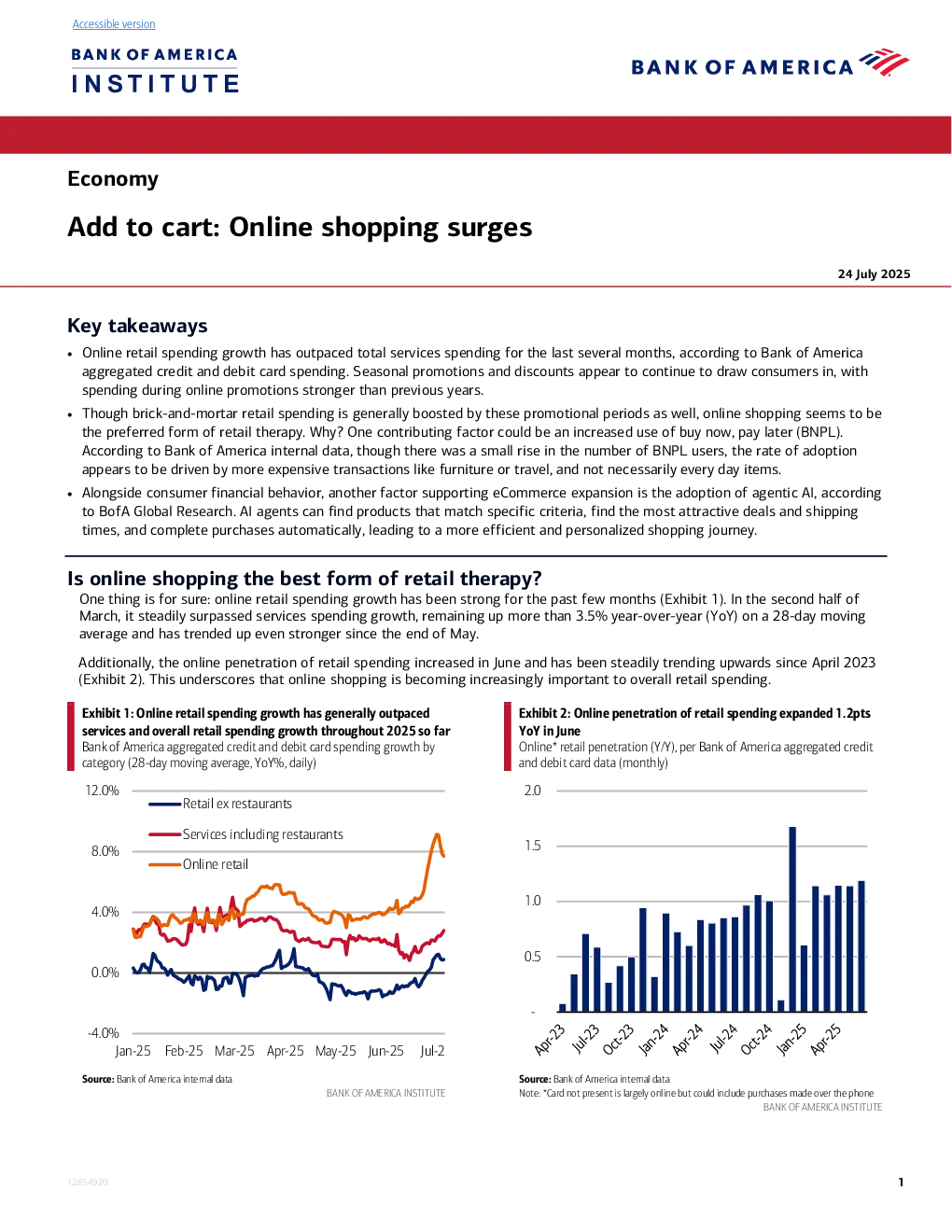
Add to cart: Online shopping surges Key takeaways •Online retail spending growth has outpaced total services spending for the last several months, according to Bank of Americaaggregated credit and debit card spending. Seasonal promotions and discounts appear to continue to draw consumers in, withspending during online promotions stronger than previous years. •Though brick-and-mortar retail spending is generally boosted by these promotional periods as well, online shopping seems to bethe preferred form of retail therapy. Why? One contributing factor could be an increased use of buy now, pay later (BNPL).According to Bank of America internal data, though there was a small rise in the number of BNPL users, the rate of adoptionappears to be driven by more expensive transactions like furniture or travel, and not necessarily every day items. •Alongside consumer financial behavior, another factor supporting eCommerce expansion is the adoption of agentic AI, accordingto BofA Global Research. AI agents can find products that match specific criteria, find the most attractive deals and shippingtimes, and complete purchases automatically, leading to a more efficient and personalized shopping journey. Is online shopping the best form of retail therapy?One thing is for sure: online retail spending growth has been strong for the past few months (Exhibit 1). In the second half of March, it steadily surpassed services spending growth, remaining up more than 3.5% year-over-year (YoY) on a 28-day movingaverage and has trended up even stronger since the end of May. Additionally, the online penetration of retail spending increased in June and has been steadily trending upwards since April 2023(Exhibit 2). This underscores that online shopping is becoming increasingly important to overall retail spending. Exhibit2:Online penetration of retailspendingexpanded 1.2ptsYoY in JuneOnline* retail penetration (Y/Y), per Bank of America aggregated credit Exhibit1: Online retail spending growth has generally outpacedservices and overall retail spending growth throughout 2025 so farBank of America aggregated credit and debit card spending growth by and debit card data (monthly) category (28-day moving average, YoY%, daily) Prime Day and other retail promotions push eCommerce forwardThe recent strength in online retail spending was driven in part by Amazon’s expanded Prime Day shopping event which ran four days this year, from July 8-11, and other retail promotions. These factors appear to have driven online retail spending upcompared to 2024 (Exhibit 3). And according to BofA Global Research, the increase in Bank of America aggregated credit and debit card spending perhousehold in the week ending July 12thwas mainly due to the expansion of and timing shift in Prime Day and other retailpromotions (Jul 8-11 '25 vs Jul 16-17 '24). Total online retail card spending per household (Index, 7-day ma of spending levels, 7-day ma as of July 16, 2024 = 100 and July 8, 2025 = 100) Buy now, pay later adoption could be fueling eCommerce gainsOnline spending may also be getting a boost as consumers turn to buy now, pay later (BNPL), a financing option that lets shoppers pay for products in small installments spread over a set period. Among the most common purchasing plans is“pay-in-four,”in which the consumer pays 25% of the transaction value upfront and makes three subsequent 25% payments every twoweeks. Others include installment plans, often used for larger purchases, as well as some with potential interest and fixedfinance charges. The share of Bank of America customers with a BNPL payment, mostly via a debit or credit card or automated clearing house(ACH) payment, in June 2025 rose by eight-tenths a percentage point (pp) from last year compared with a six-tenths pp increasein June 2024, suggesting continued, albeit gradual, adoption. A payment could be an initial payment, subsequent payment, or loanrepayment to buy now, pay later firms. Examining purchases by transaction size, the share of transactions >$50 as well as >$100 has increased (Exhibit 4) in 2025compared to prior years. By contrast, it appears the share of the number of transactions <$50 has declined, especially for those<$20 since the 2023 peak. This suggests consumers are more frequently using BNPL to make more expensive purchases, suchas furniture or travel, and not necessarily for everyday items like groceries. However, the bulk of transactions are <$50. Share of “light” and “extra heavy” use BNPL households has increasedUsing internal Bank of America data, we examined the number of BNPL payments per month and analyzed household data by frequency of use. Among our findings: the proportion of users who make the most and the least payments is accelerating. InJune, a majority of BNPL users were light, meaning they made 1-4 payments per month (Exhibit 5). Bank of America debit and credit card retail spending by households with 20 or more BNPL payments per month, our