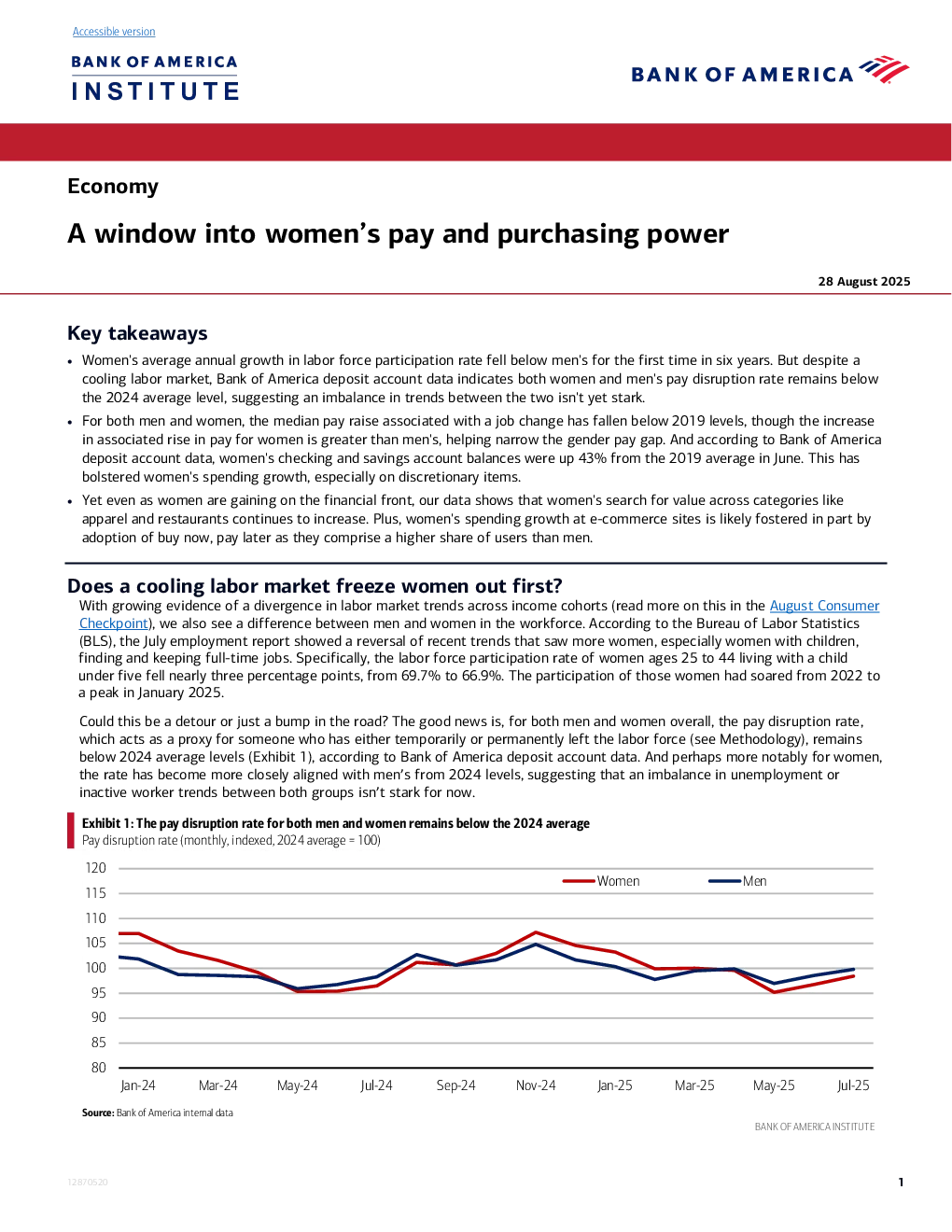
A window into women’s pay and purchasing power 28 August 2025 Key takeaways •Women's average annual growth in labor force participation rate fell below men's for the first time in six years. But despite acooling labor market, Bank of America deposit account data indicates both women and men's pay disruption rate remains belowthe 2024 average level, suggesting an imbalance in trends between the two isn't yet stark. •For both men and women, the median pay raise associated with a job change has fallen below 2019 levels, though the increasein associated rise in pay for women is greater than men's, helping narrow the gender pay gap. And according to Bank of Americadeposit account data, women's checking and savings account balances were up 43% from the 2019 average in June. This hasbolstered women's spending growth, especially on discretionary items. •Yet even as women are gaining on the financial front, our data shows that women's search for value across categories likeapparel and restaurants continues to increase. Plus, women's spending growth at e-commerce sites is likely fostered in part byadoption of buy now, pay later as they comprise a higher share of users than men. Does a cooling labor market freeze women out first?With growing evidence of a divergence in labor market trends across income cohorts (read more on this in theAugust Consumer Checkpoint), we also see a difference between men and women in the workforce. According to the Bureau of Labor Statistics(BLS), the July employment report showed a reversal of recent trends that saw more women, especially women with children,finding and keeping full-time jobs. Specifically, the labor force participation rate of women ages 25 to 44 living with a childunder five fell nearly three percentage points, from 69.7% to 66.9%. The participation of those women had soared from 2022 toa peak in January 2025. Could this be a detour or just a bump in the road? The good news is, for both men and women overall, the pay disruption rate,which acts as a proxy for someone who has either temporarily or permanently left the labor force (see Methodology), remainsbelow 2024 average levels (Exhibit 1), according to Bank of America deposit account data. And perhaps more notably for women,the rate has become more closely aligned with men’s from 2024 levels, suggesting that an imbalance in unemployment orinactive worker trends between both groups isn’t stark for now. When more women joined the labor force, recessions were milderHowever, the year-over-year (YoY) growth in the men’s labor force participation rate has outpaced women’s on average through July, reversing a trend from the past six years (Exhibit 2). For both genders, YoY growth has fallen below 2019 levels. Why does that matter? According to the Minneapolis Fed, in previous recessionary periods, as more women entered the laborforce, some aspects of downturns became milder. For example, as long as their participation was rising, women did notexperience sizable declines in hours during recessions and exhibited very strong growth in hours during recoveries. Plus, growthin women’s employment contributed substantially to total factor productivity (read more on this inMarch’s Productivitypublication). These results suggest that continued sustained growth in women’s employment after the early 1990s could have significantlyimproved economic performance in the United States.1Perhaps this could also help explain in part why, in the immediate yearsfollowing the pandemic, consumer and labor market resiliency was sustained (read more on this inJanuary’s What’s the power ofa woman’s wallet?). Chasing wage gains by changing jobs has moderatedAnother facet of slowing labor market trends has been the moderation in the rate at which people are changing jobs (read more on this inAugust’s publication on Job hoppers). And in fact, for both men and women, the growth in that rate has come downfrom last year, falling once again after seeing a brief recovery over the past few months (Exhibit 3). One reason for this:switching jobs no longer results in as big of a bump in pay. According to Bank of America internal data, for both men and women, the median pay raise associated with a job change (seeMethodology) has fallen below 2019 levels (Exhibit 4). On average through July, for men, the associated increase was 5.6%, whilewomen’s was 6.5%. For women, this marks continued progress in closing the gender pay gap (read more on this inMarch’sWomen and wealthpublication). Exhibit4:For both men and women, the pay raise associated with ajob change has fallen below 2019 average levelsMedian pay raise for job-to-job movers (annual average through year-to-date (YTD))* With more money, there’s more agency in spendingStronger wage growth for women–either through job changes or otherwise–drives further financial stability and fuels spending growth. And, in fact, Bank of America deposit account data found that women’s checking and savings account