人工智能革命是否提高了消费者的水电费?
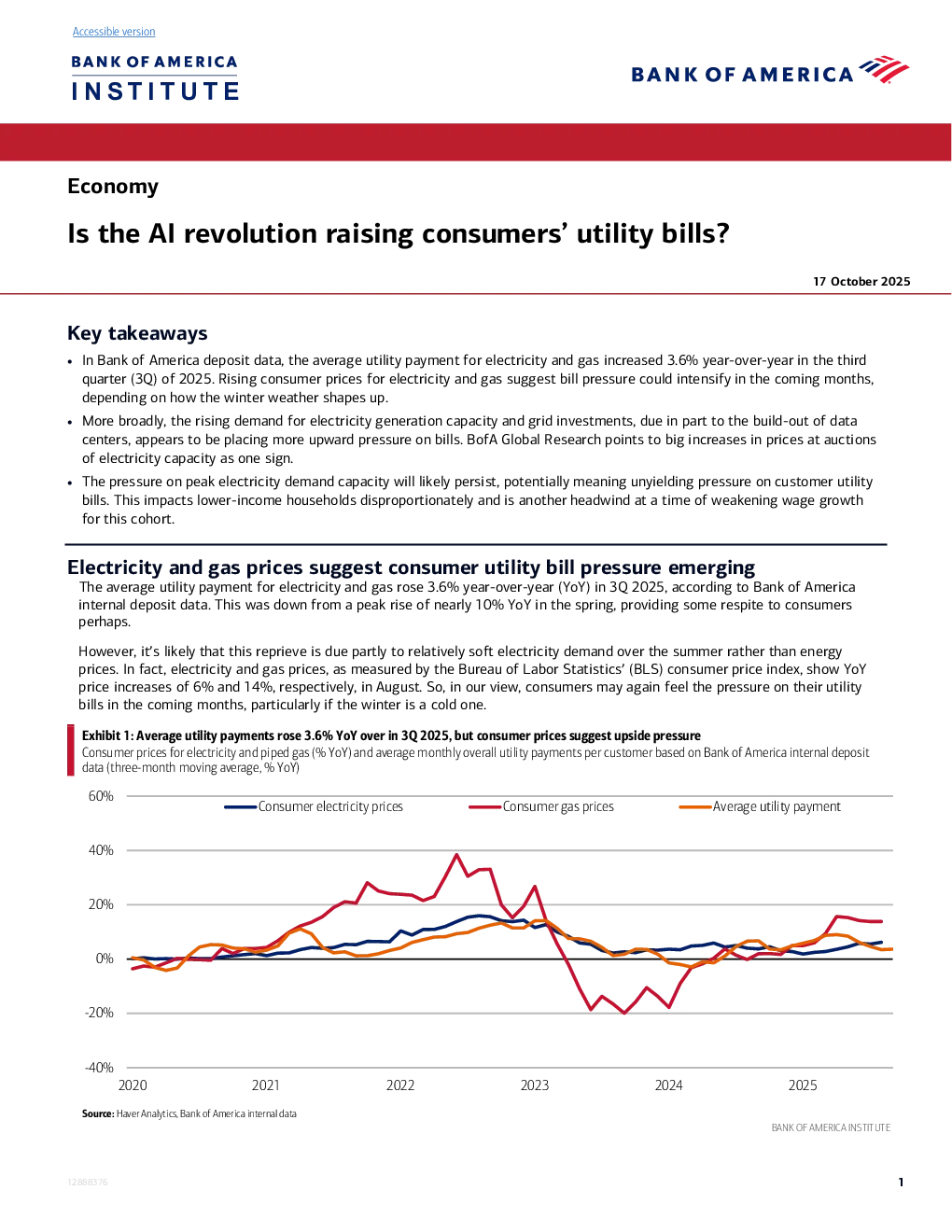
Is the AI revolution raising consumers’ utility bills? 17 October 2025 Key takeaways •In Bank of America deposit data, the average utility payment for electricity and gas increased 3.6% year-over-year in the thirdquarter (3Q) of 2025. Rising consumer prices for electricity and gas suggest bill pressure could intensify in the coming months,depending on how the winter weather shapes up. •More broadly, the rising demand for electricity generation capacity and grid investments, due in part to the build-out of datacenters, appears to be placing more upward pressure on bills. BofA Global Research points to big increases in prices at auctionsof electricity capacity as one sign. •The pressure on peak electricity demand capacity will likely persist, potentially meaning unyielding pressure on customer utilitybills. This impacts lower-income households disproportionately and is another headwind at a time of weakening wage growthfor this cohort. Electricity and gas prices suggest consumer utility bill pressure emergingThe average utility payment for electricity and gas rose 3.6% year-over-year (YoY) in 3Q 2025, according to Bank of America internal deposit data. This was down from a peak rise of nearly 10% YoY in the spring, providing some respite to consumersperhaps. However, it’s likely that this reprieve is due partly to relatively soft electricity demand over the summer rather than energyprices. In fact, electricity and gas prices, as measured by the Bureau of Labor Statistics’(BLS) consumer price index, show YoYprice increases of 6% and 14%, respectively, in August. So, in our view, consumers may again feel the pressure on their utilitybills in the coming months, particularly if the winter is a cold one. Exhibit1:Average utility paymentsrose3.6% YoYoverin 3Q2025, but consumer prices suggest upside pressureConsumer prices for electricity and piped gas (% YoY) and average monthly overall utility payments per customer based on Bank of America internal deposit data (three-month moving average, % YoY) Looking at major cities across the country, there is a relatively wide dispersion of consumer experiences. Average utilitypayments in Bank of America deposit data over the summer period rose by double-digit rates in Chicago and Tampa, forexample, but fell by over 10% in Las Vegas (Exhibit 2). The majority of cities have, however, seen YoY increases. Looking deeper, we find the average utility payment in these cities was still below the US average, even though payments rose alot in Chicago. On the other hand, some cities in the South and West had payments well above the US average. Exhibit2:There is a fairly wide dispersion of experience across thecountry in utility bill growth…Average monthly overall utility payments per customer by Core Based Exhibit3:…aswell as in bills compared to the US averageAverage monthly overall utility payments per customer relative to US average (3Q, %) Statistical Area (3Q 2025 compared to 3Q 2024, % YoY) Are data centers leading to higher utility bills for customers?It’s likely that different utility payment experiences across the US over the third quarter reflect, in part, variations in demand for energy over the summer (it was notably hot in parts of the country, such as Phoenix, boosting cooling demand), as well asdifferent regulatory structures governing utility supply across the country. But an important question both for understanding current utility bills and how they will evolve is whether energy demand–mostobviously electricity–from the explosive growth in AI and the associated build-out of data centers is also pressuring residentialbills? Indeed, BofA Global Research sees manufacturing and data centers as important drivers of electricity demand over the next10 years (Exhibit 4). Also worth noting–increasingly residential electrification including in vehicles is also pushing electricitydemand up. Exhibit4:BofA Global Research expects US electrical demand toincreaseat a 2.5%compound annual growth rate (CAGR)over 2024-35EUS electrical demand (in terawatt hours per year) 2014-2035E(estimates/forecast from 2025) BofA Global Research argues that rising demand for electricity from both data center development and manufacturing growth isalreadybeing reflected in residential customer rates. The impact runs through the spending on enhancements to the transmission and distribution grid required for data center build-outs, which is incorporated into the tariffs of all the ratepayers (residential, commercial and industrial) on the system, and theninto both higher energy and capacity pricing. Capacity prices are charged to ensure future electricity demand will be reliably met and BofA Research points to capacityauctions in the Pennsylvania-New Jersey-Maryland Interconnection (PJM) region as an example of rising cost pressure. PJM is aregional transmission organization (RTO) covering around 65 million customers in the eastern US. It hosts an open andcompetitive auction proce