您的浏览器禁用了JavaScript(一种计算机语言,用以实现您与网页的交互),请解除该禁用,或者联系我们。 [美国银行]:人工智能时代的经济变化 - 发现报告

人工智能时代的经济变化

信息技术 2025-10-01 美国银行 朝新G
报告封面

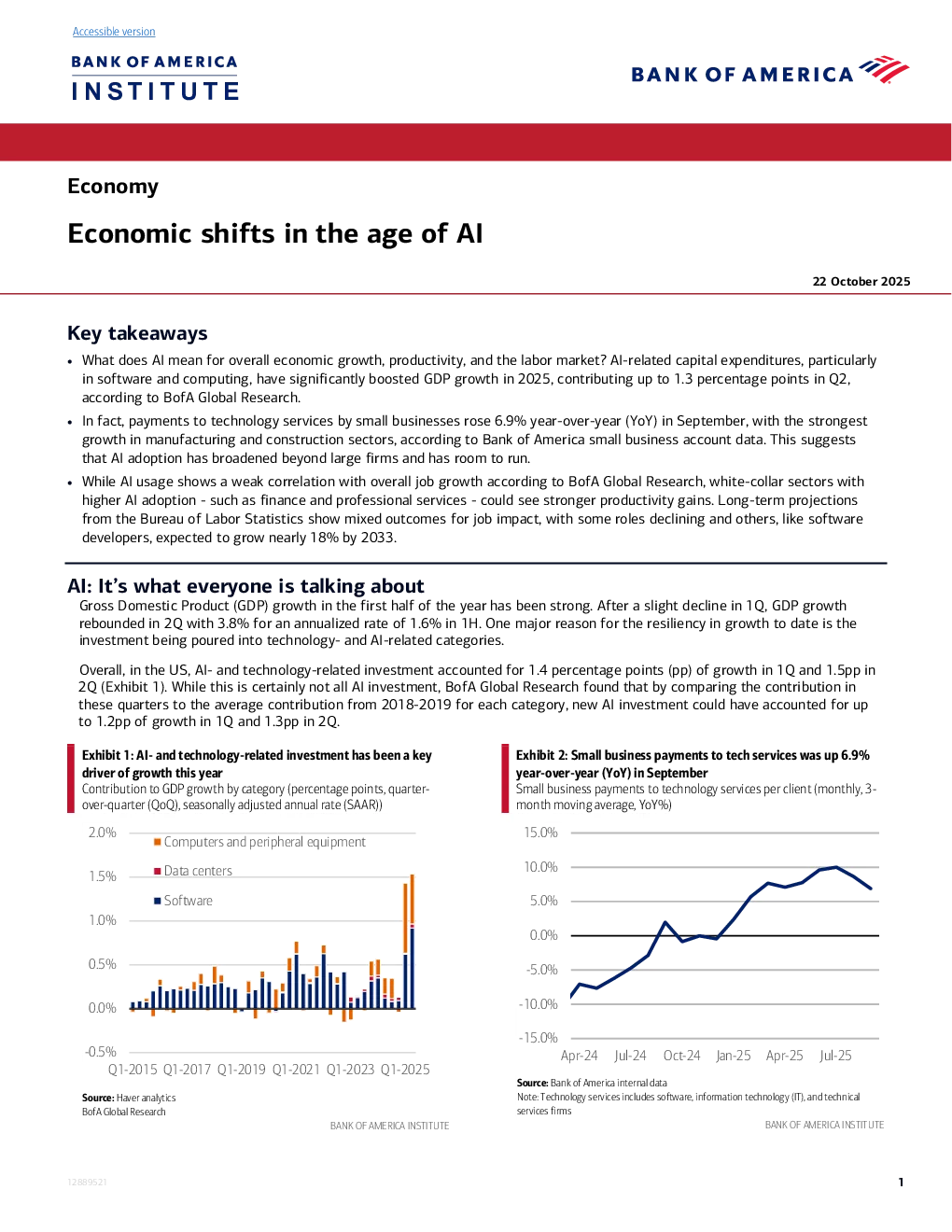
Economic shifts in the age of AI Key takeaways •What does AI mean for overall economic growth, productivity, and the labor market? AI-related capital expenditures, particularlyin software and computing, have significantly boosted GDP growth in 2025, contributing up to 1.3 percentage points in Q2,according to BofA Global Research. •In fact, payments to technology services by small businesses rose 6.9% year-over-year (YoY) in September, with the strongestgrowth in manufacturing and construction sectors, according to Bank of America small business account data. This suggeststhat AI adoption has broadened beyond large firms and has room to run. •While AI usage shows a weak correlation with overall job growth according to BofA Global Research, white-collar sectors withhigher AI adoption - such as finance and professional services - could see stronger productivity gains. Long-term projectionsfrom the Bureau of Labor Statistics show mixed outcomes for job impact, with some roles declining and others, like softwaredevelopers, expected to grow nearly 18% by 2033. AI: It’s what everyone is talking aboutGross Domestic Product (GDP) growth in the first half of the year has been strong. After a slight decline in 1Q, GDP growth rebounded in 2Q with 3.8% for an annualized rate of 1.6% in 1H. One major reason for the resiliency in growth to date is theinvestment being poured into technology- and AI-related categories. Overall, in the US, AI- and technology-related investment accounted for 1.4 percentage points (pp) of growth in 1Q and 1.5pp in2Q (Exhibit 1). While this is certainly not all AI investment, BofA Global Research found that by comparing the contribution inthese quarters to the average contribution from 2018-2019 for each category, new AI investment could have accounted for upto 1.2pp of growth in 1Q and 1.3pp in 2Q. Exhibit1: AI-and technology-related investment has been a keydriver of growth this yearContribution to GDP growth by category (percentage points, quarter- Exhibit2:Small business payments to tech services was up 6.9%year-over-year (YoY) in SeptemberSmall business payments to technology services per client (monthly, 3- over-quarter (QoQ), seasonally adjusted annual rate (SAAR)) month moving average, YoY%) In fact, looking at Bank of America small business account data, we find small firms have continued to prioritize tech spendingamongst the overall uncertain economic backdrop (read more on this inSeptember’s Small Business Checkpoint). In September,payments to technology services from small businesses increased 6.9% YoY (Exhibit 2). And across different sectors,manufacturing and construction have had the highest levels of growth (Exhibit 3). AI investment has room to runEven if import frontloading is overstating its short-term contribution to growth, the good news for the economy is that AI investment is a theme that could continue to be a positive driver of growth, per BofA Global Research. It is worth noting,however, that if investment is import-heavy, its overall contribution to GDP growth would be overstated. Data centers are just one piece of the AI puzzle…The strength of AI/tech investment can mostly be attributed to investment in software, computers and peripheral equipment (devices like computer printers or monitors). And although data centers are also a component to this growth, data centerstructures are just a small fraction of overall investment, according to BofA Global Research. That said, data centers are one of the lone bright spots of large and expensive structures investment, which has remaineddepressed since December 2023, following years of fiscal stimulus (Exhibit 4). Fading stimulus from the Inflation Reduction Actand elevated interest rates have contributed to a decline in overall structures investment since 1Q 2024. Exhibit5:A surge in demand from AI-related sectors might explainenergy services inflation outpacing headline consumer price index(CPI)CPI Energy services and Headline CPI (% y/y, monthly) Exhibit4: Data centers is one of the only positive structuresinvestment categories, but note the tiny magnitudeStructures investment by type (chained to$2017bn, monthly, SAAR) ,,,but data centers demand increased power from utilitiesThe constraints from power may already be hitting some limits, or at the very least generating spillover costs due to data centers energy demand. Indeed, consumers have seen energy prices outpace overall prices this year (Exhibit 5). And there issome evidence that prices have increased more in areas with greater data center demand (read more on this inOctober’sutilities publication). Of course, increased demand for power should also lead to more investment by utility companies, which could be anothertailwind for capex (Exhibit 6). Fading uncertainty and favorable tax treatment on capex from the One Big Beautiful Bill Act couldalso lead to a broadening out of investment next year to be more than just an AI story. However, if these