您的浏览器禁用了JavaScript(一种计算机语言,用以实现您与网页的交互),请解除该禁用,或者联系我们。 [美国银行]:区域综述:中西部流行音乐 - 发现报告

区域综述:中西部流行音乐

文化传媒 2025-11-01 美国银行 EMJENNNY
报告封面

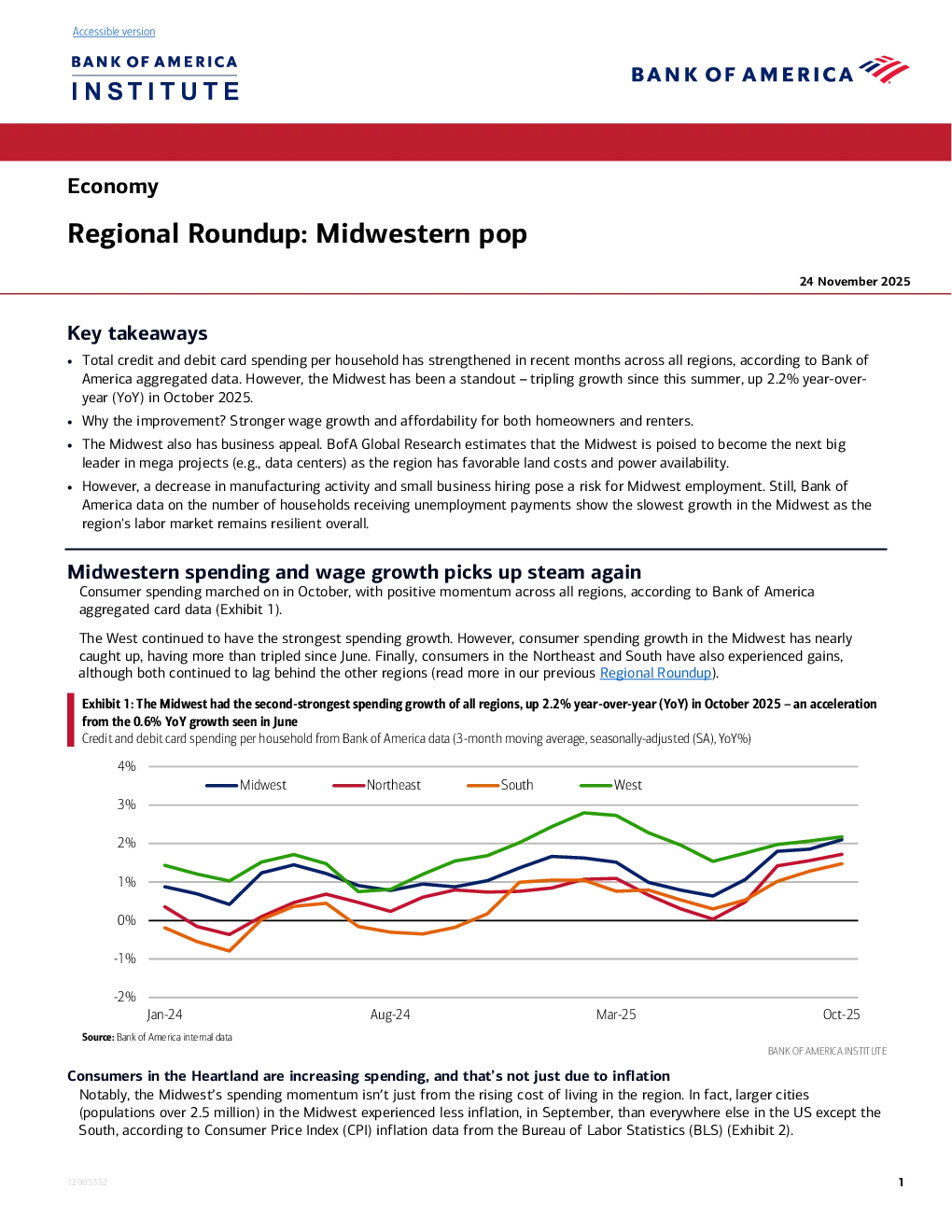
Regional Roundup: Midwestern pop Key takeaways •Total credit and debit card spending per household has strengthened in recent months across all regions, according to Bank ofAmerica aggregated data. However, the Midwest has been a standout–tripling growth since this summer, up 2.2% year-over-year (YoY) in October 2025.•Why the improvement? Stronger wage growth and affordability for both homeowners and renters.•The Midwest also has business appeal. BofA Global Research estimates that the Midwest is poised to become the next bigleader in mega projects (e.g., data centers) as the region has favorable land costs and power availability.•However, a decrease in manufacturing activity and small business hiring pose a risk for Midwest employment. Still, Bank ofAmerica data on the number of households receiving unemployment payments show the slowest growth in the Midwest as theregion's labor market remains resilient overall. Midwestern spending and wage growth picks up steam againConsumer spending marched on in October, with positive momentum across all regions, according to Bank of America aggregated card data (Exhibit 1). The West continued to have the strongest spending growth. However, consumer spending growth in the Midwest has nearlycaught up, having more than tripled since June. Finally, consumers in the Northeast and South have also experienced gains,although both continued to lag behind the other regions (read more in our previousRegional Roundup). Exhibit1:The Midwesthad thesecond-strongest spending growth of all regions, up 2.2% year-over-year (YoY) inOctober2025–an accelerationfrom the 0.6% YoY growth seen in JuneCredit and debit card spending per household from Bank of America data (3-month moving average, seasonally-adjusted(SA), YoY%) Consumers in the Heartland are increasing spending, and that’s not just due to inflationNotably, the Midwest’s spending momentum isn’t just from the rising cost of living in the region. In fact, larger cities (populations over 2.5 million) in the Midwest experienced less inflation, in September, than everywhere else in the US except theSouth, according to Consumer Price Index (CPI) inflation data from the Bureau of Labor Statistics (BLS) (Exhibit 2). So, what are Midwestern consumers increasing their spending on? The strongest spending growth can be seen in generalmerchandise and restaurants (Exhibit 3), reflecting a broader trend of consumers searching for discounts and deals, whilefavoring smaller splurges (read more in theNovember Consumer Checkpoint). And while there has been a spending decline onbigger ticket retail (e.g., furniture, electronics, building materials) and travel, Midwesterners aren’t pulling back as much as otherregions. Exhibit3:Midwestern households hadstrongerdiscretionaryspending growth than other regionsCredit and debit card spending per household by select categories from Exhibit2:CPI growth has been slower in larger Midwestern citiescompared to similar sized cities in the Northeast and WestConsumer price index for all items – US city average – by city size Bank of America data (3-month moving average to October 2025, SA,YoY%) (September 2025, YoY%) Positive wage growth momentum provides support for spending growth in the MidwestThe strength in Midwestern spending is likely related, in part, to the improvement in wage growth over the past year (Exhibit 4). While growth was similar across all regions in October, rising around 2.5% YoY; it has improved the most in the Midwestcompared to earlier this year and 2024. After-tax wage and salary growth by region, based on Bank of America aggregated consumer deposit data (YoY%, 3-month moving average, SA) The Midwest tops the US affordability leaderboard – again Rents across the Midwest remained cheaper than the national medianAnother reason for Midwest spending strength–affordability. Housing, often a household’s largest expense, is a prime example. Median rents in many major Midwestern cities are lower than the national median, according to Bank of America internal data.And this is especially true for lower-income consumers. While overall rents in Chicago are about 7% lower than the nationalmedian, they are 14% less for individuals with lower incomes (Exhibit 5). Meanwhile, Columbus, Indianapolis, and St. Louis showsimilar patterns for rental affordability. Affordability extends beyond housing, making the Midwest the most cost-effective region to put down rootsBuying a home is much more affordable in the Midwest as well. Though housing costs have risen across the US since 2020, as of September, the Midwest remained the most affordable region in the US to purchase a home, according to data from theNational Association of Realtors (Exhibit 6). And it’s not just housing–the region also ranks among those with the fewest households living paycheck to paycheck (readmore inPaycheck to Paycheck). As a result, more consumers likely have enough money left over for“nice to have”spending afterp