亚洲展望:未来一周
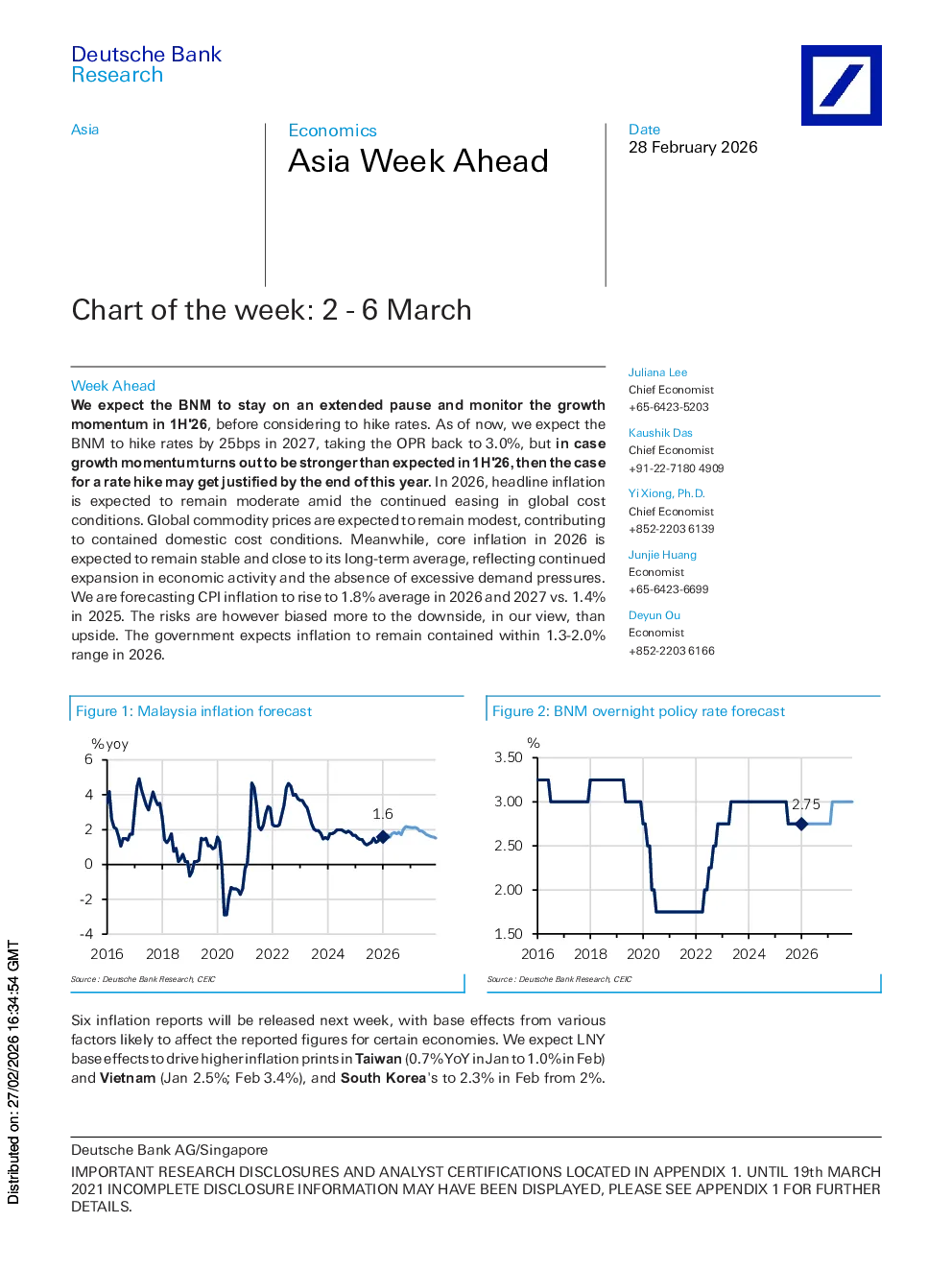
Chart of the week: 2 - 6 March Juliana Lee Week Ahead Chief Economist+65-6423-5203 We expect the BNM to stay on an extended pause and monitor the growthmomentum in 1H'26, before considering to hike rates. As of now, we expect theBNM to hike rates by 25bps in 2027, taking the OPR back to 3.0%, butin casegrowth momentum turns out to be stronger than expected in 1H'26, then the casefor a rate hike may get justified by the end of this year.In 2026, headline inflationis expected to remain moderate amid the continued easing in global costconditions. Global commodity prices are expected to remain modest, contributingto contained domestic cost conditions. Meanwhile, core inflation in 2026 isexpected to remain stable and close to its long-term average, reflecting continuedexpansion in economic activity and the absence of excessive demand pressures.We are forecasting CPI inflation to rise to 1.8% average in 2026 and 2027 vs. 1.4%in 2025. The risks are however biased more to the downside, in our view, thanupside. The government expects inflation to remain contained within 1.3-2.0%range in 2026. Kaushik DasChief Economist+91-22-7180 4909 Yi Xiong, Ph.D.Chief Economist+852-2203 6139 Junjie Huang Economist+65-6423-6699 Deyun OuEconomist+852-2203 6166 Six inflation reports will be released next week, with base effects from variousfactors likely to affect the reported figures for certain economies. We expect LNYbase effects to drive higher inflation prints inTaiwan(0.7% YoY in Jan to 1.0% in Feb)andVietnam(Jan 2.5%; Feb 3.4%), andSouth Korea's to 2.3% in Feb from 2%. 28 February 2026Asia Week Ahead Thailand's negative inflation is expected to improve (Jan -0.7%; Feb -0.3%) as lowbase effects gradually work through in 2026. InIndonesia, low base from electricitysubsidies from 2025 is likely to keep headline inflation above BI's 1.5-3.5% target(Jan 3.6%; Feb 3.7%). We forecastPhilippinesinflation in Feb to be contained at thelower end of BSP's 2-4% target (Jan 2%; Feb 2.1%), but low base effects thereafterwill likely bring inflation towards the upper half of that range. Also affected by the LNY distortion, Hong Kong retail sales will likely slow inJanuary, with value and volume dropping to -2% YoY and -3.5% YoY, respectively.However, we are expecting a solid recovery in February, based on the strongperformance of Chinese consumer during the LNY holiday. Financial conditions indicators (FCIs) Advanced Asia FCIs have diverged in the last week. Hong Kong and Singaporeexperienced a tightening of their FCIs due to stock market correction. Conversely,South Korea and Taiwan saw their FCIs ease, as their equity markets continued tobe supported by sustained strength in chip demand amid advancements in AIagents. Week in review China LNY holiday saw a significant rise in travel and consumption. Tourismexperienced an 18% YoY increase in both visitors and revenue, with stable per-person spending. It was mainly attributed to the policy efforts, including theinvoice-based lottery draw pilot and local government subsidies. Consumersentiment may have also improved among higher-income groups, evident by thestrong performance in outbound tourism and price increases. We reiterate ourforecast that consumption will likely remain the largest contributor to growth in2026 (2.5ppt out of 4.5% growth), leading the CPI to re-inflate to 1.5%. The Financial Secretary of the HKSAR announced the budget for the FY 2026-27.Our main takeaway from HKSAR's 2026-27 Budget Speech is that the Hong Konggovernmentis further breaking free from the"positive non-intervention"philosophy to direct more resources to the long-term economic developmentgoals, including through increased capital expenditure. Proactively aligning withmainland China's 15th Five-Year Plan and formulating Hong Kong's first five-yearplan is a prominent manifestation of this policy pivot. As we expected, the Bank of Thailand (BoT) cut its policy rate by 25bps to 1%tosupport economic recovery. It sought to ease debt burdens for SMEs andhouseholds, amid sustained credit contraction as financial institutions remainedcautious. More importantly, the BoT sought to anchor inflation expectations, amid"heightened downside risks." In fact it saw a further delay in headline inflation to thetarget range - from H1/27 to H2/27. It sees limited demand-driven inflationarypressure amid weakened purchasing power, while competition intensified, withthe baht's appreciation exacerbating liquidity conditions for exporters, particularlyin sectors producing exchange-rate-sensitive goods such as agricultural products,agro-manufacturing, and textiles and apparel. While the BoT sees the current policyrate of 1% as being "sufficiently accommodative", it also called for integratedpolicies and other targeted financial measures to enhance productivity andstrengthen the competitiveness of the business sector, while underlying "thelimited (monetary) policy space.In our view, while the BoT kept the door open forf