核心焦点与主题:伊朗的不确定性、希望以及我们的首选交易
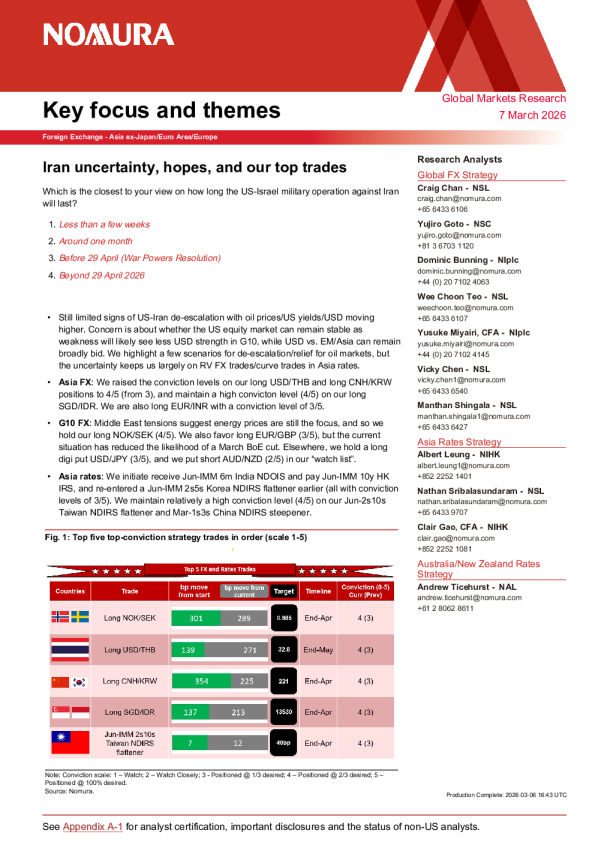
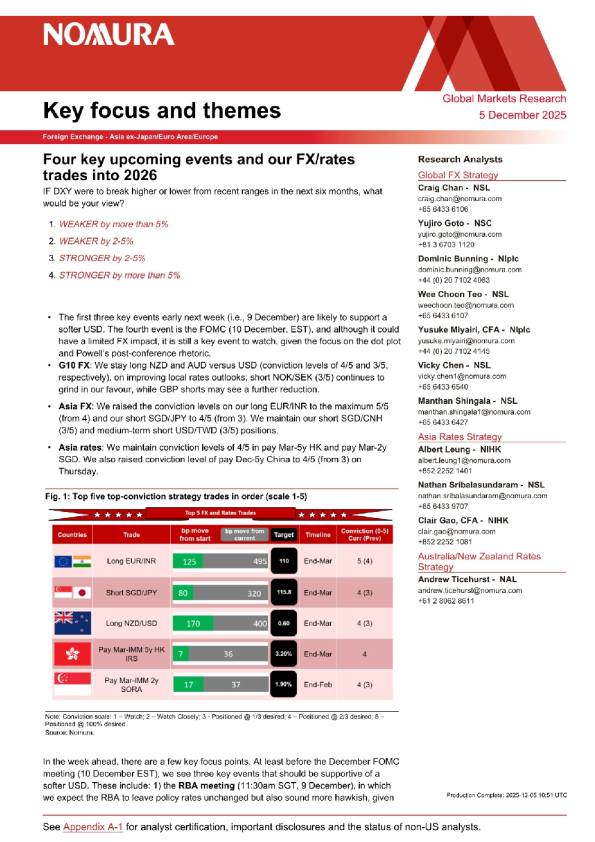
Key focus and themes Foreign Exchange - Asia ex-Japan/Euro Area/Europe Research Analysts Iran uncertainty, hopes, and our top trades Global FX Strategy Craig Chan-NSLcraig.chan@nomura.com+65 6433 6106 Which is the closest to your view on how long the US-Israel military operation against Iranwill last? Less than a few weeks1.Around one month2.Before 29 April (War Powers Resolution)3.Beyond 29 April 20264. Yujiro Goto-NSCyujiro.goto@nomura.com+81 3 6703 1120 Dominic Bunning-NIplcdominic.bunning@nomura.com+44 (0) 20 7102 4063 Wee Choon Teo-NSLweechoon.teo@nomura.com+65 6433 6107 Still limited signs of US-Iran de-escalation with oil prices/US yields/USD movinghigher. Concern is about whether the US equity market can remain stable asweakness will likely see less USD strength in G10, while USD vs. EM/Asia can remainbroadly bid. We highlight a few scenarios for de-escalation/relief for oil markets, butthe uncertainty keeps us largely on RV FX trades/curve trades in Asia rates.• Yusuke Miyairi, CFA-NIplcyusuke.miyairi@nomura.com+44 (0) 20 7102 4145 Vicky Chen-NSLvicky.chen1@nomura.com+65 6433 6540 Asia FX: We raised the conviction levels on our long USD/THB and long CNH/KRWpositions to 4/5 (from 3), and maintain a high convicton level (4/5) on our longSGD/IDR. We are also long EUR/INR with a conviction level of 3/5.• Manthan Shingala-NSLmanthan.shingala1@nomura.com+65 6433 6427 G10 FX:Middle East tensions suggest energy prices are still the focus, and so wehold our long NOK/SEK (4/5). We also favor long EUR/GBP (3/5), but the currentsituation has reduced the likelihood of a March BoE cut. Elsewhere, we hold a longdigi put USD/JPY (3/5), and we put short AUD/NZD (2/5) in our “watch list”.• Asia Rates Strategy Albert Leung-NIHKalbert.leung1@nomura.com+852 2252 1401 Asia rates:We initiate receive Jun-IMM 6m India NDOIS and pay Jun-IMM 10y HKIRS, and re-entered a Jun-IMM 2s5s Korea NDIRS flattener earlier (all with convictionlevels of 3/5). We maintain relatively a high conviction level (4/5) on our Jun-2s10sTaiwan NDIRS flattener and Mar-1s3s China NDIRS steepener.• Nathan Sribalasundaram-NSLnathan.sribalasundaram@nomura.com+65 6433 9707 Clair Gao, CFA-NIHKclair.gao@nomura.com+852 2252 1081 Australia/New Zealand RatesStrategy Andrew Ticehurst-NALandrew.ticehurst@nomura.com+61 2 8062 8611 Production Complete: 2026-03-06 16:43 UTC We highlighted inKFAT two weeksagothat military action on Iran could end upbeing a significant negative on risk markets/higher oil prices.Following the militarystrikes from US-Israel on Iran (28 February 2026),our view remained on the cautious sideowing to uncertainties over ships (energy-related) being able to pass through the Strait ofHormuz and the duration of the military action. From pre-military strike levels, oil priceshave continued to move higher (~20%+), dragging up US yields (10Y: +23bp), the broadUSD (especially against EM/Asia FX; DXY: +1.8%), and affecting equity markets (KOSPI:-11%; DAX: -6%). However, the surprise has been the relative resilience of US equities,with S&P only down ~0.7% and Nasdaq close to flat (from the close prices before themilitary strikes). The risk we see from here isthat ifUS yields continue to rise on higher oilprice/inflation concerns, this couldadversely affectUS corporate sector/equitymarkets.Making this potentially worse is whether these higher oil/inflation concerns arecombined with weaker US economic data (February NFP -92K vs. consensus +55K). Webelieve the risks are building and owing to the non-linear nature of markets, there couldeventually be a swift move lower in US equities. For the USD, this scenariocould see achange in the recent dynamics,with slightly less USD strength in G10 – especially againstthe JPY, and likely (at a minimum), slow the recent pace of EUR depreciation (-2% vs.USD since 27 February close). There are already some signs of aslowdownin foreignportfolio investments into the US from January into February (our high frequency monitorof US ETF and mutual fund flows), but outflows (or even a further slowdown in inflows)could see the USD lose some of its recent momentum owing to the need of the US tofinance its large twin deficits. We currently see the risks skewed towards negativity for risk markets,as there arestill limited signs of any de-escalation from both sides.President Trump hashighlighted the US should have a say in choosing Iran’s next leader (5 March, Reuters)following Iranian media suggesting Khamenei’s son Mojtaba (noted to be a “hardliner”;“anti-Western”; “religious fanatic”; The Guardian, 4 March) will be named the newSupreme Leader (Iran International, 3 March). This reduces scope for a US-Iranagreement/de-escalation. The rhetoric and actions from both sides also remain on anescalation path with US War Secretary Pete Hegseth saying “we have only just begun tofight and fight decisively… sustain this campaign as long as we need to” (US departmentof War, 5 March), while Iran’s army noted (