您的浏览器禁用了JavaScript(一种计算机语言,用以实现您与网页的交互),请解除该禁用,或者联系我们。[国际能源署光伏电力系统项目]:任务15 建筑光伏一体化(BIPV)发展赋能框架——BIPV:太阳能建筑教育与培训活动 - 发现报告

任务15 建筑光伏一体化(BIPV)发展赋能框架——BIPV:太阳能建筑教育与培训活动

任务15 建筑光伏一体化(BIPV)发展赋能框架——BIPV:太阳能建筑教育与培训活动

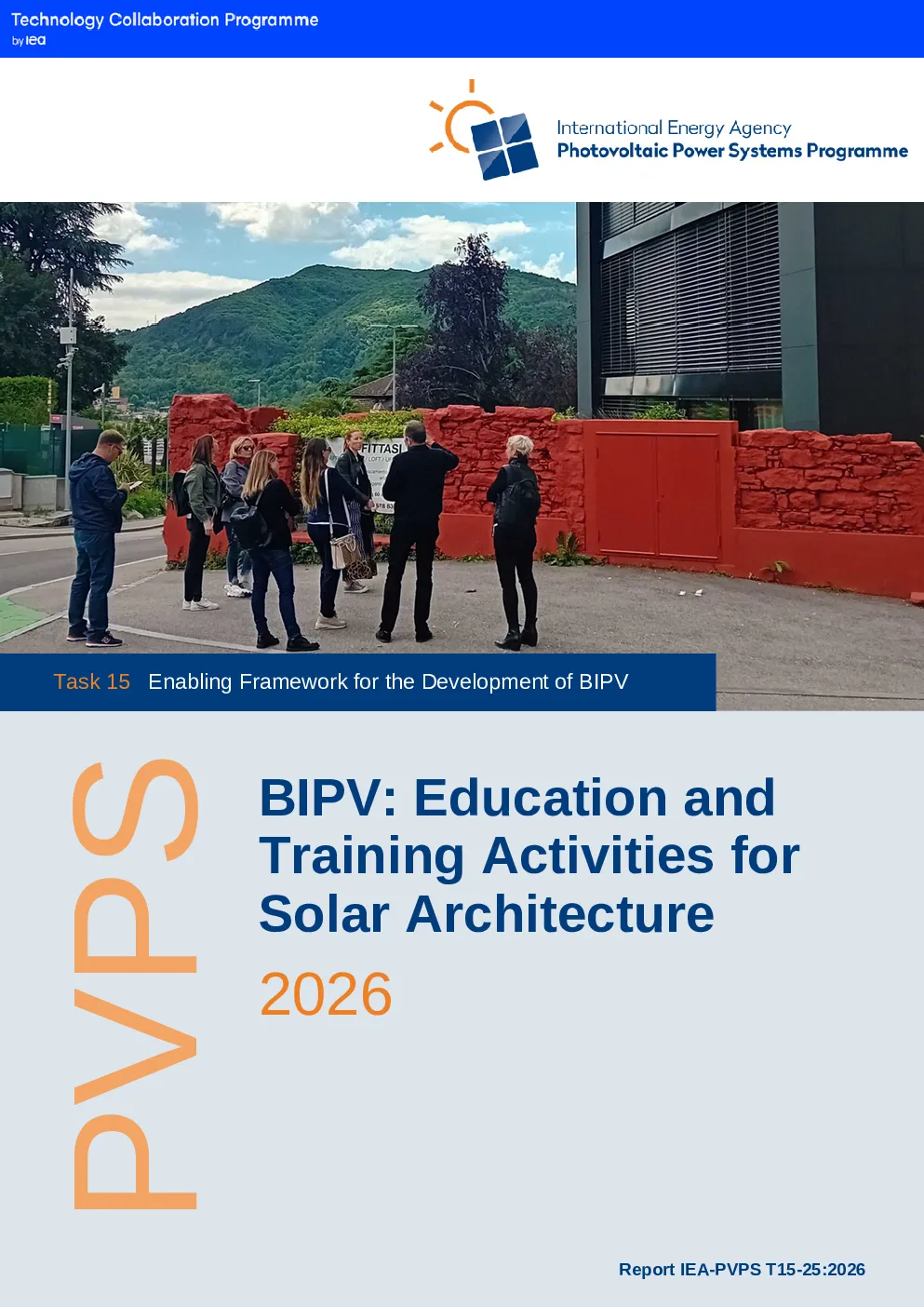
BIPV: Education andTraining Activities forSolar Architecture 2026 What is IEA PVPS TCP? The International Energy Agency (IEA), founded in 1974, is an autonomous body within the framework of theOrganisationfor Economic Cooperation and Development (OECD). The Technology Collaboration Programme (TCP) was created withthebelief that the future of energy security and sustainability starts with global collaboration. The programme is made upof 6.000 experts across government, academia, and industry dedicated to advancing common research and the applicationof specific energy technologies. The IEA Photovoltaic Power Systems Programme (IEA PVPS) is one of theTCPswithin the IEA and was established in1993. The mission of the programme is to “enhance the international collaborative efforts which facilitate the role ofphotovoltaic solar energy as a cornerstone in the transition to sustainable energy systems”.In order to achieve this, theprogramme’s participants have undertaken a variety of joint research projects in Photovoltaic (PV)power systemsapplications. The overall programme is headed by an Executive Committee, comprised of one delegate from each countryor organisation member, which designates distinct ‘Tasks’ that may be research projects or activity areas. The IEA PVPS participating countries are Australia, Austria, Belgium, Canada, China, Denmark, Finland, France,Germany, India, Israel, Italy, Japan, Korea, Lithuania, Malaysia, Morocco, the Netherlands, Norway, Portugal, SouthAfrica, Spain, Sweden, Switzerland, Thailand,Türkiye, the United Kingdom and the United States of America. TheEuropean Commission, Solar Power Europe and the Solar Energy Research Institute of Singapore are alsomembers. Visit us at:www.iea-pvps.org What is IEA PVPSTask15? The objective of Task15 ofthe IEA Photovoltaic Power Systems Programme isto create an enabling framework toaccelerate the penetration ofBuilding-Integrated Photovoltaics (BIPV)products in the global market of renewables,resulting in an equal playing field for BIPV products,Building-Applied Photovoltaics(BAPV)products and regular buildingenvelope components, respecting especially economic, technological, legal, aesthetic, reliability and normative issues. DISCLAIMER TheIEAPVPSTCPisorganisedundertheauspicesoftheInternationalEnergyAgency(IEA)butisfunctionallyandlegallyautonomous. Views,findings and publications of the IEA PVPS TCP do not necessarily represent the views or policies of the IEA Secretariat or its individualmembercountries. COPYRIGHT STATEMENT Thiscontent may be freely used, copied and redistributed, providedappropriate credit is given(please refer to the ‘Suggested Citation’). Theexception is that some licensed images may not becopied, as specified in the individual image captions. SUGGESTED CITATION Bonomo P., Frontini F. (2026),BIPV: Education and Training Activities for Solar Architecture(Report No.T15-25:2026). IEA PVPS Task 15.https://iea-pvps.org/key-topics/t15-bipv-education-training-2026/DOI:10.69766/QIFD7298 COVER PICTURE Fieldvisittoa solar building during the advanced training “SolarchitectureEssentials” in Ticino, Switzerland (photo: SUPSI). BIPV: Education andTrainingActivities forSolarArchitecture IEA PVPS Task15Enabling Framework for the Development of BIPV Report IEA-PVPST15-25:2026February-2026 ISBN:978-1-923734-00-5DOI: 10.69766/QIFD7298 Main Authors Pierluigi Bonomo, SUPSI, SwitzerlandGreta Battaglia, SUPSI, SwitzerlandFrancesco Frontini, SUPSI, SwitzerlandSune Thorsteinsson, DTU, DenmarkNuria MartínChivelet, CIEMAT, Spain,Rebecca Yang, University of Melbourne, AustraliaMomir Tabakovic, FHTW Wien, AustriaAstrid Schneider, AustriaBjörn Rau, HZB, GermanyGabriele Lobaccaro, NTNU, NorwayTahmineh Akbarinejad, NTNU, NorwayKhushal Matai,SPA Delhi, IndiaKim Jun-Tae, Kongju National University, South KoreaChristopher Klinga, Architectural Solar Association, USALuis Fernando Mulcue Nieto,BIPV Solar Consulting, USA Editors Pierluigi Bonomo, SUPSI, SwitzerlandFrancesco Frontini, SUPSI, Switzerland Acknowledgements...........................................................................................................7List of abbreviations..........................................................................................................8Glossary............................................................................................................................9Executive summary...........................................................................................................101Introduction and reference framework....................................................................112Education and training in BIPV: Database definition..............................................132.1Introduction.................................................................................................132.2Methodology...............................................................................................133BIPV co