您的浏览器禁用了JavaScript(一种计算机语言,用以实现您与网页的交互),请解除该禁用,或者联系我们。 [世界银行]:从公司层面数据看全球价格监管(英) - 发现报告

从公司层面数据看全球价格监管(英)

金融 2026-01-01 世界银行 徐红金
报告封面

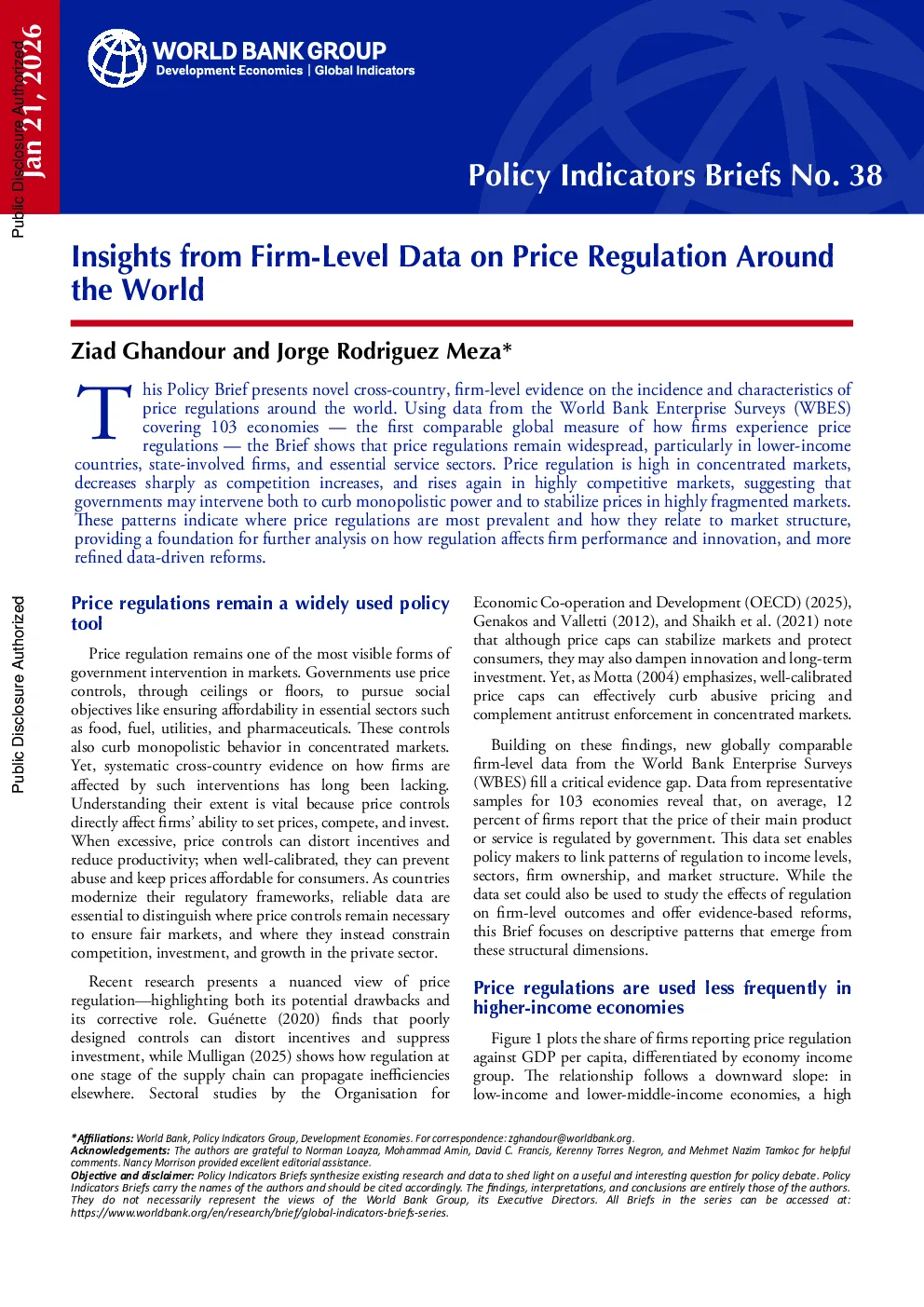
Ziad Ghandour and Jorge Rodriguez Meza*T his Policy Brief presents novel cross-country, firm-level evidence on the incidence and characteristics ofprice regulations around the world. Using data from the World Bank Enterprise Surveys (WBES)covering 103 economies — the first comparable global measure of how firms experience priceregulations — the Brief shows that price regulations remain widespread, particularly in lower-incomecountries, state-involved firms, and essential service sectors. Price regulation is high in concentrated markets,decreases sharply as competition increases, and rises again in highly competitive markets, suggesting thatgovernments may intervene both to curb monopolistic power and to stabilize prices in highly fragmented markets.These patterns indicate where price regulations are most prevalent and how they relate to market structure,providing a foundation for further analysis on how regulation affects firm performance and innovation, and morerefined data-driven reforms.Public Disclosure Authorized Economic Co-operation and Development (OECD) (2025),Genakos and Valletti (2012), and Shaikh et al. (2021) notethat although price caps can stabilize markets and protectconsumers, they may also dampen innovation and long-terminvestment. Yet, as Motta (2004) emphasizes, well-calibratedpricecaps can effectively curb abusive pricing andcomplement antitrust enforcement in concentrated markets. Price regulations remain a widely used policytool Price regulation remains one of the most visible forms ofgovernment intervention in markets. Governments use pricecontrols,through ceilings or floors,to pursue socialobjectives like ensuring affordability in essential sectors suchas food, fuel, utilities, and pharmaceuticals. These controlsalso curb monopolistic behavior in concentrated markets.Yet, systematic cross-country evidence on how firms areaffectedby such interventions has long been lacking.Understanding their extent is vital because price controlsdirectly affect firms’ ability to set prices, compete, and invest.When excessive, price controls can distort incentives andreduce productivity; when well-calibrated, they can preventabuse and keep prices affordable for consumers. As countriesmodernize their regulatory frameworks, reliable data areessential to distinguish where price controls remain necessaryto ensure fair markets, and where they instead constraincompetition, investment, and growth in the private sector.Public Disclosure Authorized Building on these findings, new globally comparablefirm-level data from the World Bank Enterprise Surveys(WBES) fill a critical evidence gap. Data from representativesamples for 103 economies reveal that, on average, 12percent of firms report that the price of their main productor service is regulated by government. This data set enablespolicy makers to link patterns of regulation to income levels,sectors, firm ownership, and market structure. While thedata set could also be used to study the effects of regulationon firm-level outcomes and offer evidence-based reforms,this Brief focuses on descriptive patterns that emerge fromthese structural dimensions. Recentresearch presents a nuanced view of priceregulation—highlighting both its potential drawbacks anditscorrective role.Guénette(2020)finds that poorlydesignedcontrols can distort incentives and suppressinvestment, while Mulligan (2025) shows how regulation atone stage of the supply chain can propagate inefficiencieselsewhere.Sectoral studies by the Organisation forPublic Disclosure Authorized Price regulations are used less frequently inhigher-income economies Figure 1 plots the share of firms reporting price regulationagainst GDP per capita, differentiated by economy incomegroup.The relationship follows a downward slope:inlow-income and lower-middle-income economies, a high share of firms report government-regulated prices, while inhigh-income economies levels of price regulation tend to bemuch lower. The negative relationship remains robust afteraccounting for the different compositions of industries acrossall economies (at the two-digit industry level). This suggeststhatstate intervention in pricing is more common inlower-income and developing economies, possibly due toweaker market institutions, more volatile prices, or concernsaround affordability and access. In contrast, high-incomeeconomiesmay rely more on competition,marketself-regulation, and other consumer protection mechanisms. Subnational variation in price regulations isgreater in developing economies Figure 3 shifts the focus from country-level averages towithin-country variation. Subnational disparities in the shareof firms reporting price regulation are substantial in some ofthe sampled economies. Variability in price regulation ishigher in Sub-Saharan Africa, the Middle East & NorthAfrica, East Asia and Pacific, and South Asia, in contrast toEurope & Central Asia, Latin America & the Caribbean, andNorthAmerica,which exhibits lower pri