您的浏览器禁用了JavaScript(一种计算机语言,用以实现您与网页的交互),请解除该禁用,或者联系我们。 [GSMA]:里加自由港的专用5G网络 - 发现报告

里加自由港的专用5G网络

休闲服务 2025-11-23 GSMA Angie
报告封面

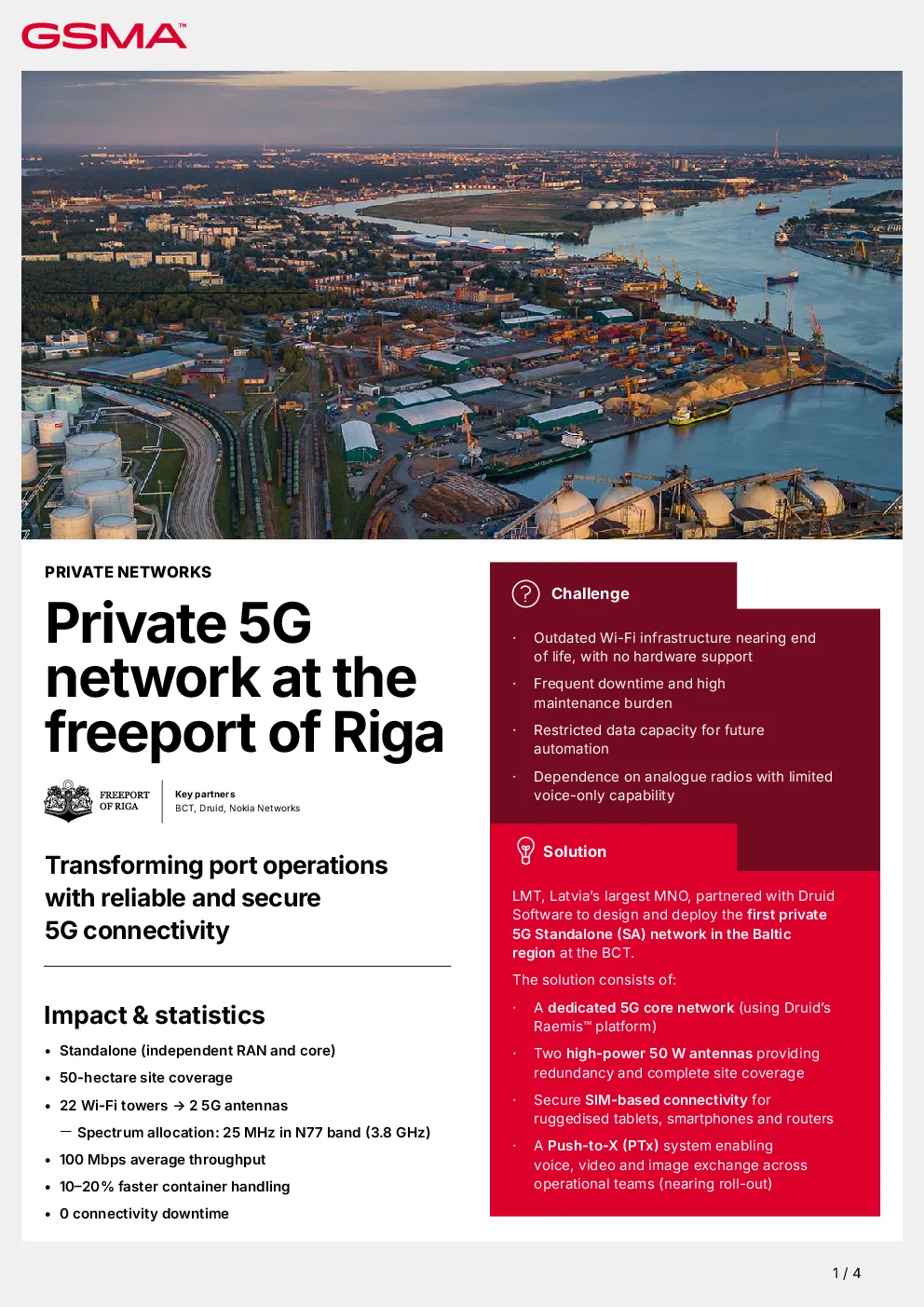
PRIVATE NETWORKS Challenge Private 5Gnetwork at thefreeport of Riga ·Outdated Wi-Fi infrastructure nearing endof life, with no hardware support·Frequent downtime and highmaintenance burden·Restricted data capacity for futureautomation·Dependence on analogue radios with limitedvoice-only capability Key partnersBCT, Druid, Nokia Networks Solution Transforming port operationswith reliable and secure5G connectivity LMT, Latvia’s largest MNO, partnered with DruidSoftware to design and deploy thefirst private5G Standalone (SA) network in the Balticregionat the BCT. The solution consists of: ·Adedicated 5G core network(using Druid’sRaemis™ platform)·Twohigh-power 50 W antennasprovidingredundancy and complete site coverage·SecureSIM-based connectivityforruggedised tablets, smartphones and routers·APush-to-X (PTx)system enablingvoice, video and image exchange acrossoperational teams (nearing roll-out) Impact & statistics •Standalone (independent RAN and core)•50-hectare site coverage•22 Wi-Fi towers → 2 5G antennas—Spectrum allocation: 25 MHz in N77 band (3.8 GHz)•100 Mbps average throughput•10–20% faster container handling•0 connectivity downtime The Baltic Container Terminal (BCT) in the Freeport of Riga is one of theleading logistics hubs in the Baltic region, covering more than 50 hectares.The terminal handles thousands of containers a day, requiring seamlesscommunication between cranes, loaders and operational control systems. Challenge Solution Until recently, BCT relied on a Wi-Fi network with22 access points mounted on 27-metre masts.Over time, this legacy system suffered fromunstable coverage, poor handover between zonesand limited data speeds (max 7 Mbps), resultingin connectivity dropouts for moving vehicles andinefficiencies in container handling. LMT, Latvia’s largest MNO, partnered with DruidSoftware to design and deploy the first private 5GStandalone (SA) network in the Baltic region atthe BCT. The 5G system integrates with BCT’s internal LAN,creating a secure, closed environment for dataexchange and remote operations. Unlike Wi-Fi,which required 22 towers, the 5G solution achievedbetter coverage with just two antennas – a nearly90% reduction in infrastructure footprint. Operational staff reported “black spots” wheredata connections failed entirely. These disruptionsdirectly affected the NAVI terminal operatingsystem, which coordinates real-time loadingand unloading of ships. Inconsistent networkperformance led to longer vessel idle times andhigher operational costs. LMT performed detailed radio planning and testingover 12 months, focusing on business-critical usecases rather than blanket coverage to reducecosts. The managed service is operated from LMT’sNetwork Operations Centre, with 24/7 monitoringand Service-Level Agreements (SLAs) for reliability. Where appropriate, existing infrastructure was usedto keep costs down, such as the fibre link to controlthe port’s main gates – a major security concern. Figure 2 WiFi vs 5G – upload speed WiFi vs 5G – download speed Source: LMT Innovations Source: LMT Innovations “Deploying a private 5GPrivate Network acrossBCT’s expansive sitedelivered comprehensivecoverage, faster dataspeeds and significant costsavings. Uninterrupted dataflow minimised containerhandling time and boostedcompetitiveness.ˮ Impact and benefits Kārlis Vilciņš, Head of LMT System Integration Business Operational performance Independent measurements showed that the 5Gnetwork provided100 Mbps average throughput,low latencyandzero session interruptions,compared to near-zero Mbps in some Wi-Fi zones.This allowed: Other use cases and innovations —Continuous operation of NAVI terminal software—Faster crane-to-server data transfer via secure 5Gcommunications—Real-time video and image exchange formaintenance teams—Seamless push-to-talk communication replacinglegacy analogue radiosBCT’s operations team reported measurableimprovements:—Container handling efficiency increased by10–20%—Vessel idle time was significantly reduced—Maintenance and network management costswere lowered Building on this deployment,LMT recentlyshowcased several 5G maritime applicationsatthe Freeport of Riga, including: —Automated drone-based crane inspectionsandunderwater dronesfor water quality monitoringand oil spill response —Unmanned Surface Vehicles (USVs)for cargohandling and environmental data collection —AI-based hydrography sensorstransmitting real-time data from ship to shore These demonstrations attracted delegationsfrom Germany, the United Arab Emirates (UAE),Italy and other countries, a clear sign of Latvia’sleadership in5G maritime innovation. Business and strategic outcomes —Cost efficiency:Comparable total cost ofownership to enterprise-grade Wi-Fi (hundreds ofthousands of euros, not millions) —Data security:Network access limited toSIM-authenticated devices, ensuring zerounauthorised use—Employee satisfaction:Simplified operations andimproved communication—Future-ready: