您的浏览器禁用了JavaScript(一种计算机语言,用以实现您与网页的交互),请解除该禁用,或者联系我们。 [GSMA]:EQUALS性别包容性指数主要发现 - 发现报告

EQUALS性别包容性指数主要发现

信息技术 2025-12-08 GSMA 李强
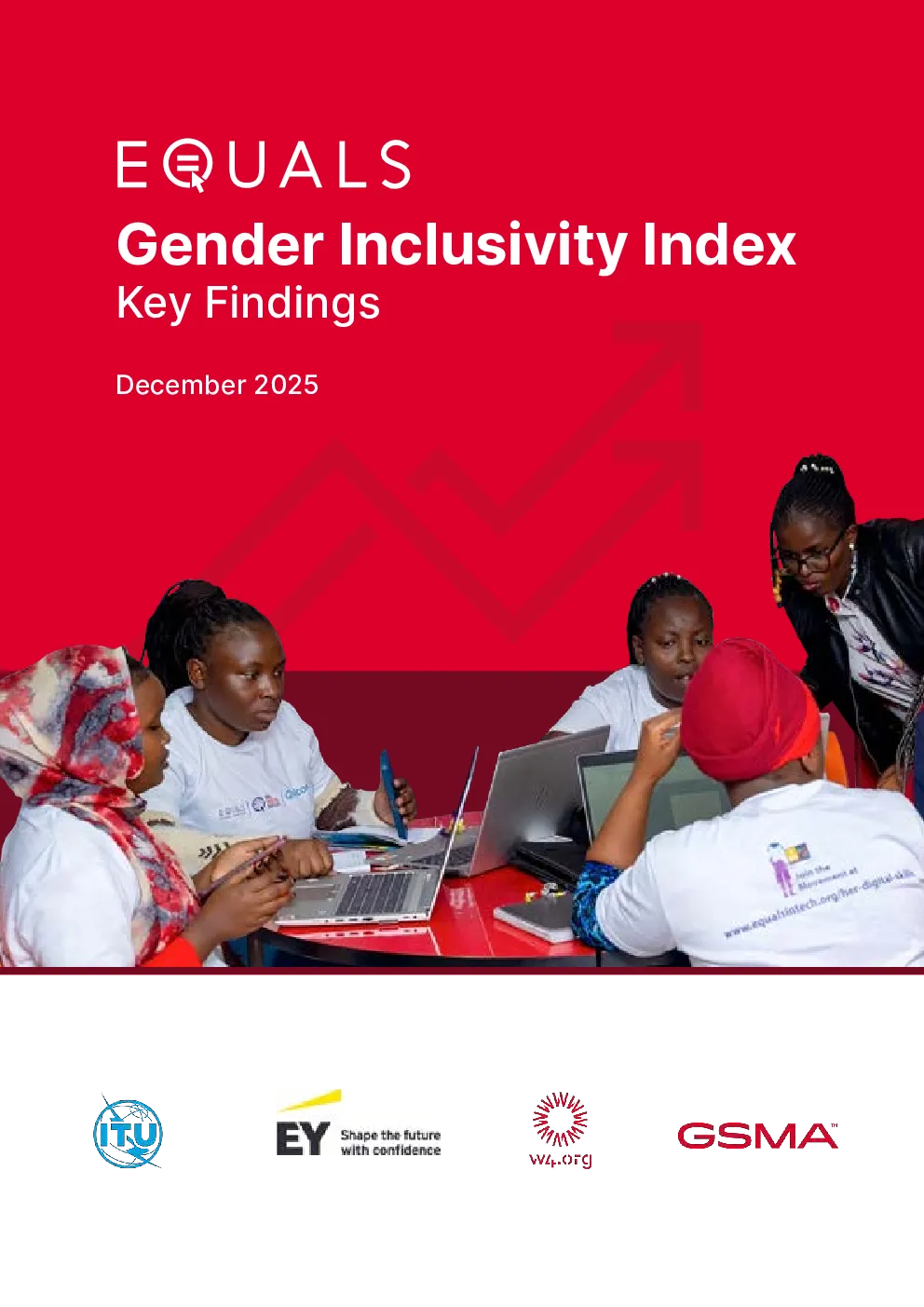
报告封面

December 2025 Acknowledgements The GSMA would like to sincerely thank all 16 mobile network operators(MNOs) that took part in the GSMA Focus Group including the 6 MNOswhich undertook an assessment using the EQUALS Gender Inclusivity Index.The following MNOs have given permission to be listed as participants inthe GSMA Focus Group for the purpose of this report: Azercell, BeelineKazakhstan, Bharti Airtel Foundation, Globe Telecom, Jazz Pakistan, TelenorPakistan, Telesom and VEON. The GSMA would also like to thank EY and in particular Rohi Choudhary andSoumaya Kalia for the pro bono support they provided to the GSMA FocusGroup and its various deliverables, as well as Arunima Chaturvedi, AbigailGooch and Lea Gill for their strategic support and guidance. Our thanks also go to Amit Vatsyayan and Sidharth Dutta for their key insightsand contributions to the compilation of this report. Special gratitude is also owed to Lindsey Nefesh-Clarke, Founder and CEOof Women’s WorldWide Web (W4) and Loly Gaitan, Programme Officer at theInternational Telecommunication Union (ITU), for the support they providedto this project. Author:Soumaya Kalia (EY) Contributing authors:Rohi Choudhary (EY), Tamara Dancheva (GSMA) andLindsey Nefesh-Clarke (W4) Comments and further contributions can be sent to: tdancheva@gsma.com Contents Executive summary 1. Introduction62. Initialsurvey andneedsanalysis93. The Index pilot: results and analysis114. Keyfindingsand recommendations14 5. Case studies16 Case study 1:Ayelder Power – Beeline Kazakhstan’s journey17to empower women leaders Case study 3:Bharti Airtel Foundation19 Case study 4:Jazz Pakistan – Flexiblework policy20 6. Conclusion: the business case for gender transformation23 Annex: Additional resources25 Executive summary The EQUALS Gender Inclusivity Index is an assessment tool for companies andorganisations to evaluate the state and progress of gender transformation in theirinternal and external operations and activities.More than a diagnostic tool, the Indexwas designed to prompt reflection, encourage dialogue and guide organisationsin this process. The Index was developed within the framework of the EQUALS HerDigital Skills (HDS) initiative –a collaborative effort between the GSMA, InternationalTelecommunication Union (ITU), Ernst & Young (EY) and Women’s WorldWide Web(W4). A pilot of the Index was carried out with MNOs across several regions, the resultsof which demonstrate both encouraging progress and the challenges of translatinggender inclusivity from policy into practice. From the outset, participating MNOs found the Indexaccessible, relevant and aligned with their existingdiversity and inclusion agendas. The survey questionswere considered clear and practical, lowering barriersto engagement and allowing companies to benchmarkthemselves without being weighed down by technicalcomplexity.The associated focus group providedan opportunity for peer learning where MNOs couldshareexperiences,compare practices and learnfromone another’s approaches.This collaborativespiritunderscores the fact that advancing genderinclusivityis not an isolated effort but a sharedindustry responsibility. “Advancing genderinclusivity is not anisolated effort buta shared industryresponsibility.” Leadership engagement was a decisive factor for MNOs to incorporate the findings ofthe Index in their policies and practices.In several cases, visible support from seniorexecutives, including women in key decision-making roles, gave the Index credibility andmomentum internally. Where leadership commitment was strong, the Index’s findingsbegan to shape hiring practices, career development strategies and workplace culture.In other contexts, progress was more gradual, with the Index raising awareness andserving as a catalyst for internal reflection.The varied experiences of MNOs reflect asector committed to gender inclusivity but at different stages of maturity. The Index pilot revealed promising best practices that others can build on. MNOsshared examples of embedding inclusive language throughout their organisations andactivities, creating women’s leadership pipelines, investing in STEM education for girlsand women and ensuring workplace flexibility for caregivers. Case studies from Azercell,Bharti Airtel Foundation, Beeline Kazakhstan, Jazz Pakistan and Telesom showcasehow gender inclusivity can be translated into action. Their initiatives demonstrate thatinclusivity is most powerful when it addresses structural barriers, social norms andlived experiences simultaneously. At the same time, MNOs were clear about how the Index could be strengthened. Theycalled for more practical tools, templates, checklists and culturally grounded casestudies to guide the implementation of recommendations. Stronger alignment withnational legislation was suggested to ensure compliance while pushing boundaries.Continuity also emerged as a recurring theme – inclusivity cannot be a one-offassessment and initiativ