您的浏览器禁用了JavaScript(一种计算机语言,用以实现您与网页的交互),请解除该禁用,或者联系我们。 [GSMA]:OQ技术:开创直接到设备NTN连接 - 发现报告

OQ技术:开创直接到设备NTN连接

信息技术 2026-01-21 GSMA M.凯
报告封面

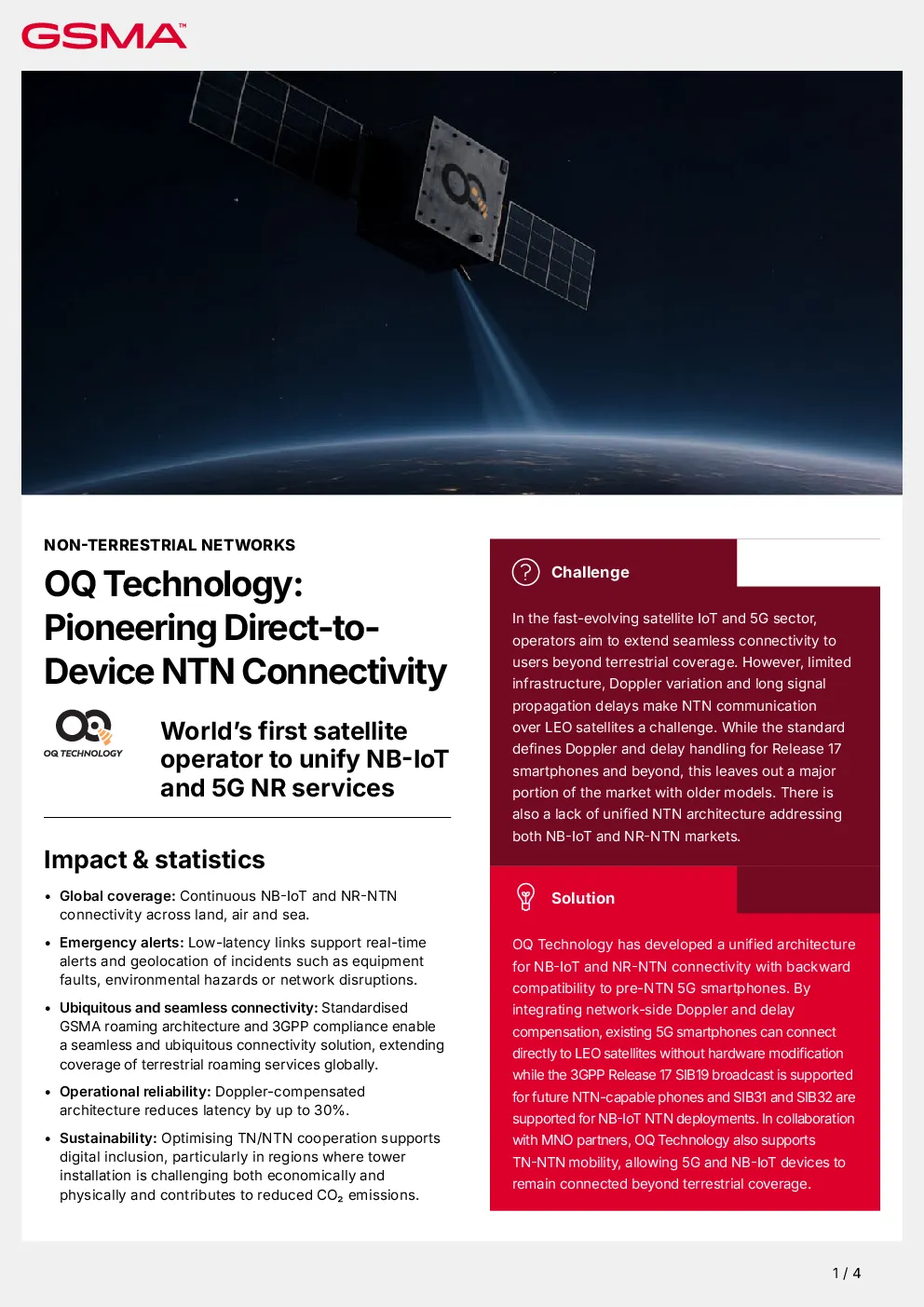
NON-TERRESTRIAL NETWORKS Challenge OQ Technology:Pioneering Direct-to-Device NTN Connectivity In the fast-evolving satellite IoT and 5G sector,operators aim to extend seamless connectivity tousers beyond terrestrial coverage. However, limitedinfrastructure, Doppler variation and long signalpropagation delays make NTN communicationover LEO satellites a challenge. While the standarddefines Doppler and delay handling for Release 17smartphones and beyond, this leaves out a majorportion of the market with older models. There isalso a lack of unified NTN architecture addressingboth NB-IoT and NR-NTN markets. World’s first satelliteoperator to unify NB-IoTand 5G NR services Impact & statistics •Global coverage:Continuous NB-IoT and NR-NTNconnectivityacross land,air and sea. Solution •Emergency alerts:Low-latency links support real-timealertsand geolocation of incidents such as equipmentfaults,environmental hazards or network disruptions. OQ Technology has developed a unified architecturefor NB-IoT and NR-NTN connectivity with backwardcompatibility to pre-NTN 5G smartphones. Byintegrating network-side Doppler and delaycompensation, existing 5G smartphones can connectdirectly to LEO satellites without hardware modificationwhile the 3GPP Release 17 SIB19 broadcast is supportedfor future NTN-capable phones and SIB31 and SIB32 aresupported for NB-IoT NTN deployments. In collaborationwith MNO partners, OQ Technology also supportsTN-NTN mobility, allowing 5G and NB-IoT devices toremain connected beyond terrestrial coverage. •Ubiquitous and seamless connectivity:StandardisedGSMA roaming architecture and 3GPP compliance enablea seamless and ubiquitous connectivity solution, extendingcoverage of terrestrial roaming services globally. •Operational reliability:Doppler-compensatedarchitecturereduces latency by up to 30%. •Sustainability:Optimising TN/NTN cooperation supportsdigitalinclusion,particularly in regions where towerinstallationis challenging both economically andphysicallyand contributes to reduced CO₂emissions. Case study OQ Technology is a Luxembourg-based satellite operator and globalleader innon-terrestrial 5G IoT connectivity. The company providessecure, low-power, wide-area communication services across sectorssuch as logistics, energy, smart cities, agriculture and defence. Introduction Challenge —Theintegration of 5G NR with NTN represents a majormilestonein global broadband connectivity.However,enablingD2D connectivity over LEO satellitesintroducessignificant technical and implementationchallenges.Rapid satellite motion,Doppler frequencyshifts,and variable propagation delays placesubstantialstrain on the physical and MAC layersofstandard 5G devices.This combined while theabsenceof dedicated NTN hardware in earliergenerationsof commercial smartphones,hindersstablesynchronisation,link maintenance,and efficientrandomaccess under dynamic LEO conditions.of standard 5G devices. This combined with the —Background:OQ Technology has developed a 5G NTNarchitecturecompliant with 3GPP Release 17 andbeyond,while also providing enhanced capabilitiesthatenable unmodified smartphones to connectdirectlyto LEO satellites for both 5G NR and NB-IoTNTN.Fully 3GPP-aligned with optimised Dopplerhandling,synchronisation and mobility management,itensures MNO interoperability and scalable D2D andIoTservices for remote areas,maritime,emergencyandmission-critical applications and defence.OQalreadyhas agreements in place with DeutscheTelekom,KPN,Telefonica and other MNOs,and is partofDeutsche Telekom’s Early Adopter Program to drivetechnologydevelopment. —Although3GPP Release 17 specifies mechanismsforDoppler and delay compensation throughephemeris-basedcorrections and enhanced timingadvanceprocedures,these capabilities are onlysupportedin newer generations of 5G chipsets.Thevastmajority of smartphones were designed forpurelyterrestrial operation and lack this support,creatinga technological gap that restricts backwardcompatibilityand delays mass-market adoption ofD2DNTN services. —Use case context:D2D connectivity allows older 5Gsmartphonesto connect directly to LEO satellites,offeringglobal coverage and enabling basicmessaging,SOS and emergency services.Voice anddatacapabilities are anticipated in the future. —Technology rationale:Along with NB-IoT for shortmessages,NR-NTN delivers broadband-class datarates,low latency and mobility support–essentialforreal-time connectivity in areas without terrestrialcoverage.It also supports dynamic Doppler and delaymanagement,beam tracking and adaptive timingadvance,critical for reliable satellite-to-smartphonecommunication.OQ’s solution introduces network-sideDoppler and timing compensation mechanisms,maintainingbackward compatibility with terrestrial5Gdevices while aligning with 3GPP Releases 17–20.Thisensures seamless transition to fully standardised5GNTN services,making OQ Technology the firstsatelliteoperator in the world to unify terrestrial andsatellite5G NR. —Objective