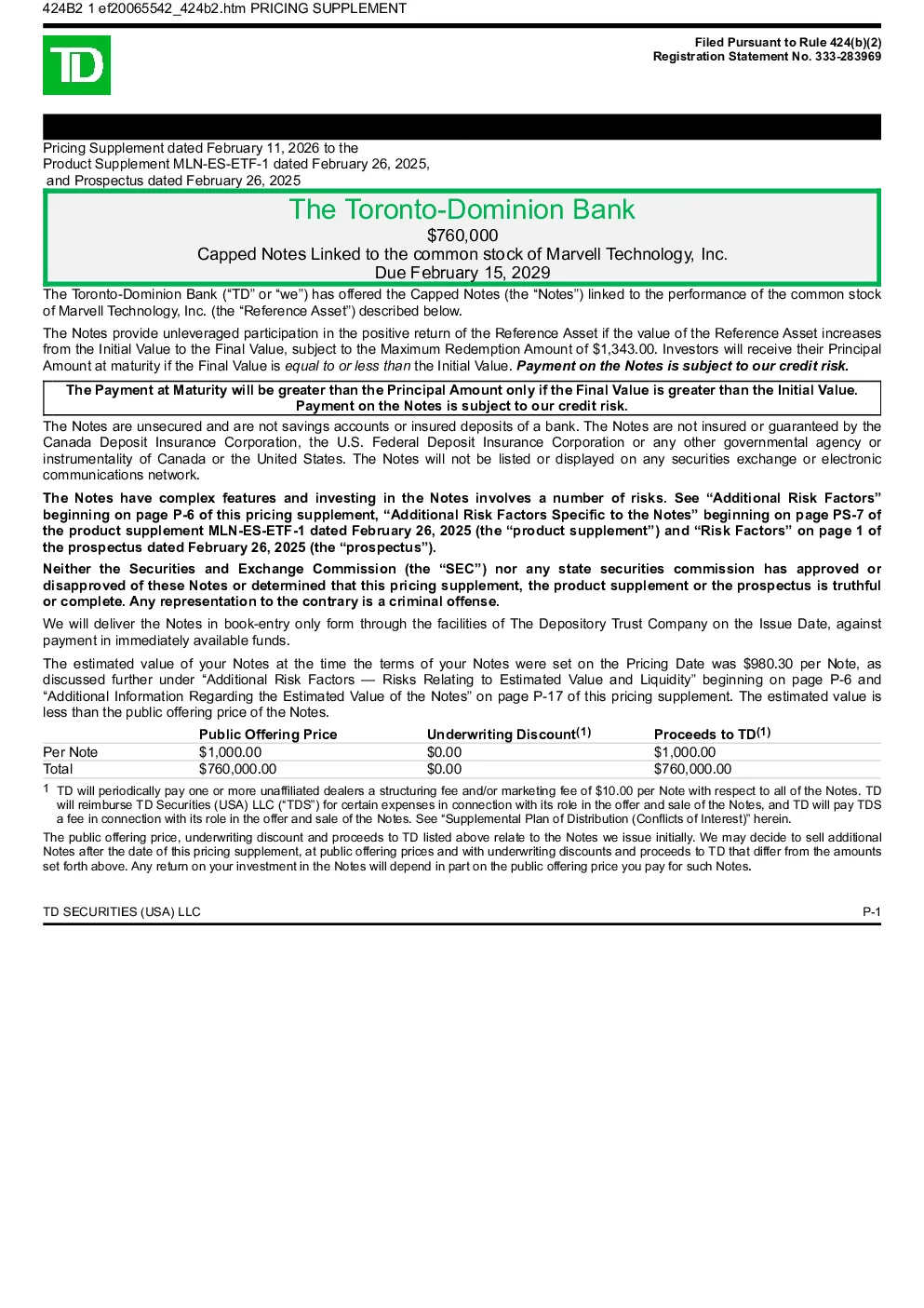
The Toronto-Dominion Bank (TD) has offered Capped Notes linked to the performance of Marvell Technology, Inc. (Marvell) common stock. The Notes provide unleveraged participation in Marvell's positive return if its value increases from the Initial Value ($100) to the Final Value, up to a Maximum Redemption Amount of $1,343.00. If Marvell's value does not increase, investors receive their Principal Amount at maturity.
Investors should be aware of several risks associated with the Notes, including:
- Return Characteristics: The Notes do not pay interest, and returns may be less than conventional debt securities. The capped nature limits potential gains, and the Final Value is only determined at the Valuation Date, potentially missing out on subsequent value increases.
- Reference Asset Risks: Marvell's stock price is subject to single-stock risks, including stock price volatility, earnings, and industry developments.
- Estimated Value and Liquidity: The estimated value of the Notes is less than the public offering price and is based on TD's internal funding rate and models, which may not accurately reflect market values. There may be limited secondary market liquidity, and selling the Notes before maturity could result in significant losses.
- Hedging Activities and Conflicts of Interest: TD's hedging activities and potential conflicts of interest with the Calculation Agent and other affiliates could impact the Notes' value.
- Credit Risk: Investors are subject to TD's credit risk, and a downgrade in TD's credit ratings could negatively affect the Notes' market value.
- Taxation: The Notes are subject to special tax rules, including potential U.S. federal income tax on ordinary income and potential withholding taxes for non-U.S. holders.
TD's internal funding rate and other factors are expected to negatively impact the economic terms of the Notes. The estimated value of the Notes is not a prediction of future market prices and could be significantly less than the public offering price in the secondary market. Investors are advised to carefully consider these risks and consult with their financial advisors.