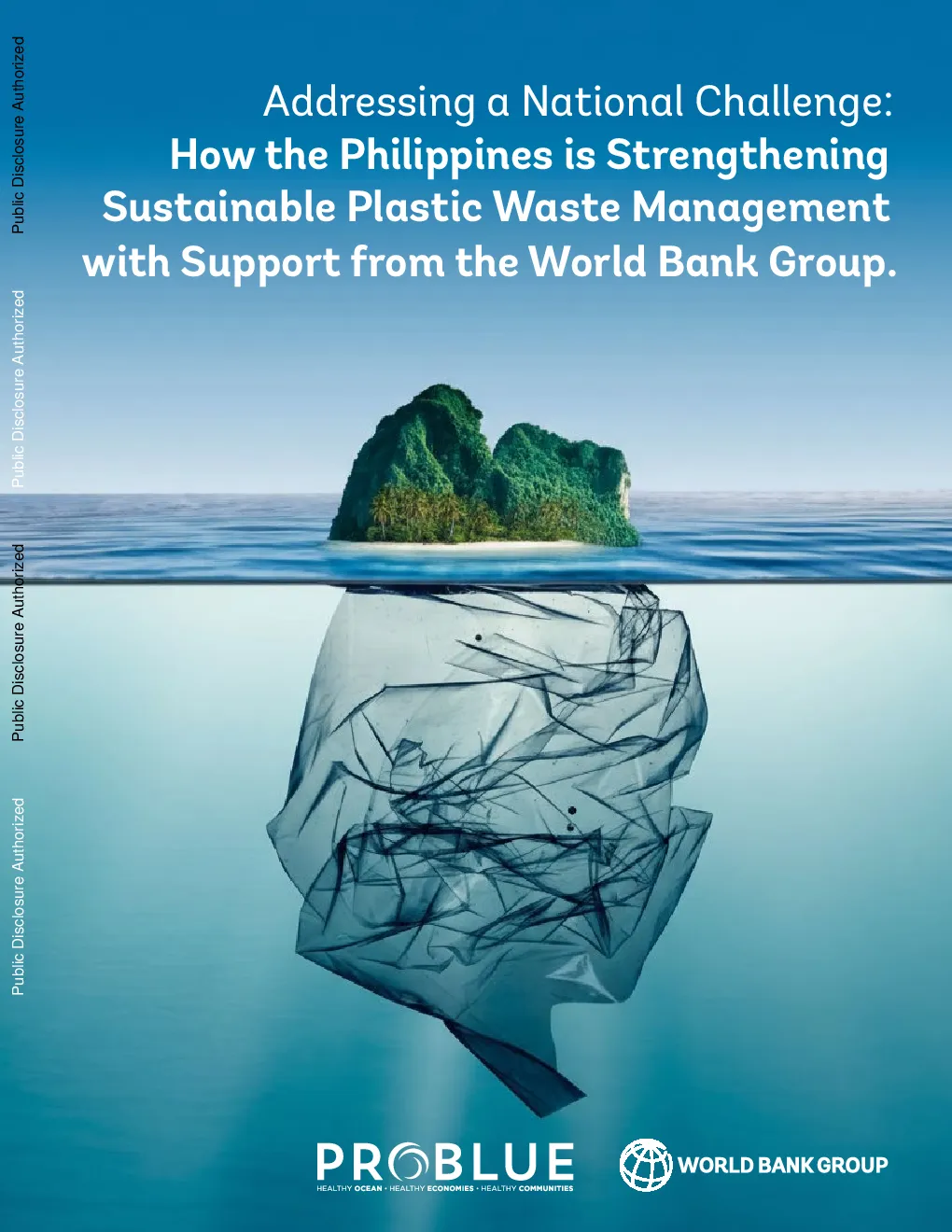
© 2025 The World Bank Group1818 H Street NW, Washington, DC 20433Telephone: 202-473-1000; Website: www.worldbank.org Acknowledgments This summary report reviews and reflects on the World Bank’s support to the Governmentof the Philippines in addressing the national plastic waste crisis. It highlights how technicalsupport, policy guidance, and strategic financing helped strengthen local capacity andlay the groundwork for a more circular and eco-sustainable plastic waste management.The report synthesizes key lessons on how coordinated action, adaptive funding, andstrong partnerships can drive systemic change toward a cleaner and more resilient future. This report was prepared by Junu Shrestha (Senior Environmental Specialist) and Ales-sandro Cresci (Consultant). The report benefited from comments of Agnes Balota (SeniorEnvironmental Specialist) and Frank Van Worden (Lead Environmental Specialist). It wasprepared under the leadership of Genevieve Connors(Acting Global Director, GlobalEnvironment Department). The report was edited by Juan David Merlo (Consultant) andreport design was provided by Human Indeed Studio. The development of this summary report was coordinated by the World Bank’sEnvironment, Natural Resources and Blue Economy Global Practice, with funding fromthe PROBLUE multi-donor trust fund. Summary This note synthesizes the World Bank’s approachto supporting the Philippines in addressing theplastic waste crisis. As one of the largest con-tributors to marine plastic pollution globally,the Philippines is estimated to leak more than0,3 million metric tons of plastic waste into theocean per year —8.8% of its total of mismanagedplastic waste.1The country has long faced chal-lenges in establishing a circular and sustainablesolid waste management system, due to gaps ininfrastructure, governance, policy, and technicalcapacity. Although there has been strong politi-cal will to tackle plastic pollution, the Philippinesneeds technical and strategic guidance, as wellas funding for well-targeted projects to catalyzemeaningful change. plastic pollution. Through strategic interventionssupported by the PROBLUE multi-donor trustfund, the World Bank raised national awarenessof the crisis, pooled in additional resources,and advised the government on global bestpractices. At the same time, it fostered thedevelopment of local knowledge and capacitywhile providing targeted financial assistance todrive reforms and investment. The experience shown in this document illus-trates how a tailored approach can navigatecomplex national contexts and support pollutionmanagement efforts. It tells the story of a strate-gic partnership and investment that culminatedin a formal request from the Government of thePhilippines for a World Bank-funded project tosupport a national investment program aimedat improving waste management and circularityin plastics and other waste streams. This note revisits the multifaceted engage-ment of the World Bank, which helped lay thefoundation for tangible progress in combating Table of Contents The Context 1.Plastic waste in the Philippines 1.1.The global plastic pollution crisis and the case of the Philippines71.2.The missing links for circularity in the Philippines8 The Story 2.Initial engagement: creating awareness of plastic pollution in the Philippines122.1. Gaining momentum through foundational analytical studies12 3.A systematic approach to achieving circularity: Roadmap for Managementof Plastic Waste and Reduction of SUPs, and Extended Producer Responsibility 3.1.The Philippines’ roadmap for management of plastic wasteand reduction of SUPs: a vision for short and long-term interventions.153.2.Supporting EPR in the Philippines163.3.The intuition of drawing lessons from Korea18 4.Merging funding from multiple sources to enable progress 4.1.An adaptive and agile funding strategy194.2.A major milestone in the World Bank’s engagement:an official request for a funded project.20 What can we learn from the World Bank’s actionagainstplastic pollution in the Philippines? References The Context 1.Plastic waste in the Philippines 1.1.The global plastic pollution crisis and the case of the Philippines Plastic is an exceptionally convenient material. Itis inexpensive, resilient, lightweight, corrosion-re-sistant, and easy to process.2These attributeshave fueled global dependence on plastics,resulting ina 200-fold increase in productionsince the 1950s3and the critical challenge ofsustainable plastic waste management (PWM). 0.3 million tonnes of plastic waste into marineecosystems each year1, equivalent to 8.9 % ofthe national plastic waste. The staggering volume of mismanaged plasticwaste in the Philippines stems from a conflu-ence of factors, including rapid urbanization,increasing consumerism, and insufficient solidwaste management (SWM) infrastructure.6Oneof the main issues is that the Philippines hasbecome a major consumer of single use plas-tics (SUPs), generating about 1.7 mil