美国利率研究:过于乐观?
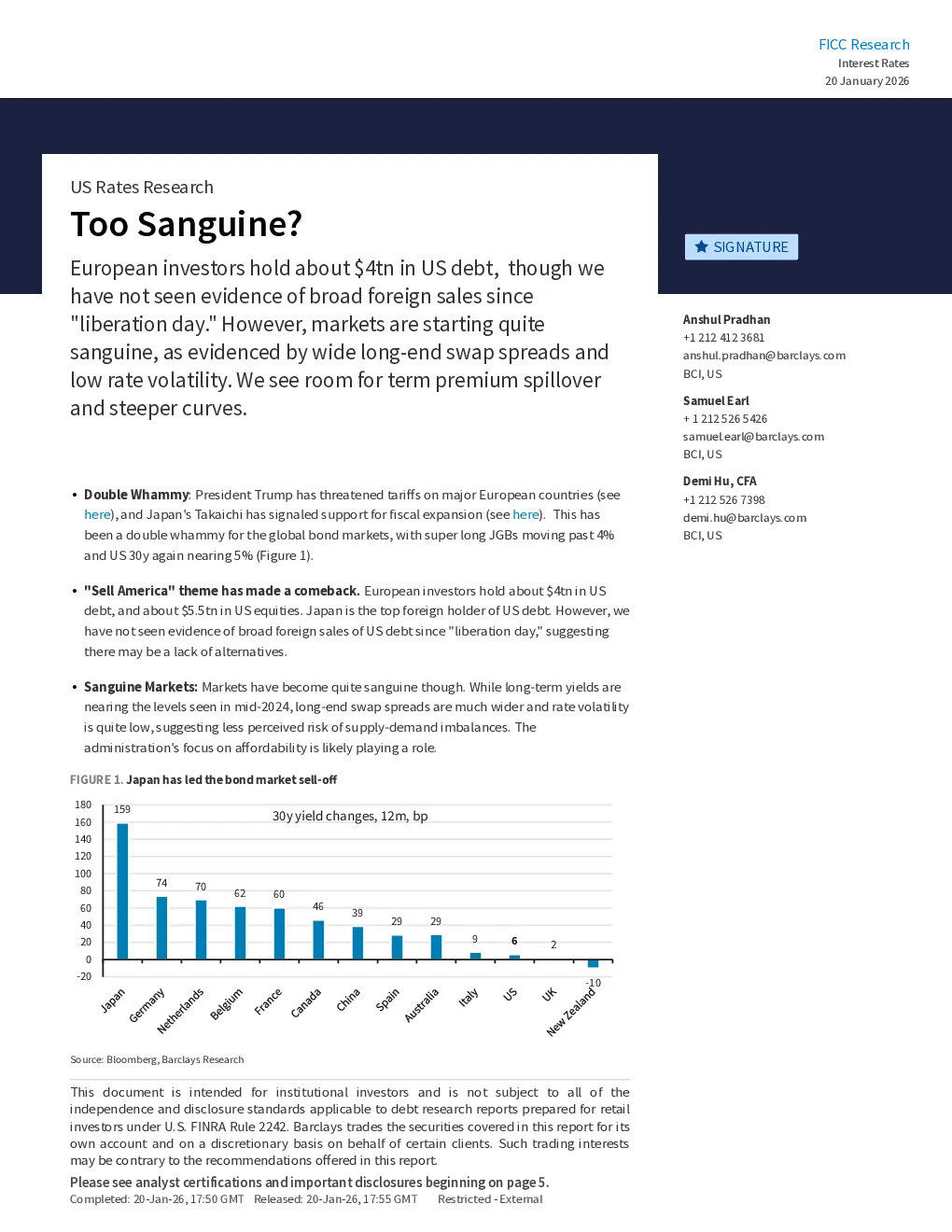
Too Sanguine? SIGNATURE European investors hold about $4tn in US debt, though wehave not seen evidence of broad foreign sales since"liberation day." However, markets are starting quitesanguine, as evidenced by wide long-end swap spreads and Anshul Pradhan+1 212 412 3681anshul.pradhan@barclays.comBCI, US Samuel Earl+ 1 212 526 5426samuel.earl@barclays.com Demi Hu, CFA+1 212 526 7398demi.hu@barclays.com •Double Whammy: President Trump has threatenedtariffson major European countries (seehere), and Japan's Takaichi has signaled support for fiscal expansion (see here). This hasbeen a double whammy for the global bond markets, with super long JGBs moving past 4% •"Sell America" theme has made a comeback.European investors hold about $4tn in USdebt, and about $5.5tn in US equities. Japan is the top foreign holder of US debt. However, wehave not seen evidence of broad foreign sales of US debt since "liberation day," suggesting Sanguine Markets:Markets have become quite sanguine though. While long-term yields arenearing the levels seen in mid-2024, long-end swap spreads are much wider and rate volatilityis quite low, suggesting less perceived risk of supply-demand imbalances. The Thisdocument is intended for institutional investors and is not subject to all of theindependence and disclosure standards applicable to debt research reports prepared for retailinvestors under U.S. FINRA Rule 2242. Barclays trades the securities covered in this report for its Who holds US long-term assets?Given concerns about foreign sales of US Treasuries, we firsttabulate holdings of long-term assets by European countries as well as for the top 20 holdersglobally (Figures 2 and 3). The euro area holds about $4tn in US fixed income assets and another$5.5tn in equities.Interestingly, the euro area holds more corporate bonds and equities While we have not seen much evidence of broad foreign net sales of US debt since"liberation day" (see here), that concern persists among market participants. Bond markets are sanguine, likely due to focus on While long-term yields are not far from the highs set in May, we argue that the markets are farmore sanguine about an adverse bond market reaction than last year. Two things stand out: Wider swap spreads: Figures 4 and 5 show that 30y swap spreads, while somewhat tighter thanthe recent wides, are significantly wider than the levels that prevailed in May. While the generalwidening of swap spreads is reflecting the deregulation agenda, the 5s30s swap spread curve is Low rate volatility:At the same time, rate vol is quite low. Figures 6 and 7 show that not only islong-term realized rate vol low in absolute terms but it is also not trading at any premium to Hence, depending upon the political developments, bond markets could easily price inmore term premium. One overarchingdifferencefrom last time, though, is the The Treasury refunding is coming up andthere has been some speculation about potentialcuts to Treasury issuance at the long-end. We think that is unlikely for now.At just the lastrefunding meeting, the Treasury noted that it "anticipates maintaining nominal coupon andFRN auction sizes for at least the next several quarters. Looking ahead, Treasury has begun to The Supreme Court ruling on IEEPAtariffsis also likely in the near term, which is likely to addvolatility to markets. Were the IEEPAtariffsdeemed illegal and the administration delayed areplacement as part of aneffortto contain inflation heading into midterms, that could weigh on Overall, while there are valid reasons for bond markets to indeed be more sanguine thanlast year, we find the US yield curve is still quite flat in a global context and maintain our Source: Bloomberg, Barclays Research Source: Bloomberg, Barclays Research Analyst(s) Certification(s): We, Anshul Pradhan, Samuel Earl and Demi Hu, CFA, hereby certify (1) that the views expressed in this research report accurately reflect our personalviews about any or all of the subject securities or issuers referred to in this research report and (2) no part of our compensation was, is or will be Important Disclosures: Barclays Research is produced by the Investment Bank of Barclays Bank PLC and itsaffiliates(collectively and each individually, "Barclays").All authors contributing to this research report are Research Analysts unless otherwise indicated. The publication date at the top of the report reflectsthe local time where the report was produced and maydifferfrom the release date provided in GMT. Availability of Disclosures: For current important disclosures regarding any issuers which are the subject of this research report please refer to https://publicresearch.barclays.com or alternatively send a written request to: Barclays Research Compliance, 745 Seventh Avenue, 13th Floor, New York, NY Barclays Capital Inc. and/or one of itsaffiliatesdoes and seeks to do business with companies covered in its research reports. As a result, investorsshould be awa