您的浏览器禁用了JavaScript(一种计算机语言,用以实现您与网页的交互),请解除该禁用,或者联系我们。 [亚开行]:支持斯里兰卡可再生能源试点项目(英)2025 - 发现报告

支持斯里兰卡可再生能源试点项目(英)2025

公用事业 2026-02-03 亚开行 曾阿牛
报告封面

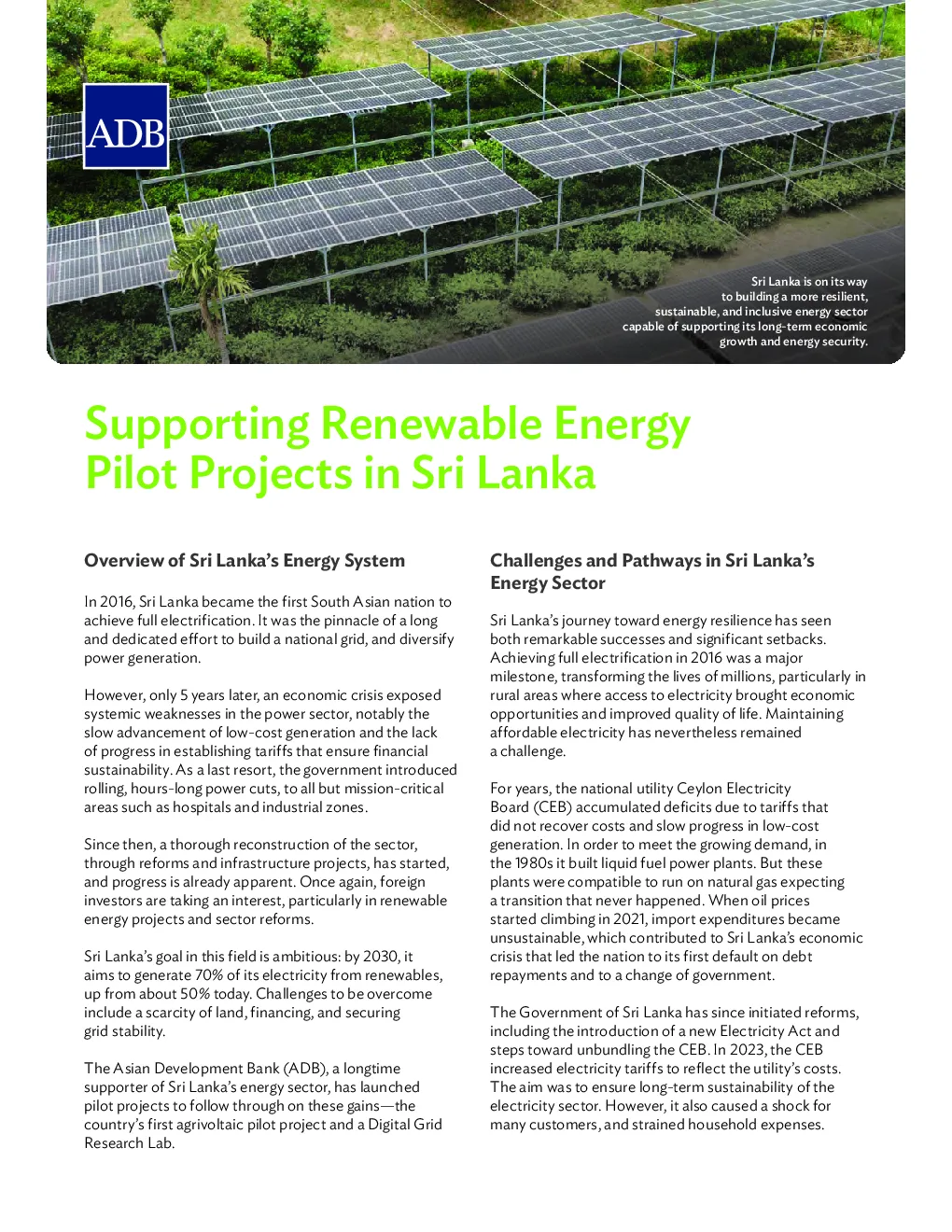
Overview of Sri Lanka’s Energy System Challenges and Pathways in Sri Lanka’s In 2016, Sri Lanka became the first South Asian nation toachieve full electrification. It was the pinnacle of a long Sri Lanka’s journey toward energy resilience has seenboth remarkable successes and significant setbacks.Achieving full electrification in 2016 was a majormilestone, transforming the lives of millions, particularly inrural areas where access to electricity brought economic However, only 5 years later, an economic crisis exposedsystemic weaknesses in the power sector, notably theslow advancement of low-cost generation and the lackof progress in establishing tariffs that ensure financialsustainability. As a last resort, the government introduced For years, the national utility Ceylon ElectricityBoard (CEB) accumulated deficits due to tariffs thatdid not recover costs and slow progress in low-costgeneration. In order to meet the growing demand, inthe 1980s it built liquid fuel power plants. But theseplants were compatible to run on natural gas expectinga transition that never happened. When oil prices Since then, a thorough reconstruction of the sector,through reforms and infrastructure projects, has started,and progress is already apparent. Once again, foreign Sri Lanka’s goal in this field is ambitious: by 2030, itaims to generate 70% of its electricity from renewables,up from about 50% today. Challenges to be overcomeinclude a scarcity of land, financing, and securing The Government of Sri Lanka has since initiated reforms,including the introduction of a new Electricity Act andsteps toward unbundling the CEB. In 2023, the CEBincreased electricity tariffs to reflect the utility’s costs. The Asian Development Bank (ADB), a longtimesupporter of Sri Lanka’s energy sector, has launchedpilot projects to follow through on these gains—the Experiences from the Field Sarath Kumar Senarath, a small brick factory ownernear Colombo, faced a significant financial loss inDecember 2024 when an unannounced power cutruined a fresh batch of concrete he had just mixed.“It was a huge loss for me,” he said. “If I could affordit, I would install a backup power system.” His storyillustrates the critical need for a reliable power Similarly, R. L. Nandajeewa, a betel farmer inMirigama, has also struggled with electricity issues.An electricity price hike erased Nandajeewa’sprofits, forcing him to default on his bills, Nandajeewa’s story underscores the devastatingsocial and economic impact of an unreliable energysystem on rural livelihoods, the importance of Pilot Projects The intermittent nature of solar and wind energyrequires advanced grid systems and storage solutions toensure reliability. Land use conflicts also pose a significantchallenge, as agricultural and environmentally sensitive Agrivoltaic Pilot ProjectTA 9690-REG: Integrated High Impact Innovation in Sustainable Energy Technology—Energy System Analysis, ADB has been instrumental in addressing thesechallenges, providing technical and financial support forinnovative projects aimed at modernizing Sri Lanka’senergy sector. Two notable initiatives—the agrivoltaicpilot project in Hanthana and the Digital Grid Research •approved in December 2018•funded by the Clean Energy Fund (CEF) under theClean Energy Financing Partnership Facility (CEFPF) Located in Hanthana, central Sri Lanka, the agrivoltaicpilot project combines solar energy generation withagricultural productivity. Agrivoltaics is a dual land useapproach that combines agriculture and solar energyproduction by installing solar panels above or alongsidecrops. It not only maximizes the use of land but also has Tea Pluckers Benefit fromAgrivoltaic Innovations R. Rajeshwari is a tea plucker living in a houseoverlooking the district capital of Kandy in centralSri Lanka. On stormy days, lights are still ondown in the valley, while her community suffersoutages. During the past 2 years, as power tariffs “I haven’t been using the water kettle because theelectricity price was so high,” she says. Not usingthe electric kettle means spending more time and Tea plucker R. Rajeshwari is grateful for the better quality of life that theagrivoltaic installation is providing for her community A recent ADB project is changing this. Further upthe hill, in the tea plantation where Rajeshwariworks, several rows of solar panels have beeninstalled atop the tea bushes. They generateelectricity and are meant to improve the yieldsof the shade-loving plants. They also provideshelter for the workers. “We’re not as affected Considering the scarcity of land suitable for solar power inSri Lanka, ADB identified an opportunity for agrivoltaicsin tea plantations. First, tea needs to grow in partial shade, A pilot project was therefore proposed under a regionalknowledge and support technical assistance. It wasdeveloped together with the Sri Lanka SustainableEnergy Authority, and the Tea Smallholding DevelopmentAuthority, and funded by the Cl