您的浏览器禁用了JavaScript(一种计算机语言,用以实现您与网页的交互),请解除该禁用,或者联系我们。 [PitchBook]:12月总结:尽管浮动利率资产面临逆风,但2025年贷款上限稳定(英) - 发现报告

12月总结:尽管浮动利率资产面临逆风,但2025年贷款上限稳定(英)

金融 2026-01-20 PitchBook Joken Hu
报告封面

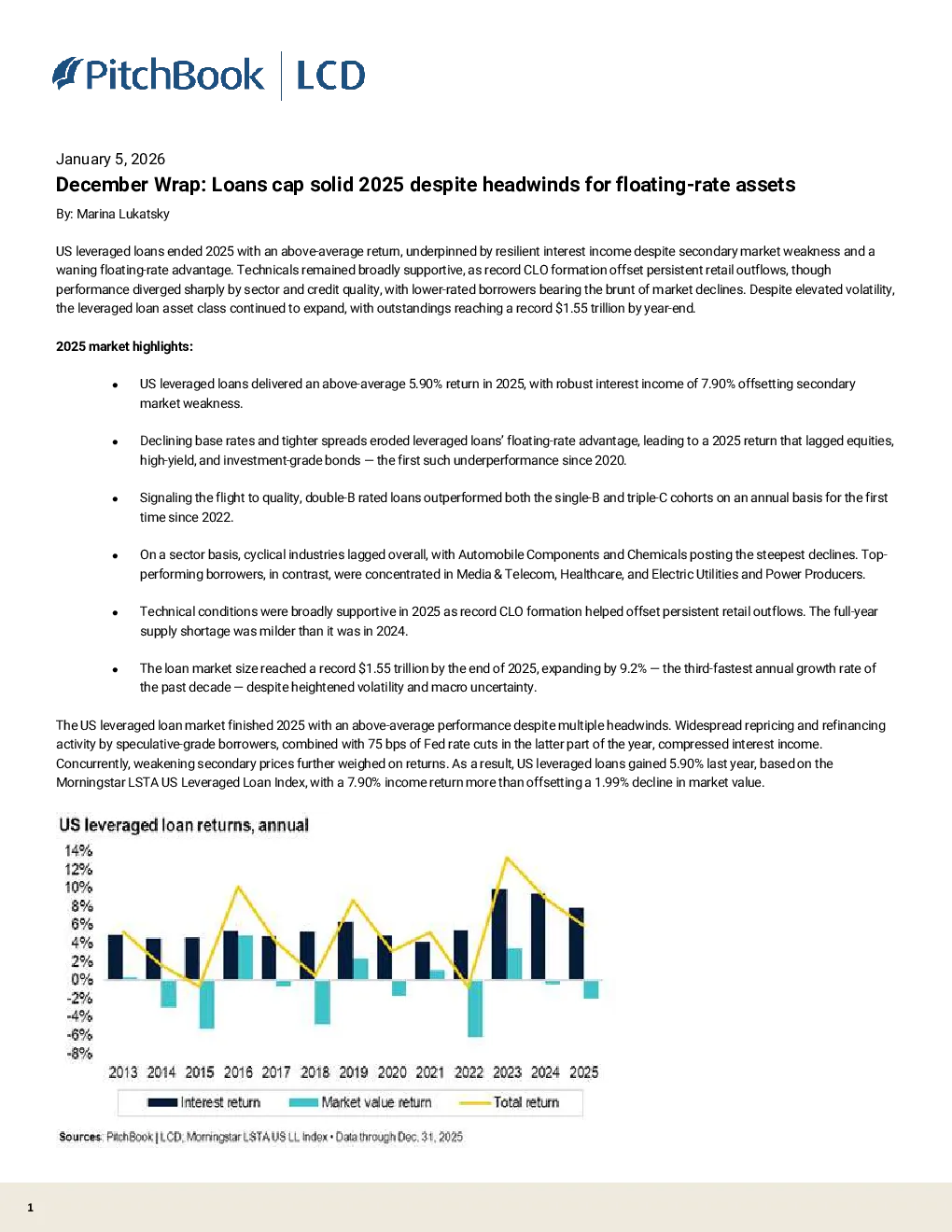
January 5, 2026 December Wrap: Loans cap solid 2025 despite headwinds for floating-rate assets By: Marina Lukatsky US leveraged loans ended 2025 with an above-average return, underpinned by resilient interest income despite secondary market weakness and awaning floating-rate advantage. Technicals remained broadly supportive, as record CLO formation offset persistent retail outflows, thoughperformance diverged sharply by sector and credit quality, with lower-rated borrowers bearing the brunt of market declines. Despite elevated volatility, 2025 market highlights: •US leveraged loans delivered an above-average 5.90% return in 2025, with robust interest income of 7.90% offsetting secondary •Declining base rates and tighter spreads eroded leveraged loans’ floating-rate advantage, leading to a 2025 return that lagged equities,high-yield, and investment-grade bonds — the first such underperformance since 2020. •Signaling the flight to quality, double-B rated loans outperformed both the single-B and triple-C cohorts on an annual basis for the first •On a sector basis, cyclical industries lagged overall, with Automobile Components and Chemicals posting the steepest declines. Top-performing borrowers, in contrast, were concentrated in Media & Telecom, Healthcare, and Electric Utilities and Power Producers. •Technical conditions were broadly supportive in 2025 as record CLO formation helped offset persistent retail outflows. The full-year •The loan market size reached a record $1.55 trillion by the end of 2025, expanding by 9.2% — the third-fastest annual growth rate ofthe past decade — despite heightened volatility and macro uncertainty. The US leveraged loan market finished 2025 with an above-average performance despite multiple headwinds. Widespread repricing and refinancingactivity by speculative-grade borrowers, combined with 75 bps of Fed rate cuts in the latter part of the year, compressed interest income.Concurrently, weakening secondary prices further weighed on returns. As a result, US leveraged loans gained 5.90% last year, based on the Supported by still-elevated base rates, the full-year return surpassed the 5.25% annual average recorded from 2015 to 2024 and materially exceededthe 4.66% median return over the same period. That said, loan performance is beginning to normalize as the interest component — reflecting bothbase rates and loan coupons — retreats from the unusually elevated levels in 2023 and 2024. By comparison, loan investors earned approximately In addition, volatility increased in 2025 after relatively calm conditions in 2024. After reaching an intra-year high of 97.70 in January, the LLI’s weightedaverage bid fell sharply, to 94.41 in early April, following the "Liberation Day" tariff announcements. Prices nearly reached their January highs by July,but those gains unwound over the final five months of the year as sentiment weakened amid retail outflows, sector-specific headwinds and softness Declining base rates, together with tighter nominal spreads following two years of intense refinancing and repricing activity, eroded the floating-rateadvantage of leveraged loans relative to other risk assets. As a result, the leveraged loan index’s 5.90% gain lagged the 17.88% return of the S&P 500,the 8.66% return of the Morningstar US High-Yield Bond Index, and the 7.56% return of the Morningstar US Corporate Bond Index. Notably, 2025 The best and worst performers of 2025 Which segments of the leveraged loan market delivered the strongest returns in 2025, and which lagged? Performance by borrower credit rating underscores a clear flight to quality during a period of elevated uncertainty. Double-B loans, representing roughly 23% of the market, led returns with a gain of 6.26%. Single-B loans — the largest segment at 62% of the index —followed closely, returning 6.18%. In contrast, triple-C loans were the weakest performers in 2025, posting a return of just 1.81%. While lower-rated loans offer higher coupons, the incremental interest income was insufficient to offset steeper market-value declines. Double-Bloans recorded a modest market-value loss of 0.74% in 2025, compared with a 1.96% drop for single-B loans. Triple-C loans fared significantly worse,with a market-value loss of 8.87%, reflecting much weaker secondary-market performance. Triple-C loans account for only about 6% of the market — Notably, 2025 marked the first year since 2022 in which the double-B sub-index outperformed both the single-B and triple-C cohorts. Given their lowercoupons, BB loans typically trail riskier segments; over the past decade, they have outperformed single-B and triple-C loans on an annual basis only In contrast, triple-C loans have struggled since the onset of the Federal Reserve’s rate-hiking cycle. The increased cost of debt, combined withmacroeconomic uncertainty and policy volatility, exacerbated investor concerns over the riskiest companies’ ability to meet interest obligations andaddress